Ocean Park in Santa Monica in Los Angeles County, California — The American West (Pacific Coastal)
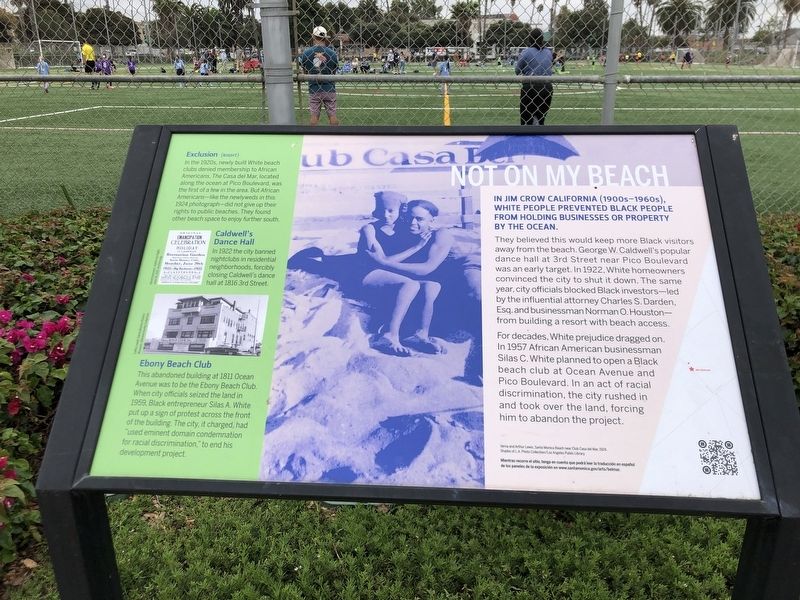
Not on My Beach
Photographed by Duane and Tracy Marsteller, September 27, 2025
1. Not on My Beach Marker
They believed this would keep more Black visitors away from the beach. George W. Caldwell's popular dance hall at 3rd Street near Pico Boulevard was an early target. In 1922, White homeowners convinced the city to shut it down. The same year, city officials blocked Black investors – led by the influential attorney Charles S. Darden, Esq. and businessman Norman O. Houston – from building a resort with beach access.
For decades, White prejudice dragged on. In 1957 African American businessman Silas C. White planned to open a Black beach club at Ocean Avenue and Pico Boulevard. In an act of racial discrimination, the city rushed in and took over the land, forcing him to abandon the project.
(Sidebar)
Exclusion (right)
In the 1920s, newly built White beach clubs denied membership to African Americans. The Casa del Mar, located along the ocean at Pico Boulevard, was the first of a few in the area. But African Americans – like the newlyweds in this 1924 photograph – did not give up their
this page online
Caldwell's Dance Hall
In 1922 the city banned nightclubs in residential neighborhoods, forcibly closing Caldwell's dance hall at 1816 3rd Street.
Ebony Beach Club
This abandoned building at 1811 Ocean Avenue was to be the Ebony Beach Club. When city officials seized the land in 1959, Black entrepreneur Silas A. White put up a sign of protest across the front of the building. The city, it charged, had “used eminent domain condemnation for racial discrimination,” to end his development project.
(Image captions/credits)
• Top left: Advertisement, California Eagle, June 10, 1921. Archives.org
• Bottom left: Lolita Lowell, Santa Monica History Museum, Gilmore Family Collection
• Center: Verna and Arthur Lewis, Santa Monica Beach near Club Casa del Mar, 1924. Shades of L.A. Photo Collection/Los Angeles Public Library
Erected by City of Santa Monica. (Marker Number 16.)
Topics. This historical marker is listed in these topic lists: African Americans • Civil Rights • Industry & Commerce. A significant historical year for this entry is 1922.
Location. 34° 0.612′ N,
Photographed by Duane and Tracy Marsteller, September 27, 2025
2. Not on My Beach Marker

Regionally, this marker is in Greater Los Angeles and in the Transverse Ranges. It is also on the American Pacific Coast. Globally, it is in North America, on the Ring of Fire, on the Pacific Rim, in the Western Hemisphere, in the Western World, and in the Anglosphere. Historically, it finds itself in what was once New Spain and also Mexico’s Alta California.
Other nearby markers. At least 8 other markers are within walking distance of this marker: Black Women Empowered (a few steps from this marker); “No, No, No Jim Crow” (a few steps from this marker); Environmental Justice (within shouting distance of this marker); Early Black Businesses (within shouting distance of this marker); Welcome to Historic Belmar Park (within shouting distance of this marker); A Resurrection in Four Stanzas (within shouting distance of this marker); Black Lives in Ocean Park (about 300 feet away, measured in a direct line); A Neighborhood Erased (about 300 feet away). Touch for a list and map of all markers in Santa Monica.
More about this marker. It is part of Belmar History + Art, a commemoration and celebration of the African American neighborhoods of South Santa Monica and their contributions to the city's history and cultural heritage. Belmar History + Art includes sculptural artwork, an educational program, website, and interpretive signage (including this one) installed around the perimeter of Belmont Park. Note: The project web address has been changed to www.santamonica.gov/belmar-history-art
Credits. This page was last revised on December 4, 2025. It was originally submitted on November 4, 2025, by Duane and Tracy Marsteller of Murfreesboro, Tennessee. This page has been viewed 69 times since then and 29 times this year. Photos: 1, 2. submitted on November 4, 2025, by Duane and Tracy Marsteller of Murfreesboro, Tennessee.
