Saqarah in Badrshein, Giza Governorate, Egypt — مصر (Northeast Africa)
Step Pyramid Complex
Photographed by James Hulse, October 8, 2024
1. Step Pyramid Complex Marker
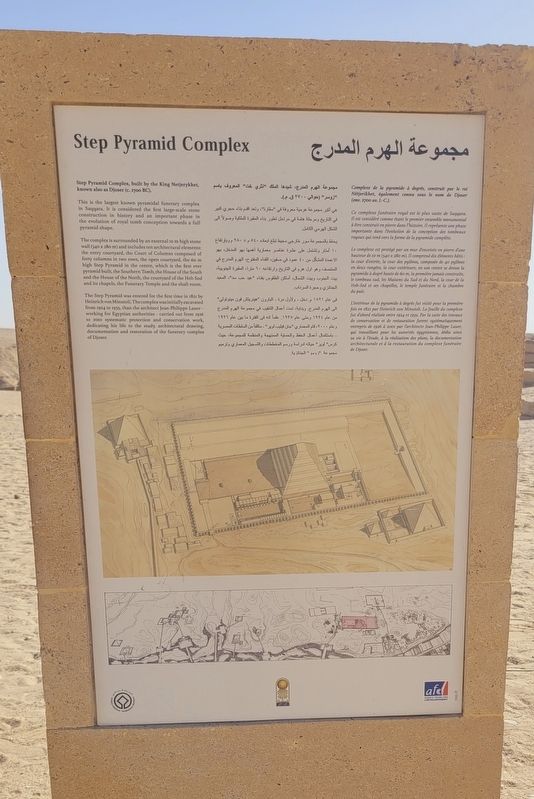
 Step Pyramid Complex, built by the King Netjerykhet, known also as Djoser (c. 2700 BC).
This is the largest known pyramidal funerary complex in Saqqara. It is considered the first large-scale stone construction in history and an important phase in the evolution of royal tomb conception towards a full pyramid shape.
The complex is surrounded by an external 10 m high stone wall (540 x 280 m) and includes ten architectural elements: the entry courtyard, the Court of Columns composed of forty columns in two rows, the open courtyard, the 60 m high Step Pyramid in the centre, which is the first ever pyramid built, the Southern Tomb, the House of the South and the House of the North, the courtyard of the Heb Sed and its chapels, the Funerary Temple and the shaft room.
The Step Pyramid was entered for the first time in 1821 by Heinrich von Minutoli. The complex was initially excavated from 1924 to 1935, than the architect Jean-Philippe Lauer - working for Egyptian authorities - carried out from 1926 to 2001 systematic protection and conservation work, dedicating his life to the study, architectural drawing, documentation and restoration of the funerary complex of Djoser.
Complexe de la pyramide à degrés, construit par le roi Nétjerikhet, également connu sous le nom de Djoser (env. 2700 av. J.-C.).
Ce complexe funéraire royal est le plus vaste de Saqqara. Il est considéré comme étant le premier ensemble monumental à être construit en pierre dans l'histoire. Il représente une phase importante dans l'évolution de la conception des tombeaux royaux qui tend vers la forme de la pyramide complète.
Le complexe est protégé par un mur d'enceinte en pierre d'une hauteur de 10 m (540 x 280 m). Il comprend dix éléments bâtis: la cour d'entrée, la cour des pylônes, composée de 40 pylônes en deux rangées, la cour extérieure, en son centre se dresse la pyramide à degré haute de 60 m, la première jamais construite, le tombeau sud, les Maisons du Sud et du Nord, la cour de la Heb-Sed et ses chapelles, le temple funéraire et la chambre du puit.
L'intérieur de la pyramide à degrés fut visité pour la première fois en 1821 par Heinrich von Minutoli. La fouille du complexe fut d'abord réalisée entre 1924 et 1935. Par la suite des travaux de conservation et de restauration furent systématiquement entrepris de 1926 à 2001 par l'architecte Jean-Philippe Lauer, qui travaillant pour les autorités égyptiennes, dédia ainsi sa vie à l'étude, à la réalisation des plans, la documentation architecturale et à la restauration du complexe funéraire de Djoser.
مجموعة الهرم المدرج
مجموعة الهرم المدرج،

Click or scan to see
this page online
شيدها الملك "نثري خت" المعروف باسم "زوسر" (حوالي ۲۷۰۰ ق. م.).
هي أكبر مجموعة هرمية معروفة في سقارة"، وتعد اقدم بناء حجري كبير في التاريخ ومرحلة هامة في مراحل تطور بناء المقبرة الملكية وصولاً الى الشكل الهرمي الكامل.
يحاط بالمجموعة سور خارجي محيط تبلغ ابعاده ٥٤٠ م × ۲۸۰ م وبارتفاع ۱۰ امتار وتشتمل على عشرة عناصر معمارية أهمها بهو المدخل، بهو الاعمدة المشكل من ٤٠ عمود في صفين،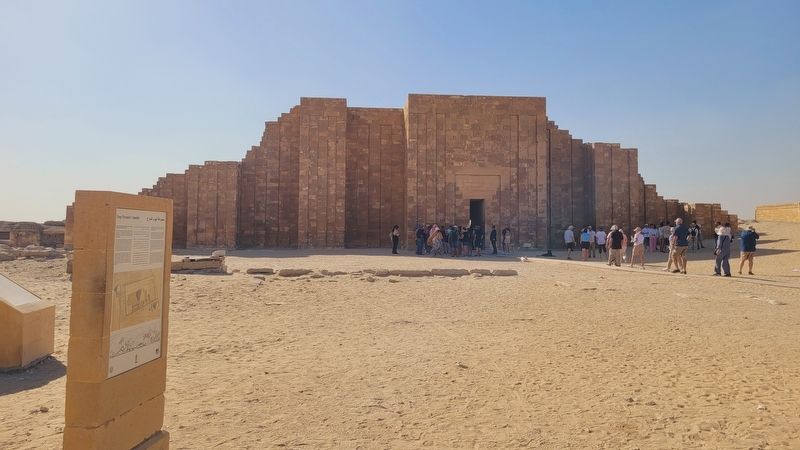 الفناء المفتوح، الهرم المدرج في المنتصف وهو اول هرم في التاريخ وارتفاعه ٦٠ مترا، المقبرة الجنوبية بيت الجنوب وبيت الشمال أماكن الطقوس بفناء "عيد حب سد"، المعبد الجنائزي وحجرة السرداب.
في عام ۱۸۲۱م. دخل - ولأول مرة - البارون هينريتش فون مينوتولي" الى الهرم المدرج. وبداية، تمت أعمال التنقيب في مجموعة الهرم المدرج من عام ١٩٢٤ وحتى عام ۱۹۳۵. علماً انه فى الفترة ما بين عام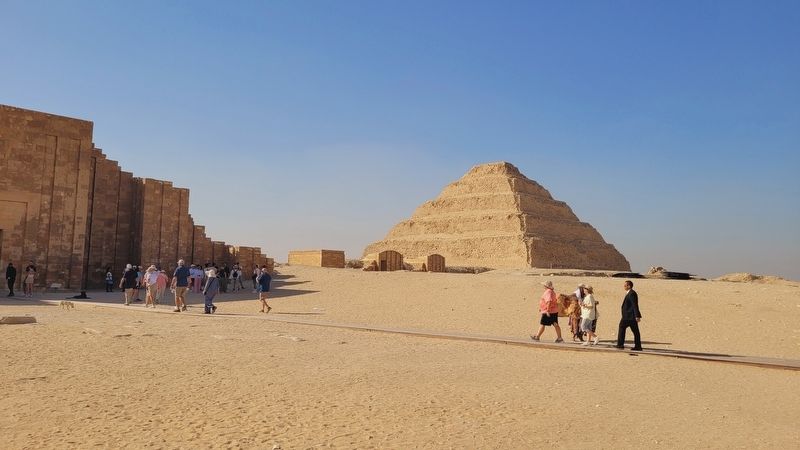 ١٩٢٦ وعام ۲۰۰۰ ، قام المعماري جان فيليب لوير " - مكلفاً من السلطات المصرية باستكمال أعمال الحفظ والحماية الممنهجة والمنظمة للمجموعة، حيث كرس" لوير " حياته لدراسة ورسم المخططات والتسجيل المعماري وترميم مجموعة "زوسر " الجنائزية.
مجموعة الهرم المدرج،
this page online
هي أكبر مجموعة هرمية معروفة في سقارة"، وتعد اقدم بناء حجري كبير في التاريخ ومرحلة هامة في مراحل تطور بناء المقبرة الملكية وصولاً الى الشكل الهرمي الكامل.
يحاط بالمجموعة سور خارجي محيط تبلغ ابعاده ٥٤٠ م × ۲۸۰ م وبارتفاع ۱۰ امتار وتشتمل على عشرة عناصر معمارية أهمها بهو المدخل، بهو الاعمدة المشكل من ٤٠ عمود في صفين،
Photographed by James Hulse, October 8, 2024
2. Step Pyramid Complex and Marker
في عام ۱۸۲۱م. دخل - ولأول مرة - البارون هينريتش فون مينوتولي" الى الهرم المدرج. وبداية، تمت أعمال التنقيب في مجموعة الهرم المدرج من عام ١٩٢٤ وحتى عام ۱۹۳۵. علماً انه فى الفترة ما بين عام
Photographed by James Hulse, October 8, 2024
3. The view of the Step Pyramid and Complex
Erected by UNESCO World Heritage.
Topics. This historical marker is listed in this topic list: Anthropology & Archaeology. A significant historical year for this entry is 2700 BCE.
Location. 29° 52.14′ N, 31° 13.089′ E. Marker is in Saqarah, Giza Governorate, in Badrshein. It is on Pyramid of Djoser Road. Touch for map. Marker is at or near this postal address: Pyramid of Djoser Rd, Saqarah, Giza Governorate 33520-01, Egypt. Touch for directions.

Regionally, it is in Africa, specifically in North Africa, in the Middle East, on the Red Sea, and in a coastal Mediterranean country. Historically, it finds itself in what was once the Byzantine Empire, the Ottoman Empire, a British colony, and the Roman Empire.
Other nearby markers. At least 8 other markers are within walking distance of this marker: Enclosure Wall
Photographed by James Hulse, October 8, 2024
4. The view of the Step Pyramid Complex and Marker
Also see . . . Pyramid of Djoser. Wikipedia
The Pyramid of Djoser, sometimes called the Step Pyramid of Djoser or Step Pyramid of Horus Netjerikhet, is an archaeological site in the Saqqara necropolis, Egypt, northwest of the ruins of Memphis. It was the first Egyptian pyramid to be built. The six-tier, four-sided structure is the earliest colossal stone building in Egypt. It was built in the 27th century BC during the Third Dynasty for the burial of Pharaoh Djoser. The pyramid is the central feature of a vast mortuary complex in an enormous courtyard surrounded by ceremonial structures and decoration.(Submitted on November 6, 2025, by James Hulse of Medina, Texas.)
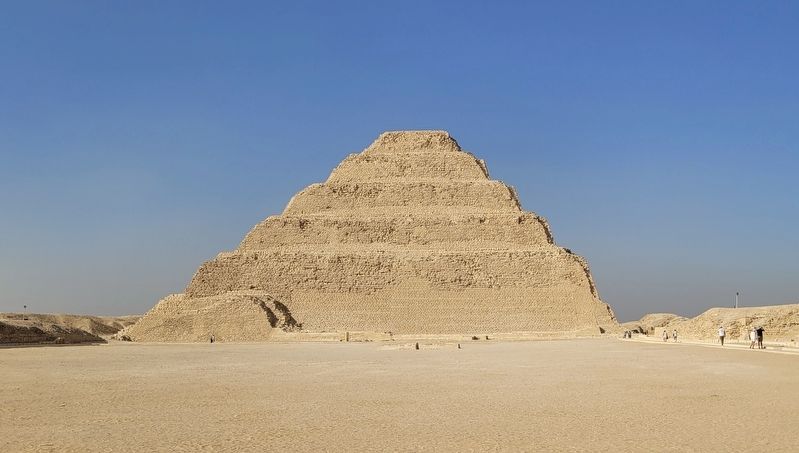
Photographed by James Hulse, October 8, 2024
5. The Step Pyramid
Credits. This page was last revised on November 6, 2025. It was originally submitted on November 5, 2025, by James Hulse of Medina, Texas. This page has been viewed 86 times since then and 50 times this year. Photos: 1, 2, 3, 4, 5. submitted on November 6, 2025, by James Hulse of Medina, Texas.
