Mead in Saunders County, Nebraska — The American Midwest (Upper Plains)
Atlas D Missile Site A-1

Photographed by Cosmos Mariner, September 14, 2025
1. Atlas D Missile Site A-1 Marker
During the height of the Cold War, the Soviet Union launched the world’s first artificial satellite, Sputnik I, in October 1957. A perceived “missile gap” led to the massive construction of Intercontinental Ballistic Missile (ICBM) sites in the United States in the early 1960s. The Atlas was America’s first ICBM. The 549th Strategic Missile Squadron at Offutt Air Force Base near Omaha was tasked with deploying the Atlas D at three sites: “A-1” at Mead, “A-2” at Arlington, and “A-3” at Missouri Valley, Iowa.
The sites consisted of a launch operations building, three launch and service buildings, two warhead storage magazines, and associated generating and communications facilities. The 103-foot by 133-foot launch and service buildings of reinforced concrete contained the missile bays. To launch a missile, the roof of the bay was pulled back and the 83-foot-tall, liquid-fueled rocket was raised upright. The Atlas had a range of 10,360 miles. This launch complex was completed in July 1960 and deactivated in October 1964. Today, it is home to Mead Atlas and Titan Readiness Centers of the Nebraska National Guard.
Erected 2016
this page online
Topics and series. This historical marker is listed in these topic lists: Air & Space • War, Cold. In addition, it is included in the Nebraska State Historical Society series list. A significant historical month for this entry is October 1957.
Location. 41° 11.083′ N, 96° 26.486′ W. Marker is in Mead, Nebraska, in Saunders County. It can be reached from County Road J just east of County Road 8, on the right when traveling east. The marker is located in front of the Army National Guard Mead Atlas Readiness Center. Touch for map. Marker is at or near this postal address: 789 County Road J, Yutan NE 68073, United States of America. Touch for directions.

Regionally, this marker is in Eastern Nebraska and in Greater Lincoln. It is also in the American Midwest, in the Corn Belt, and on the prairies. Globally, it is in North America, the Western Hemisphere, the Western World, and the Anglosphere. Historically, it finds itself in what was once the Louisiana Purchase.
Other nearby markers. At least 8 other markers are within 11 miles of this marker,

Photographed by Cosmos Mariner, September 14, 2025
2. Atlas D Missile Site A-1 Marker
Looking north from the Army National Guard Atlas Readiness Center. The parking lot and County Road J are in the background.
More about this marker. This is one of two nearly identical Atlas D Missile Site A-1 historical markers. The other one is located 2.2 miles west on County Road J at County Road 10.
Related markers. Click here for a list of markers that are related to this marker. Atlas D Missile Site A-1
Also see . . .
1. An Important Part of Nebraska and the Cold War Era (549th Strategic Missile Squadron).
Excerpt: The 549th SMS was based at Offutt Air Force Base in Omaha, Nebraska from 1961 thru 1965. There were 3 sites built around Omaha. These sites were manned 24 hours a day, 365 days a year during the time the Squadron was active. During the Cuban Missile Crisis, all 549th sites were(Submitted on November 5, 2025, by Cosmos Mariner of Cape Canaveral, Florida.)at a high level of alert and were ready to launch the Atlas missile should it have become necessary. The squadron was armed with the SM-65 weapon system, more commonly know as the Atlas. The 549th was an Atlas D unit which meant the missile was housed in a "coffin launcher" style complex. The missile was kept in a horizontal position. In order to launch, a large overhead door was rolled back after which the "bird" was raised to a vertical position. Once upright, the rocket was fueled with RP-1 and Liquid Oxygen after which it would then be made ready for launch. The Atlas D was equipped with a Mark IV re-entry vehicle developed by General Electric and carried a type W-38 warhead which had a yield of approximately 3.8 megatons of TNT. Developed by General Dynamics, the Atlas weapons system became a national priority during which no expense was spared in the development, testing and implementation of this first-generation ICBM system. The Atlas D rocket was also used by NASA during the early days of manned space travel and was the booster used to put John Glenn into Earth orbit.Photographed by Cosmos Mariner, September 14, 20253. Atlas D Missile Site A-1 MarkerLooking northeast from the Army National Guard Atlas Readiness Center.

2. Atlas Readiness Center.
Photographed by Cosmos Mariner, September 14, 2025
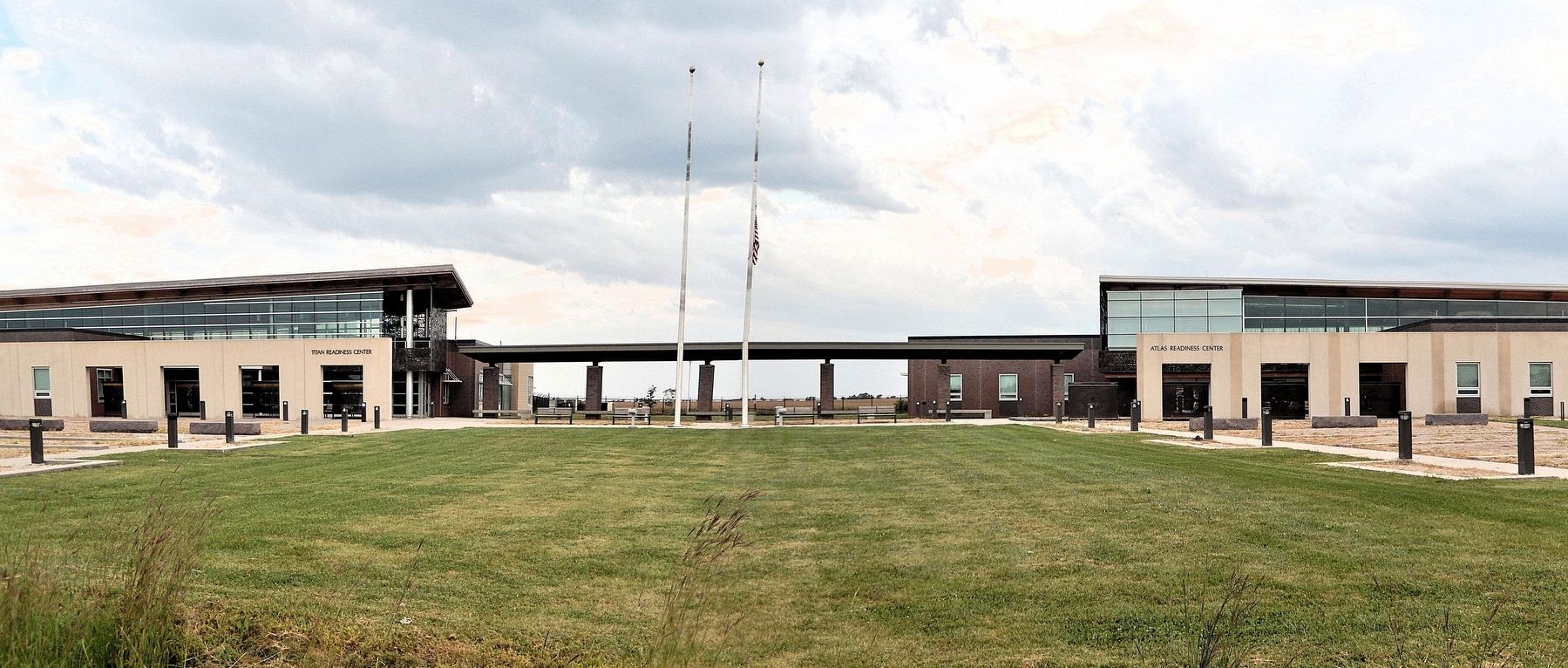
4. Nebraska Army National Guard Atlas (right) and Titan (left) Readiness Centers
Looking south from the Atlas D Missile Site A-1 historical marker.
Excerpt: This campus honors the history of the Nebraska National Guard while preparing current and future members to serve their communities and their country. This 50,000-SF center is the formation of the new Mead Training Site. The design uses wood glulam beams and decking as used in National Guard facilities of the past while providing a modern facility with today's technologies. The program includes an assembly hall, administrative offices, recruiting center, fitness center, vehicle maintenance training bay, lockers, classrooms, kitchen, storage and POV/GOV parking for large military vehicles. A new outdoor gun range adds 300-, 100- and 50-meter fixed and 25-meter tactical ranges and a gun cleaning, RSO office and classroom.(Submitted on November 6, 2025, by Cosmos Mariner of Cape Canaveral, Florida.)
Credits. This page was last revised on November 6, 2025. It was originally submitted on November 5, 2025, by Cosmos Mariner of Cape Canaveral, Florida. This page has been viewed 120 times since then and 72 times this year. Photos: 1, 2, 3, 4. submitted on November 5, 2025, by Cosmos Mariner of Cape Canaveral, Florida.
