Luxor, Luxor Governorate, Egypt — مصر (Northeast Africa)
Cachette courtyard
⎯⎯⎯
Cour de la cachette
فناء الخبيئة
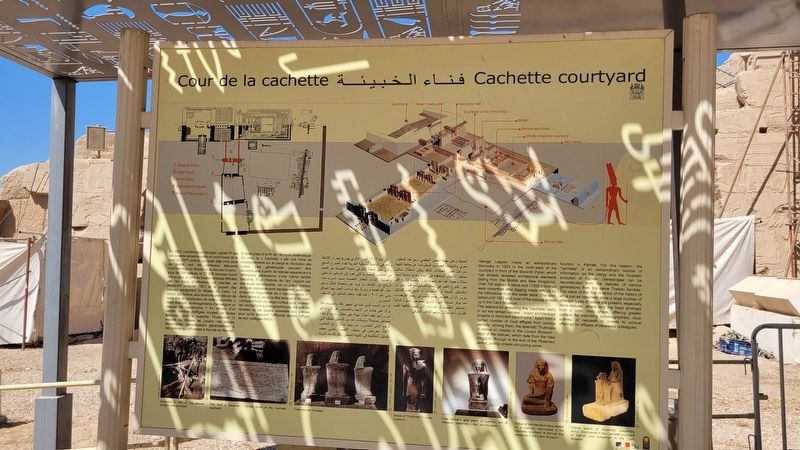
Photographed by James Hulse, October 10, 2024
1. Cachette courtyard / Cour de la cachette Marker
 George Legrain made an extraordinary discovery in 1903 in the north-west of the courtyard in front of the Seventh Pylon, which had already revealed architectural elements dating from the Middle and New Kingdoms. Over 700 statues in stone and 17000 in bronze were unearthed after digging made difficult by the infiltrations from the water table. The work lasted until 1907 and most of the statues ended up in the Cairo Museum.
The reasons for amassing this "cachette" early in our era remain unclear : major architectural projects or imminent catastrophe? Apart from a certain number of royal effigies from various periods - among them, the splendid Thutmosis III statue on display in the Louxor Museum - most of the statues, which date from the New Kingdom, through to the end of the Ptolemaic period, portray priests occupying some function in Karnak. For this reason, the "cachette" is an extraordinary source of information on the clergy and the ritualistic evolution of Karnak. Genealogies can be reconstituted from the statutes of various generations from the same Theban families. The value of this find in terms of the history
this page online
Captions
(Photo #1) Extraction in 1903 of the statues buried in the courtyard. © CFEETK Legrain G., 1904
(Photo #2) Pilar from a Senusret | Temple found in the Cachette courtyard. © CFEETK, Legrain G. 1904
(Photo #3) Cube-statues of priests. © CFEETK, Legrain G., 1901-1905
(Photo #4) Statue of Thutmosis III, Luxor museum. © CFEETK, Chéné A. et Perrot R., 1995
(Photo #5) Cube statue-in grey granit of Ousirour, son of Hersenef, preserved in the Cairo Museum. © IFAO, Gout J.F., 1999
(Photo #6) Statue of the intendant Hapy seated on a cushion. Discovered in the Cachette courtyard at Kamak and preserved in the Cairo Museum. © IFAO, Lecler A, 2004
(Photo #7) Calcite statue of Horakhbit, presenting Amun. Discovered in the Cachette courtyard at Karnak and preserved in the Calro Museum. © IFAO, Lecler A., 2004
En
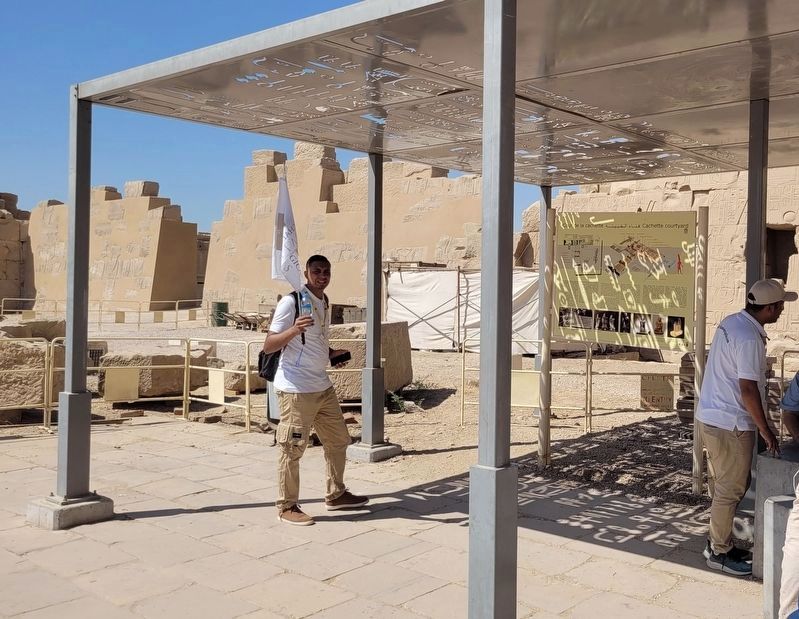
Photographed by James Hulse, October 10, 2024
2. The view of the Cachette courtyard and Marker
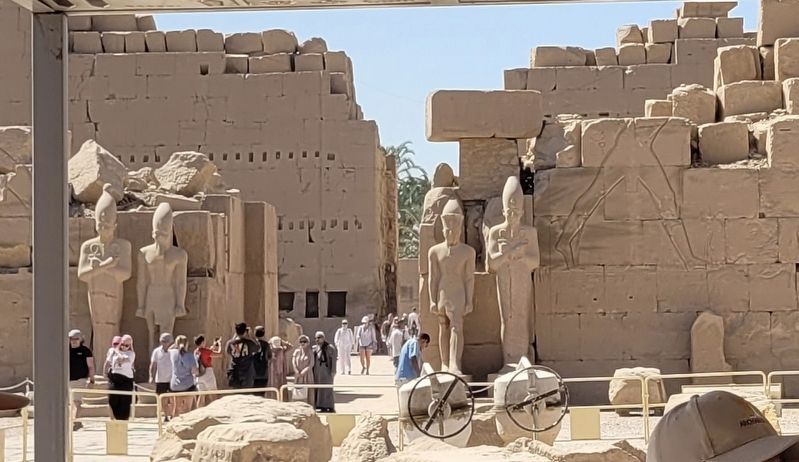
Photographed by James Hulse, October 10, 2024
3. The view of the Seventh Pylon entrance to the Cachette courtyard
فناء الخبيئة
في عام 1903 أحرز الاثري چورچ ليجران إكتشافاً رائعاً في الناحية الشمالية الغربية لفناء الصرح السابع والذي سبق إماطة اللثام في ناحيته الجنوبية عن العديد من العناصر المعمارية التي تعود إلى الدولتين الوسطى والحديثة. أثمرت الحفائر المضنية بسبب تسرب مياه الرشح عن اكتشاف ما يزيد عن سبعمائة تمثال وسبع عشر ألفاً قطعةً برونزية. وقد تواصل العمل بهذا الموقع حتى عام ١٩٠٧، كما نُقلت معظم التماثيل إلى المتحف المصري.
أما عن السبب الذي إستدعى تجهيز تلك «الخبيئة» فلا يزال على جانب من الإبهام والغموض. هل كان الدافع من ورائها تنفيذ أعمال تهيئة على نطاق واسع، أم إتقاء لمخاطر جسيمة؟ وبإستثناء عدد من التماثيل الملكية التي ترجع لشتى العصور، من بينها تمثال رائع لتحتمس الثالث معروض في متحف الأقصر، تنتمي معظم التماثيل المُكْتَشَفَة إلى الكهنة العاملين بالكرنك منذ الدولة الحديثة وحتى نهاية العصر البطلمي. ومن هذا المنظور تحوي «الخبيئة» فيضا من المعلومات عن طائفة الكهنة ومراحل تطور العبادات. كذلك يمكن استغلال تماثيل مختلف الأجيال المتعاقبة في إعادة وضع سلسلة نسب عائلات طيبة. كما تُعد إسهاماً بارزاً بالنسبة لتاريخ الفن نظراً للتنوع الكبير في أنماط التماثيل مع قدر وفير من «التماثيل القابعة أو المُكْعَبَة». إذ تتميز هذه التماثيل ببروز الرأس فقط من جسم مُكعّب في وضع القرفصاء، مما يوفر مساحة كبيرة لتدوين نصوص السيرة الذاتية والمناظر الطقسية أو النداءات التي تهيب بالكهنة تقديم القربان أمام تمثال زميلهم الكاهن المتوفي.
Erected by Ministry of Tourism & Antiquity.
Topics. This historical marker is listed in this topic list: Anthropology & Archaeology. A significant historical year for this entry is 1903.
Location. 25° 43.076′ N, 32° 39.473′ E. Marker is in Luxor, Luxor Governorate. It is on Tariaq Bedon Esm just east of Fondok Al Nile Helton. The marker is located on the grounds of the Karnak archaeological site. Touch for map. Marker is at or near this postal address: Tariaq Bedon Esm, Luxor, Luxor Governorate 13630-67, Egypt. Touch for directions.

Regionally, it is in Africa, specifically in North Africa, in the Middle East, on the Red Sea, and in a coastal Mediterranean country. Historically, it finds itself in what was once the Byzantine Empire, the Ottoman Empire, a British colony, and the Roman Empire.
Other nearby markers. At least 8 other markers are within 3 kilometers of this marker, measured as the crow flies: Courtyard of the Third Pylon / Cour du IIIᵉᵐᵉ Pylône (within shouting distance of this marker); Sacred Lake / Lac sacré (within shouting distance of this marker); Wadjyt / Ouadjyt (within shouting distance of this marker); Hypostyle Hall / Salle Hypostyle (about 90 meters away, measured in a direct line); The Two Obelisques Of Queen Hatshepsut (about 90 meters away); Great Forecourt / Grande Cour (about 150 meters away); Temple of Khonsu / معبد خونسو (approx. 0.3 kilometers away); Ancient Luxor / مدينة الاقصر (approx. 2.6 kilometers away). Touch for a list and map of all markers in Luxor.
Credits. This page was last revised on November 13, 2025. It was originally submitted on November 7, 2025, by James Hulse of Medina, Texas. This page has been viewed 74 times since then and 48 times this year. Photos: 1, 2, 3. submitted on November 13, 2025, by James Hulse of Medina, Texas.
