Near White Cloud in Doniphan County, Kansas — The American Midwest (Upper Plains)
Kansas & Nebraska: From Wilderness to Statehood

Photographed by Jason Voigt, October 27, 2025
1. Kansas & Nebraska: From Wilderness to Statehood Marker
first part of marker
This survey monument lies on the 40th parallel north latitude which also is the boundary between the present states of Kansas and Nebraska. In 1803 this area was but a small portion of a large, French-owned region known as Louisiana. That year, President Thomas Jefferson sent emissaries to Paris to attempt to purchase the vital port city of New Orleans. There, they were surprised to be offered the sale of all of Louisiana. This was accepted. The amount paid for this inland empire was $15 million. In May 1804, the famous "Corps of Discovery" army expedition led by Meriwether Lewis and William Clark headed up the Missouri River from St. Louis to explore the newly acquired territory and fins a route across the Rockies to the Pacific. On July 11, 1804, they passed upriver near this spot and again on their return downstream in 1806. Their expedition was a remarkable success in spite of terrible hardships, but it also demonstrated the Missouri River was not a practical cross-continental route. In the ensuing decades the Platte River, in what became Nebraska, became the favored overland route westward.
In 1812 Louisiana became
this page online
In the 1820's and 30's adventurous men in search of furs, gold, and other riches, explored into the Rockies, the disputed Oregon country, and into the Mexican owned Southwest. In so doing, they found the best routes westward. In the 1840's a growing tide of pioneers followed the "Oregon Trail" westward along the Platte River route to reach Oregon. Following the annexation of Texas in 1845 and victory in the controversial "Mexican War", 1846-1848, the United States had possession of all the southwest, including California.
Photographed by Jason Voigt, October 27, 2025
2. Kansas & Nebraska: From Wilderness to Statehood Marker
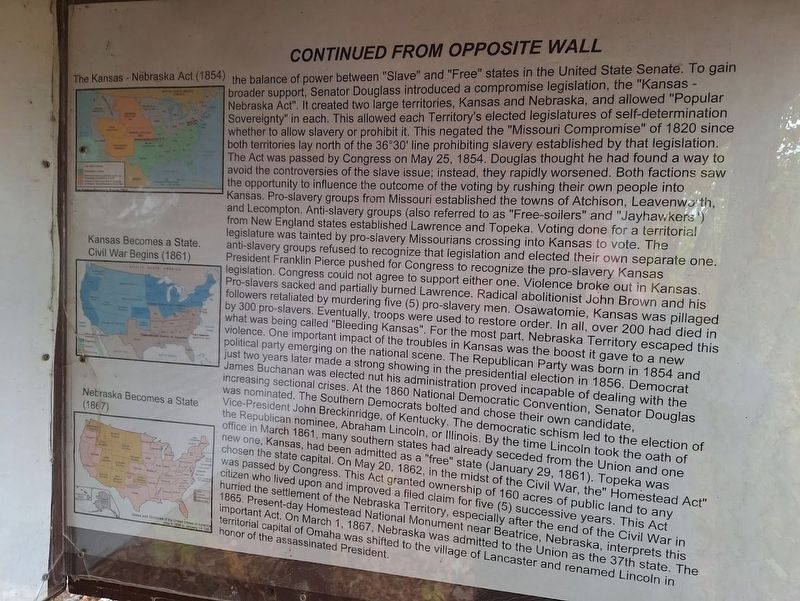
second part of the marker

Photographed by Jason Voigt, October 27, 2025
3. Kansas & Nebraska: From Wilderness to Statehood Marker
Marker is on the left and right sides of the kiosk

Photographed by Jason Voigt, October 27, 2025
4. Kansas & Nebraska: From Wilderness to Statehood Marker
Kiosk is at the 40th Parallel monument
Topics and series. This historical marker is listed in these topic lists: Exploration • Settlements & Settlers • War, US Civil. In addition, it is included in the Lewis & Clark Expedition series list. A significant historical month for this entry is May 1804.
Location. 39° 59.993′ N, 95° 19.927′ W. Marker is near White Cloud, Kansas, in Doniphan County. It can be reached from 703 Trail. Marker is off a hiking trail that leads to the 40th Parallel Marker, which is 100 feet high from the starting point. 703 Trail continues as Kansas State Route 7. Touch for map. Marker is at or near this postal address: 703 Trail, Rulo NE 68431, United States of America. Touch for directions.

Regionally, this marker is in Eastern Kansas. It is also in the American Midwest, in the Lewis & Clark Corridor, in the Corn Belt, on the prairies, and on the Southern Plains. Globally, it is in North America, the Western Hemisphere, the Western World, and the Anglosphere. Historically, it finds itself in what was once the Louisiana Purchase.
Other nearby markers. At least 8 other markers are within 3 miles of this marker, measured as the crow flies: The Cast Iron Monument (here, next to this marker); Our System of Land Surveys (here, next to this marker); Atchison & Nebraska Railroad (within shouting distance of this marker in Nebraska); Point of Beginning, Public Land Surveys of the Sixth Principal Meridian (within shouting distance of this marker in Nebraska); Wilbur Chapman (approx. 2.4 miles away); July 10, 1804 (approx. 2½ miles away); Glacial Hills Scenic Byway (approx. 2½ miles away); The Lewis and Clark Expedition (approx. 2½ miles away). Touch for a list and map of all markers in White Cloud.
Regarding Kansas & Nebraska: From Wilderness to Statehood. How to access the marker:
Park at the Nebraska Historical Marker (at the Kansas/Nebraska state line; there is a small parking area). Walk 125 yards north to the trailhead. Journey up the trail until it ends. The trail is not long, but it is very steep as you go 100 feet from the starting point. There is railing in most places on the trail.
Additional commentary.
1. Kansas or Nebraska?
It can be argued all day where this marker (along with the two next to it) is on the map. Is it in Kansas or Nebraska? Google Maps says it is in Doniphan County near White Cloud, and the monument is just a few feet from the actual state line.
— Submitted November 8, 2025, by Jason Voigt of Glen Carbon, Illinois.
Credits. This page was last revised on November 8, 2025. It was originally submitted on November 8, 2025, by Jason Voigt of Glen Carbon, Illinois. This page has been viewed 132 times since then and 69 times this year. Photos: 1, 2, 3, 4. submitted on November 8, 2025, by Jason Voigt of Glen Carbon, Illinois.
