Cozens Ranch
1874

Homestead, ranch, stagecoach stop, post office, hotel, Jesuit retreat, museum
Placed on the National Register of Historic Places by the United States Department of the Interior June 9, 1988
Topics and series. This historical marker is listed in these topic lists: Architecture • Industry & Commerce • Roads & Vehicles • Settlements & Settlers. In addition, it is included in the National Register of Historic Places (NRHP) series list. A significant historical year for this entry is 1874.
Location. 39° 55.955′ N, 105° 47.45′ W. Marker is in Winter Park, Colorado, in Grand County. It is on Zerex Street (U.S. 40) 0.1 miles north of Grand Park Drive, on the right when traveling north. The marker is mounted directly on the subject building, at eye-level on the right side of the east entrance. Touch for map. Marker is at or near this postal address: 77849 US Highway 40, Winter Park CO 80482, United States of America. Touch for directions.

Regionally, this marker is in the Colorado High Rockies and on the Continental Divide. It is also in the American Mountain West. Globally, it is in North America, the Rocky Mountains,
this page online
Other nearby markers. At least 8 other markers are within 2 miles of this marker, measured as the crow flies: Grand County Tourism, Scenic Byways & Water (here, next to this marker); Cozens Ranch Museum (a few steps from this marker); Grand County Skiing (a few steps from this marker); Gone Fishin' (approx. 1.2 miles away); Jim Bridger (approx. 1½ miles away); Sheriff Billy Cozens (approx. 1½ miles away); Doc Susie (approx. 1½ miles away); Jeremiah (John) Johnson (approx. 1½ miles away). Touch for a list and map of all markers in Winter Park.
Regarding Cozens Ranch. National Register of Historic Places № 88000709.
From the National Register Nomination prepared by Regina M. Black, 5/1988:
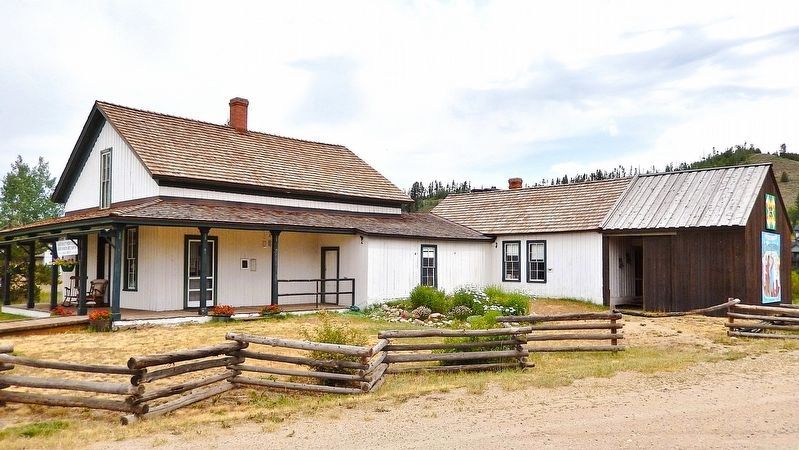
The Cozens Ranch House is a 1½ story vernacular board and batten structure constructed in 1874. The house has a large stage stop addition to the rear and a small post office addition on the south elevation. The house was the focus of a ranch operation, stage stop and post office in Grand County, Colorado. The ranch is situated in the Fraser Valley, an area of open "parks"or meadows surrounded by high mountains which lead into Middle Park. Around the ranch, Fraser Valley remains essentially undeveloped with the Winter Park Ski area 3 miles south of the ranch house and the Fraser shopping center two miles to the north as the only major modern intrusive elements in the area.July 30, 20252. Marker detail: Cozens Ranch (historic photo)
The ranch house sits 50-75 feet east of the historic wagon road, now U. S. Highway 40, which winds its way through the valley. The Fraser River flows within 200 feet of the rear of the house. The original ranch lands surrounding the Cozens Ranch House and Stage Stop are little changed from the time of William Cozens death in 1904. However, most of the outbuildings and structures associated with the ranch no longer exist. Photographs taken before the turn of the century show that the stage stop and ranch house were part of a substantial ranch complex fronting the road then as it is aligned today, as a prosperous grouping of barns and dwellings. All that remains of the ranch complex is the main house constructed in 1874 with its post office and stage stop additions constructed soon thereafter.
The Cozens Ranch House and Stage Stop isarchitecturally significant as one of the few remaining planked log buildings in Colorado and for the quality of its late nineteenth century western vernacular classical architecture. The craftsmanship of its construction is exemplary. The building is significant for its association with the history of 19th century transportation and settlement in Grand County from 1874 to 1905. The building was an important stage stop on the road from Georgetown to Hot Sulphur Springs, serving from the first opening of the road over Berthoud Pass in 1874 until the coming of the railroad in 1905, when roadhouses associated with stage lines were no longer needed. The significance of the building is enhanced by the local fame of its owner and builder, William Zane Cozens: ex-sheriff of Central City, early homesteader of the Fraser Valley, postmaster and stage stop host.Photographed by Cosmos Mariner, July 30, 20253. Cozens Ranch MarkerSupplemental details are provided on a panel mounted beside the historical marker.————— Life was hard for women during the last decades of the 1800's. Isolation made Middle Park truly an “island in the Rockies” and the winters were so very long. Mrs. Cozens and her two girls were expected to care for any travelers who stopped by, at whatever hour and in whatever numbers, a duty sometimes resented by Mary Elizabeth, at least.What pleasures might the women hope for? When spring came at last, there was the garden. It surely must have brightened Mary Elizabeth Cozens' eyes and lifted her heart. In her diary written in 1887-1888, she often speaks of the growing things.
Sept. 27. 1887 — Extra frost after rain — it covered the ground like snow. Pansies, poppies, and daisies all right yet.
Oct. 11 — Pansies still in bloom, also daisies, in spite of heavy frosts.
Oct. 24 — The pansies, poppies, and daisies are flat. No more blooms this year.
Oct. 31 — Oh, if only winter would miss us this year!
Jan. 8, 1888 — 42 below zero, more plants frozen and banished to cellar for the winter.
Feb. 29 — Order seeds from Vick — pansy, morning glory, phlox, dandelion, nasturtiums, and plants also — 2 roses, 1 daphne, 1 paeony, 1 mock orange.
March 14 — No seeds yet.
March 21 — Seeds come at last.
April 2 — Poppies and dandelions coming up.
April 17 — Clear the straw and rubbish from flower garden — find most of the giant pansies dead but contrary to expectations, carnations and sweet William all right.
April 24 — Rains very hard — plants in garden ought not to be uncovered here before May 1st. The carnations suffer for my haste.
May 7 — Get plants from Vick at last, in very nice condition.
May 9 — Set out daphne, paeony, and lilac.
May 26 — Somehow the spring impresses me badly — these heavy frosts and sudden warm spells. Storms seem to check the growth of everything except the grass!
June 27 — First pansy gathered this morning — lilacs sprouting.
July 13, 1888 — Nearly all the plants are budded!
Cozens was one of the earliest settlers in the valley and contributed to the area's development. William Zane Cozens and Mary York Cozens crossed the divide from Central City to the east and homesteaded 160 acres on the Fraser in 1872, and in 1874 built the house which stands today, essentiallyunaltered. Appointed deputy sheriff soon after his arrival, William, better known as Billy, was appointed chief deputy sheriff of Gilpin County in 1861. Cozens assumed the office of sheriff in 1862 when the elected sheriff resigned. He completed the term, gained election in his own right, then held the office for six years.Photographed by Cosmos Mariner, July 30, 20254. Cozens Ranch MarkerThe marker is mounted near the southeast corner of the ranch house, on the right side of the east entrance.
Mary York Cozens was born in England of Irish parents in 1830 and immigrated with her family to Canada when she was twelve. Her father died at sea, and her mother died but three months after landing. Mary was placed in a private home as a servant, later moved to New York, then to Baltimore. She came west with a family as their house servant, and as the Cozens children later told the story, was intended by her employer as a white slave for the gold fields. She escaped and found protection with the Gregory party (of Gregory diggings fame), ultimately to meet and marry Billy Cozens in 1860.


Related markers. Click here for a list of markers that are related to this marker.
Also see . . . Cozens Ranch House (Wikipedia). (Submitted on November 11, 2025, by Cosmos Mariner of Cape Canaveral, Florida.)



Born July 2, 1830
Died Jan. 17, 1904
R.I.P.
Mary Cozens
Nee York
Born Mar. 17, 1830
Died Mar. 15, 1909
R.I.P.
Credits. This page was last revised on November 17, 2025. It was originally submitted on November 9, 2025, by Cosmos Mariner of Cape Canaveral, Florida. This page has been viewed 1,071 times since then and 896 times this year. Photos: 1, 2, 3, 4, 5, 6, 7. submitted on November 11, 2025, by Cosmos Mariner of Cape Canaveral, Florida. 8, 9. submitted on November 17, 2025, by Cosmos Mariner of Cape Canaveral, Florida.
