Near Bishop in Inyo County, California — The American West (Pacific Coastal)
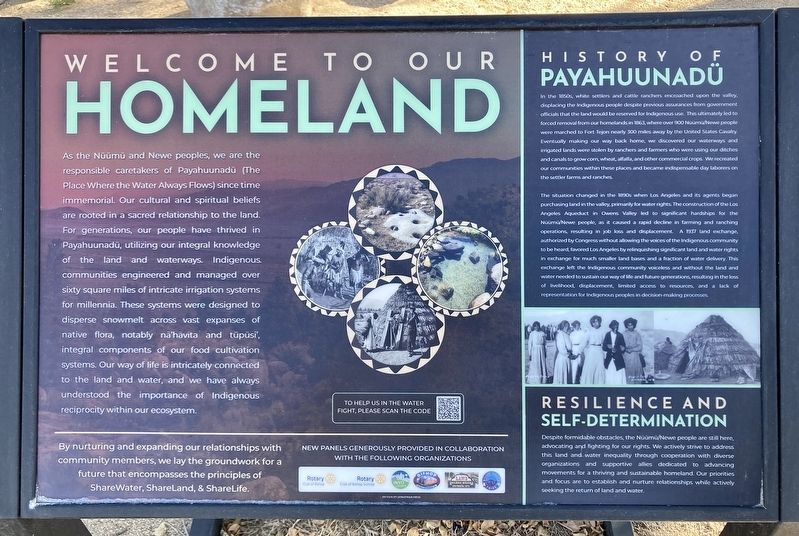
Welcome To Our Homeland
Photographed by Craig Baker, October 30, 2025
1. Welcome To Our Homeland Marker
As the Nuümü and Newe peoples, we are the responsible caretakers of Payahuunadu (The Place Where the Water Always Flows) since time immemorial. Our cultural and spiritual beliefs are rooted in a sacred relationship to the land. For generations, our people have thrived in Payahuunadu, utilizing our integral knowledge of the land and waterways. Indigenous. communities engineered and managed over sixty square miles of intricate irrigation systems for millennia. These systems were designed to disperse snowmelt across vast expanses of native flora, notably na'havita and tüpüsi integral components of our food cultivation systems. Our way of life is intricately connected to the land and water, and we have always understood the importance of Indigenous reciprocity within our ecosystem.
By nurturing and expanding our relationships with community members, we lay the groundwork for a future that encompasses the principles of ShareWater, ShareLand, & ShareLife.
History of Payahuunadü
In the 1850s, white settlers and cattle ranchers encroached upon the valley, displacing the Indigenous
this page online
The situation changed in the 1890s when Los Angeles and its agents began purchasing land in the valley, primarily for water rights. The construction of the Los Angeles Aqueduct in Owens Valley led to significant hardships for the Nüümü/Newe people, as it caused a rapid decline in farming and ranching operations, resulting in job loss and displacement. A 1937 land exchange, authorized by Congress without allowing the voices of the Indigenous community to be heard, favored Los Angeles by relinquishing significant
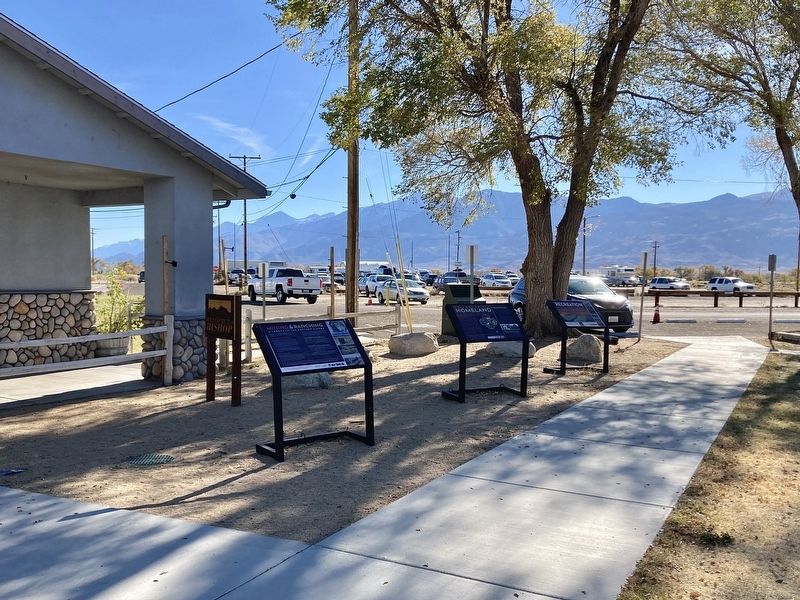
Photographed by Craig Baker, October 30, 2025
2. Welcome To Our Homeland Marker
Resilience and Self-Determination
Despite formidable obstacles, the Nüümü/Newe people are still here, advocating and fighting for our rights. We actively strive to address this land and water inequality through cooperation with diverse organizations and supportive allies dedicated to advancing movements for a thriving and sustainable homeland. Our priorities and focus are to establish and nurture relationships while actively seeking the return of land and water.
Topics. This historical marker is listed in this topic list: Indigenous Peoples and Communities.
Location. 37° 22.281′ N, 118° 21.975′ W. Marker is near Bishop, California, in Inyo County. It is on Airport Road 0.7 miles north of East Line Street. Located next to the airport terminal building. Touch for map. Marker is at or near this postal address: 701 Airport Rd, Bishop CA 93514, United States of America. Touch for directions.

Regionally, this marker is in the Sierra Nevada. It is also in the American Mountain West. Globally, it is in North America, on the Ring of Fire, on the Pacific Rim, in the Western Hemisphere, in the Western World, and in the Anglosphere. Historically, it finds itself in what was once New Spain and also Mexico’s Alta California.
Other nearby markers. At least 8 other markers are within 2 miles of this marker, measured as the crow flies: Mining & Ranching (here, next to this marker); Project Sierra Wave (within shouting distance of this marker); Fifty Year Soaring Commemorative (within shouting distance of this marker); The Fortune Seekers (approx. 1.6 miles away); "Atlas Copco Mucker" (approx. 1.6 miles away); Slim Princess (approx. 1.6 miles away); Whiskey Creek History (approx. 1.6 miles away); James D. Birchim (approx. 1.6 miles away). Touch for a list and map of all markers in Bishop.
Credits. This page was last revised on November 9, 2025. It was originally submitted on November 9, 2025, by Craig Baker of Sylmar, California. This page has been viewed 59 times since then and 28 times this year. Photos: 1, 2. submitted on November 9, 2025, by Craig Baker of Sylmar, California.
