Perryville in Boyle County, Kentucky — The American South (East South Central)
Stanford's Battery
Perryville • The Battle For Kentucky
| — | October 8, 1862 | — |
Photographed by Bradley Owen, October 18, 2025
1. Stanford's Battery Marker
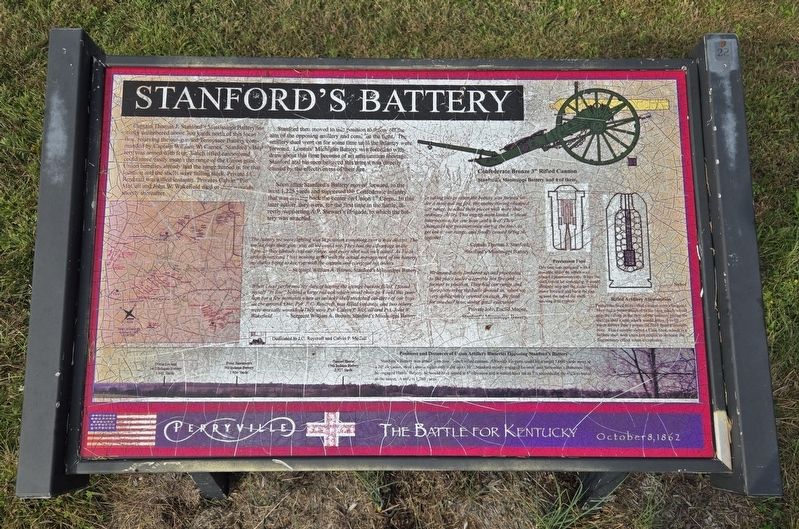
Captain Thomas J. Stanford's Mississippi Battery initially unlimbered about 300 yards north of this location, relieving the out-gunned Tennessee Battery commanded by Captain William W. Carnes. Stanford's Battery was armed with four, 3-inch rifled cannon and could more easily match the range of the Union guns. Union batteries already had the range zeroed in for that location and the shells were falling thick. Private J.C. Roycraft was killed instantly. Privates Calvin “Pitt" McCall and John W. Wakefield died of their wounds shortly thereafter.
Stanford then moved to this position to throw off the aim of the opposing artillery and continue the fight. The artillery duel went on for some time until the infantry went forward. Loomis' Michigan Battery was forced to withdraw about this time because of an ammunition shortage. Stanford and his men believed this retreat was directly caused by the effectiveness of their fire.
Soon after, Stanford's Battery moved forward, to the west 1,225 yards and supported the Confederate infantry that was driving back the center on Union 1st Corps. In this later action, they were, for the
this page online
The battery we were fighting was in position something over a mile distant. The smoke from their guns was all we could see. They had the advantage in the fight, as they already had our range, and every shot was well aimed. As I was orderly sergeant I had nothing to do with the actual management of the battery, my duties being to keep up with the captain and carry out his orders.
- Sergeant William A. Brown, Stanford's Mississippi Battery.
When I had performed my duty of having the sponge buckets filled, I found myself "in line" behind a large red oak which stood close by. I held this position but a few moments when an unlucky shell stretched out three of our boys on the ground. One, Pvt. J.C. Roycraft, was killed instantly, and two others were mortally wounded. They were Pvt. Calvin P. McCall and Pvt. John W. Wakefield.
- Sergeant William A. Brown, Stanford's Mississippi Battery.
In taking this position the battery was formed under a most galling fire, the enemy having obtained our range, handled their pieces with more than ordinary ability. This engagement lasted, without intermission, for one hour and a half. They changed their position once during the time, to get out of our range, and finally ceased firing altogether.
Captain
Photographed by Bradley Owen, October 18, 2025
2. Stanford's Battery Marker
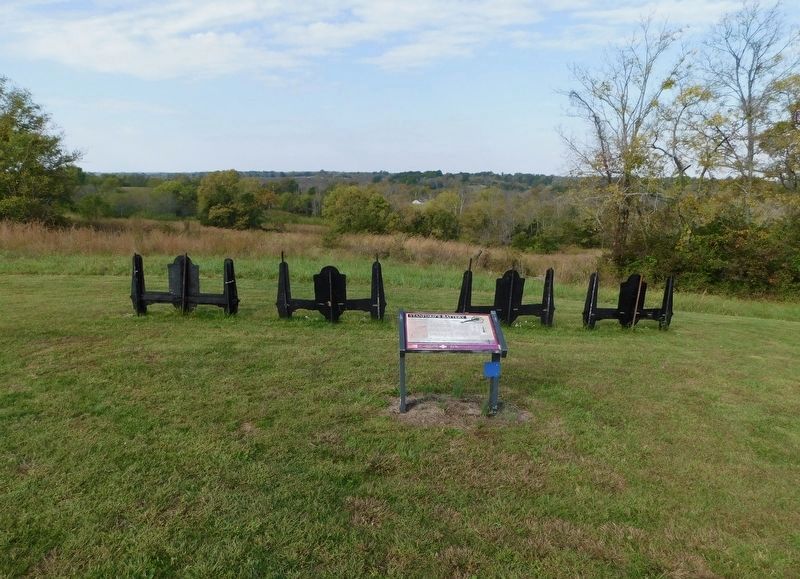
View is looking west towards the Union artillery positions.
We immediately limbered up and proceeded to the place under a terrible hot fire and formed in position. They had our range and were showering the balls around us, when we very deliberately opened on them. We fired for one-half hour, doing great execution.
Private John Euclid Magee, Stanford's Mississippi Battery.
Confederate Bronze 3" Rifled Cannon
Stanford's Mississippi Battery had 4 of these.
Percussion Fuse
This fuse was designed with a movable slider on which was placed a percussion cap. When the shell would hit something, it would abruptly stop and the slider would move forward and burst the cap against the top of the shell, causing it to explode.
Sabot
Rifled Artillery Ammunition
Projectiles fired from rifled cannon were elongated. They had a Sabot attached to the base which would grip the rifling in the bore of the cannon, giving the shell or shot a spin which would allow it to fly much farther than a projectile fired from a smoothbore. This example shows a Case Shot, which is a hollow shell with extra projectiles to increase the fragmentary effect when it explodes.
Positions and Distances of Union Artillery Batteries Opposing Stanford's Battery
Stanford's Battery was armed with four, 3-inch rifled cannon. Although his guns could hit a target 5,000 yards away at a 20º elevation, most cannon sights only went up to 10º. Stanford mostly engaged Loomis' and Simonson's Batteries. Had he engaged Harris' Battery, he would have aimed at 6º elevation and it would have taken 7 1/2 seconds for the shell to travel to the target. A mile is 1,760 yards.
(Photo Points of Reference Descriptions):
Cyrus Loomis' 1st Michigan Battery 1,641 Yards
Peter Simonson's 5th Indiana Battery 1,636 Yards
Samuel Harris' 19th Indiana Battery 2,307 Yards
Erected by In honor of J.C. Roycraft and Calvin P. McCall.
Topics. This historical marker is listed in this topic list: War, US Civil.
Location. 37° 40.252′ N, 84° 57.326′ W. Marker is in Perryville, Kentucky, in Boyle County. It can be reached from Battlefield Road (Kentucky Route 1920) half a mile south of Park Road, on the left when traveling south. Marker is located on the Confederate Artillery Trail at the Perryville Battlefield State Historic Site. Parking for the trailhead is located at 1360 Battlefield Road. Touch for map. Marker is at or near this postal address: 1360 Battlefield Road, Perryville KY 40468, United States of America. Touch for directions.

Regionally, this marker is in the Bluegrass Region. It is also in the American South and specifically in the Upper South. Globally, it is in North America, the Western Hemisphere, the Western World, and the Anglosphere. Historically, it finds itself in what was once the territory of the Mississippian Culture and also the Antebellum South.
Other nearby markers. At least 8 other markers are within walking distance of this marker: Carnes' Battery (approx. 0.2 miles away); Battle of Perryville (approx. ¼ mile away); Semple's Battery (approx. 0.4 miles away); Kirkland Home (approx. 0.4 miles away); The Dye House (approx. half a mile away); Unknown Confederate Soldiers (approx. 0.6 miles away); Hawkins' Mississippi Sharpshooters (approx. 0.6 miles away); Jones' Crossing (approx. 0.6 miles away). Touch for a list and map of all markers in Perryville.
Regarding Stanford's Battery. Marker includes a map: Battle of Perryville October 8, 1862 12:30 PM.
Credits. This page was last revised on November 11, 2025. It was originally submitted on November 10, 2025, by Bradley Owen of Morgantown, West Virginia. This page has been viewed 145 times since then and 107 times this year. Photos: 1, 2. submitted on November 10, 2025, by Bradley Owen of Morgantown, West Virginia.
