Luxor, Luxor Governorate, Egypt — مصر (Northeast Africa)
Nectanebo I

Photographed by James Hulse, October 10, 2024
1. Nectanebo I Marker

Ruled for: 18 years (379-361 B.C.)
30th Dynasty
He began to build the first pylon at Karnak, and renovated the Avenue of Sphinxes with a length of 2220 m., as he erected 807 Androsphinxes starting from the Temple of Mut to Luxor which represents the last stage of the construction of this road.
الملك نختنبو الأول
فترة الحكم: ١٨ عاماً (٣٧٩ - ٣٦١ ق.م)
الأسرة الثلاثون.
شرع في بناء الصرح الأول بمعبد الكرنك، وقام باستكمال طريق الكباش بداية من معبد موت وحتى معبد الأقصر بطول ٢٢٢٠ متر، حيث أقام ٨.٧ تمثال على هيئة أبي الهول برأس آدمية والتي مثلت المرحلة الأخيرة من إنشاء هذا الطريق.
فترة الحكم: ١٨ عاماً (٣٧٩ - ٣٦١ ق.م)
الأسرة الثلاثون.
شرع في بناء الصرح الأول بمعبد الكرنك، وقام باستكمال طريق الكباش بداية من معبد موت وحتى معبد الأقصر بطول ٢٢٢٠ متر، حيث أقام ٨.٧ تمثال على هيئة أبي الهول برأس آدمية والتي مثلت المرحلة الأخيرة من إنشاء هذا الطريق.
Erected by Ministry of Tourism & Antiquity, Luxor, World Heritage Center and UNESCO.
Topics. This historical marker is listed in this topic list: Anthropology & Archaeology. A significant historical year for this entry is 379 BCE.
Location. 25° 42.048′ N, 32° 38.405′ E. Marker is in Luxor, Luxor Governorate. It is on Mabad Al Oksor just north of Al Mahata. The marker is located at the front entrance of the Luxor Temple. Touch for map. Marker is at or near this postal address: Mabad Al Oksor, Luxor, Luxor Governorate 13625-01, Egypt. Touch for directions.

Regionally, it is in Africa, specifically in North Africa, in the Middle East, on the Red Sea, and in a coastal Mediterranean country. Historically, it finds itself in what was once the Byzantine Empire, the Ottoman Empire, a British colony, and the Roman Empire.
Other nearby markers. At least 8 other markers are within walking distance of this marker: Pinedjem I (here, next to this marker); Ramses II (here, next to this marker); Tutankhamun (here, next to this marker); Amenhotep III (here, next to this marker); Hatshepsut (a few steps from this marker); Avenue of Sphinxes/ طريق الكباش (a few steps from this marker); Luxor Temple / معبد الأقصر (within shouting distance of this marker); Pylon of Ramesses II (within shouting distance of this marker). Touch for a list and map of all markers in Luxor.
Also see . . . Nectanebo I. Wikipedia
Nectanebo's Egyptian personal name was Nḫt-nb.f (Nakhtnebef), which means "the strong one of his lord". Greek sources rendered the name as Νεκτάνεβις (Nectanebis). The writings of Manetho which have been preserved by George Syncellus spell it Νεκτανέβης(Submitted on November 17, 2025, by James Hulse of Medina, Texas.)(Nectanebēs), but this is probably only based on a phonetic approximation due to iotacism. Although convention in English assigns identical names to him and his grandson, Nectanebo II, the two in fact had different names.
Click or scan to see
this page online

Photographed by James Hulse, October 10, 2024
2. The marker is the first marker on the left side
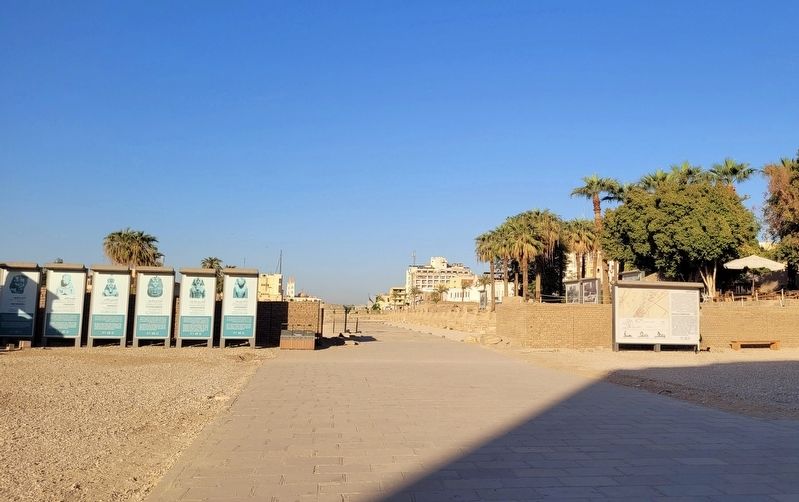
Photographed by James Hulse, October 10, 2024
3. The entrance to the Avenue of the Sphinxes
Credits. This page was last revised on November 17, 2025. It was originally submitted on November 12, 2025, by James Hulse of Medina, Texas. This page has been viewed 79 times since then and 57 times this year. Photos: 1, 2, 3. submitted on November 17, 2025, by James Hulse of Medina, Texas.
