Luxor, Luxor Governorate, Egypt — مصر (Northeast Africa)
Tutankhamun

Photographed by James Hulse, October 10, 2024
1. Tutankhamun Marker

Ruled for: 9 years (1332-1323 B.С.)
New Kingdom, 18th Dynasty
He restored the rule to Thebes at the end of the Amarna Period and re-celebrated the Opet Festival. King Tut constructed 130 Criosphinxes from the tenth pylon to the Temple of Mut, and completed the scenes of King Amenhotep III in the hall of the fourteen columns in Luxor Temple.
الملك توت عنخ أمون
فترة الحكم: 9 أعوام ( ١٣٣٢ - ١٣٢٣ ق.م)
الدولة الحديثة - الأسرة الثامنة عشر
أعاد الحكم إلى العاصمة طيبة فى نهاية عصر العمارنة وقام بإعادة الإحتفال بعيد الأوبت واستكمل إنشاء طريق الكباش بين الصرح العاشر ومعبد موت، حيث أقام ١٣٠ تمثالاً للكباش، كما استكمل مناظر الملك أمنحتب الثالث في صالة الأربعة عشر عمود بمعبد الأقصر.
Erected by Ministry of Tourism & Antiquity, Luxor, World Heritage Center and UNESCO.
Topics. This historical marker is listed in this topic list: Anthropology & Archaeology. A significant historical year for this entry is 1332 BCE.
Location. 25° 42.046′ N, 32° 38.407′ E. Marker is in Luxor, Luxor Governorate. It is at the intersection of Mabad Al Oksor and Al Mahata on Mabad Al Oksor. The marker is located at the front entrance of the Luxor Temple. Touch for map. Marker is at or near this postal address: Mabad Al Oksor, Luxor, Luxor Governorate 13625-01, Egypt. Touch for directions.

Regionally, it is in Africa, specifically in North Africa, in the Middle East, on the Red Sea, and in a coastal Mediterranean country. Historically, it finds itself in what was once the Byzantine Empire, the Ottoman Empire, a British colony, and the Roman Empire.
Other nearby markers. At least 8 other markers are within walking distance of this marker: Amenhotep III (here, next to this marker); Ramses II (here, next to this marker); Pinedjem I (here, next to this marker); Hatshepsut (here, next to this marker); Nectanebo I (here, next to this marker); Avenue of Sphinxes/ طريق الكباش (a few steps from this marker); Luxor Temple / معبد الأقصر (within shouting distance of this marker); Ancient Luxor / مدينة الاقصر (within
this page online
Also see . . . Tutankhamun. Wikipedia
Tutankhamun or Tutankhamen (c. 1341 BC – c. 1323 BC), was the thirteenth pharaoh of the Eighteenth Dynasty of ancient Egypt, who ruled c. 1333 – 1323 BC. Born Tutankhaten, he instituted the restoration of the traditional polytheistic form of ancient Egyptian religion, undoing a previous shift to the religion known as Atenism. Tutankhamun's reign is considered one of the greatest restoration periods in ancient Egyptian history, and his tomb door proclaims his dedication to illustrative constructions of the ancient Egyptian gods.(Submitted on November 17, 2025, by James Hulse of Medina, Texas.)
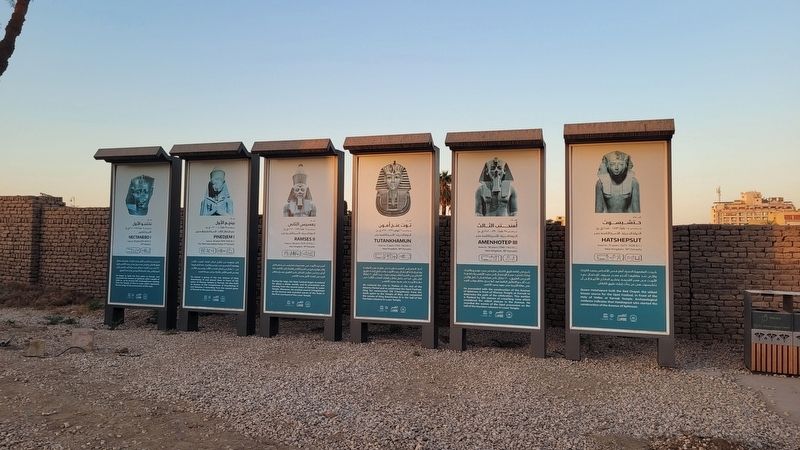
Photographed by James Hulse, October 10, 2024
2. The marker is the third marker from the right side
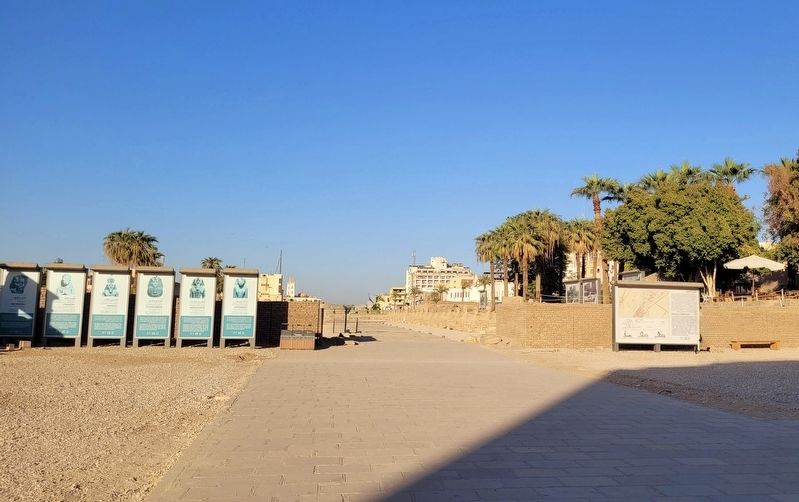
Photographed by James Hulse, October 10, 2024
3. The entrance to the Avenue of the Sphinxes
Credits. This page was last revised on November 17, 2025. It was originally submitted on November 12, 2025, by James Hulse of Medina, Texas. This page has been viewed 76 times since then and 53 times this year. Photos: 1, 2, 3. submitted on November 17, 2025, by James Hulse of Medina, Texas.
