Old Bethpage in Nassau County, New York — The American Northeast (Mid-Atlantic)
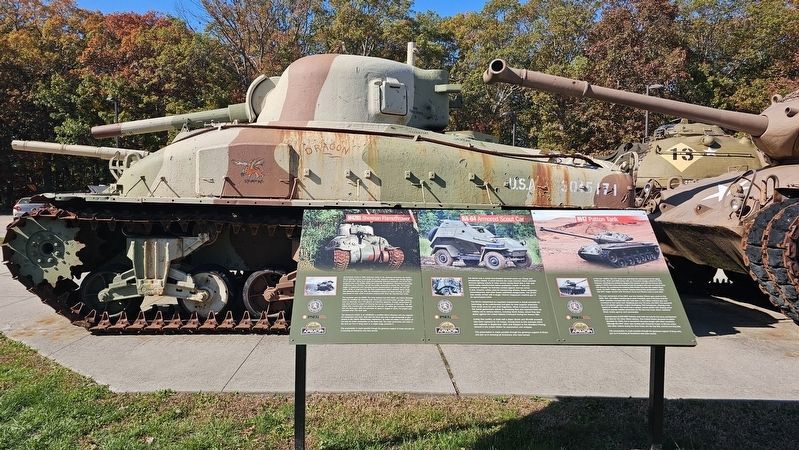
M42B1 Sherman Flamethrower

Photographed by Ian Lefkowitz, October 26, 2025
1. M42B1 Sherman Flamethrower Marker
The response was the M42B. The Army ordered that 640 M4A1 and M4A3 Sherman tanks be modified by removing their 75mm gun and ammunition storage, allowing room to internally carry 270 gallons of thickened gasoline. Enough compressed air was also carried to propel the flaming fuel out to a distance of 400 feet. The .30 caliber bow machine gun was retained as was the .30 caliber gun mounted
this page online
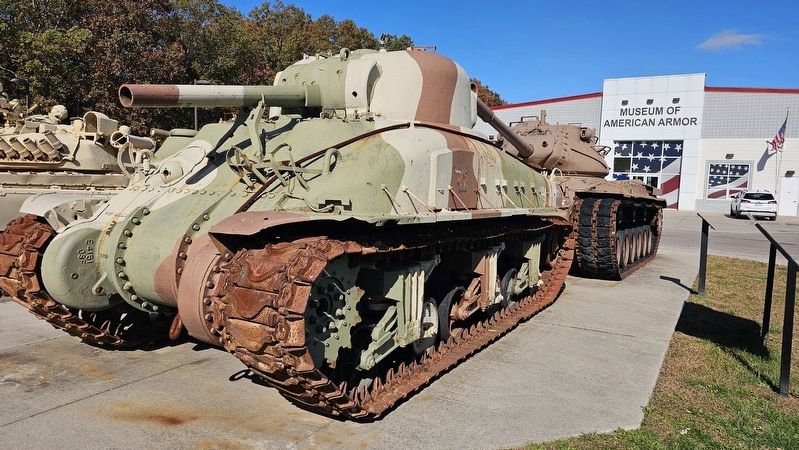
The Museum’s exhibit is an M42B1E9, a modified M4A1 Sherman with the widened E9 suspension and track. Note that the flame gun tube is split horizontally to give access to the interior flamethrower mechanism. Air holes are drilled in the bottom of the tube for better combustion of the flame fuel. The many pockmarks and holes in the tank are from it being used on a target range, post-War II.
This presentation is made possible through the generous support of those who join us in honoring all Americans who have served.
Topics. This historical marker is listed in these topic lists: Military • Roads & Vehicles • War, World II. A significant historical month for this entry is August 1945.
Location. 40° 46.542′ N, 73° 26.76′ W. Marker is in Old Bethpage, New York, in Nassau County. It is on Round Swamp Road. This marker is located in the parking lot of the Museum of American Armor. Touch for map. Marker is at or near this postal address: 1303 Round Swamp Road, Plainview NY 11803, United States of America. Touch for directions.

Regionally,
Photographed by Ian Lefkowitz, October 26, 2025
2. M42B1 Sherman Flamethrower Marker
The marker is the left-most of a set of three markers, located in front of the M42B1E9 Sherman tank.
Other nearby markers. At least 8 other markers are within walking distance of this marker: BA-64 Armored Scout Car (here, next to this marker); M47 Patton Tank (here, next to this marker); M60 MBT (a few steps from this marker); T-72 Main Battle Tank (a few steps from this marker); The U.S. M1 155mm Gun (a few steps from this marker); The Higgins Boat (within shouting distance of this marker); Long Island During the Cold War (within shouting distance of this marker); M110 Howitzer (about 300 feet away, measured in a direct line). Touch for a list and map of all markers in Old Bethpage.
Also see . . . Flame Thrower Tank – 151 M42B1 and 49 M42B3 Built (The Online Tank Museum).
The US invasions of numerous Pacific Islands(Submitted on November 15, 2025, by Ian Lefkowitz of New York, New York.)in the latter part of the Second World War highlighted what would be a critical need for the invasion of Japan, namely clearing bunkers and other fortified points using flamethrowers under armor. This led to the development of the Mechanized Flame Thrower, M5-4, which was then mounted in the M4A1 and M4A3 Shermans, thus becoming the M42B1 and M42B3. These were designed to look like normal 75 mm-armed Shermans, hiding their fiery ‘breath’. While around 200 were built across both versions, they did not see combat. However, they still saw service for over a decade and helped train the next generation of US troops.Photographed by Ian Lefkowitz, October 26, 20253. The Museum of American Armor
Credits. This page was last revised on November 15, 2025. It was originally submitted on November 15, 2025, by Ian Lefkowitz of New York, New York. This page has been viewed 169 times since then and 111 times this year. Photos: 1, 2, 3. submitted on November 15, 2025, by Ian Lefkowitz of New York, New York. • Andrew Ruppenstein was the editor who published this page.
