
Near Culpeper in Culpeper County, Virginia — The American South (Mid-Atlantic)
Battle of Cedar Mountain
Photographed by Craig Swain, December 22, 2007
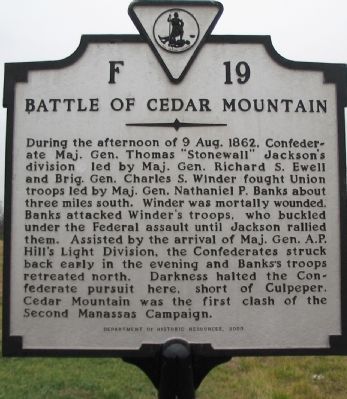
1. Battle of Cedar Mountain Marker
During the afternoon of 9 Aug. 1862, Confederate Maj. Gen. Thomas "Stonewall" Jackson's division led by Maj. Gen. Richard S. Ewell and Brig. Gen. Charles S. Winder fought Union troops led by Maj. Gen. Nathaniel P. Banks about three miles south. Winder was mortally wounded. Banks attacked Winder's troops, who buckled under the Federal assault until Jackson rallied them. Assisted by the arrival of Maj. Gen. A.P. Hill's Light Division, the Confederates struck back early in the evening and Banks's troops retreated north. Darkness halted the Confederate pursuit here, short of Culpeper. Cedar Mountain was the first clash of the Second Manassas Campaign.
Erected 2000 by Department of Historic Resources. (Marker Number F-19.)
Topics and series. This historical marker is listed in this topic list: War, US Civil. In addition, it is included in the Virginia Department of Historic Resources (DHR) series list. A significant historical date for this entry is August 9, 1862.
Location. Marker is missing. It was located near 38° 26.467′ N, 78° 1.217′ W. Marker was near Culpeper, Virginia, in Culpeper County. It was at the intersection of James
this page online

Regionally, this marker was in the Washington Metropolitan Area and in Northern Virginia. It was also in the American South, specifically in the Upper South, and in the Mid-Atlantic. Globally, it was in North America, the Western Hemisphere, the Western World, and the Anglosphere. Historically, it found itself in what was once the territory of the Mississippian Culture, one of the original Thirteen Colonies, one of the Confederate States of America, and the Antebellum South.
Other nearby markers. At least 8 other markers are within 3 miles of this location, measured as the crow flies: Lee and Pope (here, next to this marker); Mount Pony Signal Station (approx. 0.6 miles away); Greenwood (approx. 1.4 miles away); Col. John Jameson (approx. 2 miles away); Culpeper Minute Men (approx. 2.2 miles away); Guinn Bungalow (approx. 2.2 miles away); 902 South East Street (approx. 2.2 miles
Photographed by Craig Swain
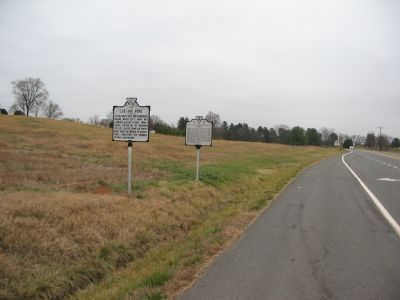
2. Virginia Markers F 16 and F 19
More about this marker. This marker replaced a previous F 19 with the same title which read, "Here Stonewall Jackson halted his advance late in the afternoon of August 9, 1862, having driven Banks back from Cedar Mountain." The old marker stood about a mile and a half further north on US. Highway 15.
Regarding Battle of Cedar Mountain. This is one of several markers interpreting the Battle of Cedar Mountain. See the Battle of Cedar Mountain Virtual Tour by Markers linked below.
Also see . . .
1. Friends of Cedar Mountain Battlefield. Assisted by the Civil War Preservation Trust, the organization has worked to restore the 152-acre Cedar Mountain Battlefield Park to its wartime appearance. (Submitted on December 30, 2007, by Craig Swain of Leesburg, Virginia.)
2. Battle of Cedar Mountain Virtual Tour by Markers. A set markers that document the Battle of Cedar Mountain, August 9, 1862. (Submitted on January 1, 2008, by Craig Swain of Leesburg, Virginia.)
Photographed by Craig Swain, December 22, 2007
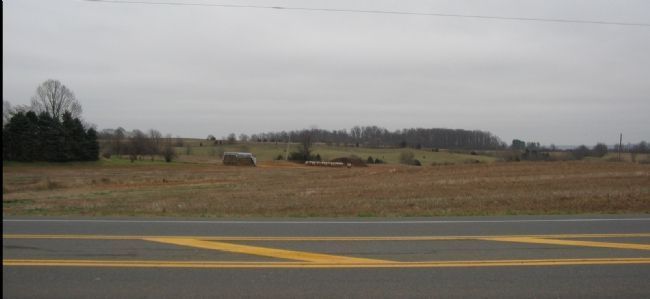
3. Confederate Pursuit
The Federals retreated through farm lanes and along the Orange and Culpeper Road as the sun sat on August 9, 1862. The Road's historical path lay through the valley in the foreground. This ground near the battlefield on the east side of modern James Madison Highway has changed only little since the battle, dominated by farmland. However the west side is heavily developed.
Credits. This page was last revised on November 16, 2025. It was originally submitted on December 30, 2007, by Craig Swain of Leesburg, Virginia. This page has been viewed 2,564 times since then and 38 times this year. Last updated on November 15, 2025, by Evan Dwyer of Richmond, Virginia. Photos: 1, 2. submitted on December 30, 2007, by Craig Swain of Leesburg, Virginia. 3. submitted on January 1, 2008, by Craig Swain of Leesburg, Virginia. • Bernard Fisher was the editor who published this page.
