Sebastian in Indian River County, Florida — The American South (South Atlantic)
The Four Chaplains Monument

Photographed by Brandon D Cross, May 7, 2025
1. Four Immortal Chaplains Fountain
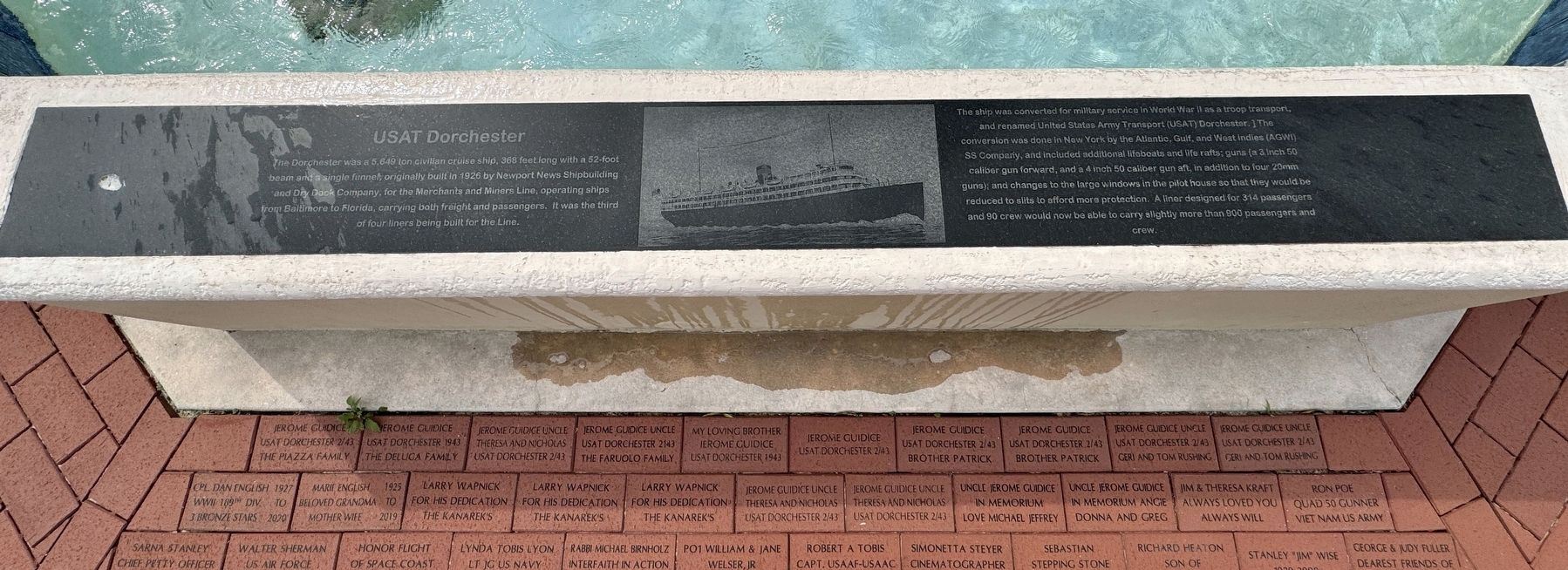
USAT Dorchester
The Dorchester was a 5,649 ton civilian cruise ship, 368 feet long with a 52-foot beam and a single funnel originally built in 1926 by Newport News Shipbuilding and Dry Dock Company, for the Merchants and Miners Line, operating ships from Baltimore to Florida, carrying both freight and passengers. It was the third of four liners being built for the Line.
The ship was converted for military service in World War Il as a troop transport, and renamed United States Army Transport (USAT) Dorchester. The conversion was done in New York by the Atlantic, Gulf, and West Indies (AGWI) SS Company, and included additional lifeboats and life rafts; guns (a 3 inch 50 caliber gun forward, and a 4 inch 50 caliber gun aft, in addition to four 20mm guns); and changes to the large windows in the pilot house so that they would be reduced to slits to afford more protection. A liner designed for 314 passengers and 90 crew would now be able to carry slightly more than 900 passengers and crew.
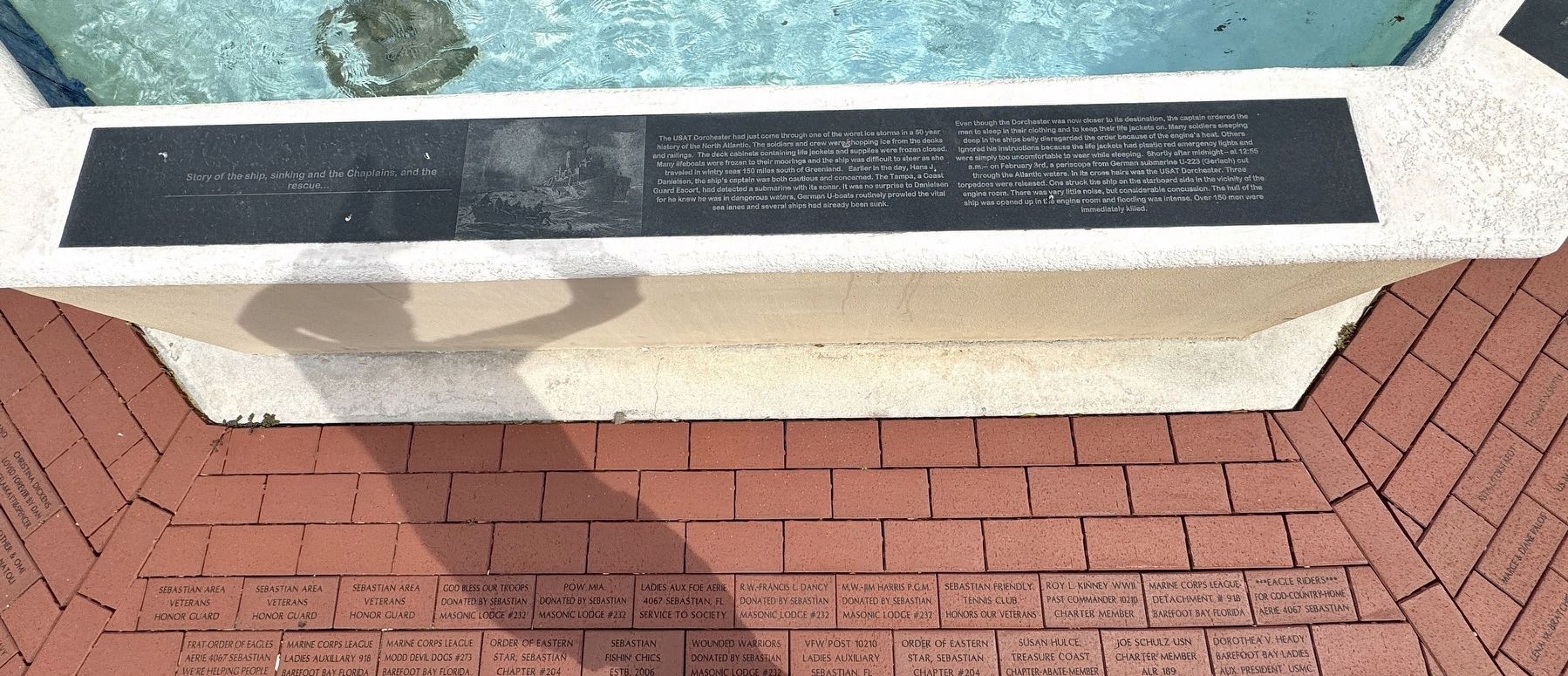
Story of the ship, sinking and the Chaplains, and the rescue…
The USAT Dorchester had just come through one of the worst ice
this page online
Even though the Dorchester was now closer to its destination, the captain ordered the men to sleep in their clothing and to keep their life Jackets on. Many soldiers sleeping deep in the ships belly disregarded the order because of the engine's heat. Others ignored his instructions because the life jackets had plastic red emergency lights and were simply too uncomfortable to wear while sleeping. Shortly after midnight—at. 12:55 a.m.—on February 3rd, a periscope from German submarine
Photographed by Brandon D Cross
2. USAT Dorchester (panel 1)
Two lifeboats, #4 and & 7 were smashed beyond use. The vessel immediately lost control as the engines had been destroyed by the explosion. The Captain ordered abandon ship at 12:56 am. Some of the crew and passengers left the ship but there were many who were frozen with fear and in shock, they remained and were lost. Life boats being launched were swamped by overcrowding and hopelessly crashed into the sea. Several Iife rafts were cut loose by the ship's crew to float clear if the ship sank.
The four U.S. Army Chaplains who were gathered at the bow gave up their life jackets to soldiers who had none. Many survivors attested to the courage displayed by these four men who remained with the ship, calming and instructing the men to go to their life stations.
Photographed by Brandon D Cross
3. Story of the ship, sinking and the Chaplains, and the rescue… (Panel 2)
The USCG Escanaba picked up 56 survivors from lifeboat #6 The USCG Comanche found lifeboat #13 and removed the survivors. These were the only two boats out of 14 lifeboats aboard the ship that were successfully launched. There were only 229 survivors, 675 men were lost. This was America's third largest naval disaster during wartime. The USCG Comanche and USCG Escanaba stayed in the vicinity of the sinking until 9:39 am, continuing to pick up survivors from the water and on the floating rafts. The Escanaba rescued 132 persons and the Comanche rescued 97. The survivors were then
![Story of the ship, sinking and the Chaplains, and the rescue… [continued] (panel 3) image. Click for full size.](Photos8/864/Photo864455.jpg?512202523400PM "Story of the ship, sinking and the Chaplains, and the rescue… [continued] (panel 3). Click for full size.")
Photographed by Brandon D Cross
4. Story of the ship, sinking and the Chaplains, and the rescue… [continued] (panel 3)
This rescue at sea was made easier by the Escanaba's first use of rescue swimmers clad in survival suits. They were to aid survivors who were too weakened by shock or hypothermia after being in the icy waters. These survivors were not strong enough to pull themselves up cargo nets or sea ladders to safety. The survival suits later evolved into what we call today the "wet suit". Mr. Ernest Heaton, our local USAT Dorchester survivor, was pulled from the water by the Escanaba's rescue swimmers using the new survival suit. He had been in the icy cold water for almost nine hours. Four months later, the Escanaba was hit by a torpedo during the early morning of June 13, 1943, while serving as a convoy escort. The ship suffered a fiery explosion and sank within minutes, leaving only two survivors out of her 105-man crew.
George L. Fox was born March 15, 1900 in Lewistown, Pennsylvania. In addition to George, he had a sister Gertrude and brothers Bert, Leo and John. When George was just 17, he left school and with strong determination, convinced the military

Photographed by Brandon D Cross
5. Captain George L. Fox (panel 4)
Upon his discharge, he returned home to Altoona, completed his last year in high school, and went to work for the Guarantee Trust Company. In 1923, he entered Moody Institute in Illinois, where he married at Winona Lake, Indiana. After he withdrew from Moody, he became an itinerant preacher in the Methodist faith. A son, Wyatt Ray, was born on November 11, 1924, After several successful years.
Upon his discharge, he returned home to Altoona, completed his last year in high school, and went to work for the Guarantee Trust Company. In 1923, he entered Moody Institute in Illinois, where he married at Winona Lake, Indiana. After he withdrew from Moody, he became an itinerant preacher

Photographed by Brandon D Cross
6. Lieutenant Alexander D. Goode (panel 5)
George held a student pastorate in Downs, Illinois, He entered Illinois Wesleyan University in Bloomington in 1929 and graduated with an A.B. degree in 1931. Again as a student pastorate in Rye, New Hampshire, he entered the Boston University School of Theology. George was ordained a Methodist minister on June 10, 1934 and graduated with a S.T.B. degree. He was appointed pastor in Waits River, Vermont. Their second child, Mary Elizabeth, was born shortly thereafter. In 1936, he accepted a pastorate in Union Village, Vermont. His next calling was in Gilman, Vermont where he joined the Walter G. Moore American Legion Post. He was later appointed state chaplain and historian for the Legion.
In mid-1942, George decided to join the Army Chaplain Service and he was appointed on July 24, 1942. He went on active duty August 8, 1942, the same day his son Wyatt enlisted in the Marine Corps. He was assigned to the Chaplains school at Harvard and then reported to the 411th Coast Artillery Battalion at Camp Davis. He was then reunited with

Photographed by 2
7. Lieutenant John P. Washington (panel 6)
Alexander D. Goode was born in Brooklyn New York on May 10, 1911. His father was a rabbi and his mother, Fay had two other sons, Joseph and Moses, and a daughter, Agatha. Alex received medals at Eastern High School, Washington D.C. for tennis, swimming and track. He led his class in scholarship too! He decided to follow in his father's footsteps and became a rabbi, but that did not keep him from having a laughing, shouting, hall-fellow-well-met boyhood with all the Protestant and Catholic boys in his neighborhood. He graduated from Eastern in 1929.
He entered the University of Cincinnati and graduated in 1934 with an A.B, degree…. and then on to Hebrew Union College with a B.H. degree in 1937. He later received his Ph.D. from John Hopkins University in 1940.
Alex married his childhood sweetheart, Theresa Flax, daughter of Nathan and Rose Flax. Theresa was a niece of singer and motion picture star, Al Jolson.

Photographed by Brandon D Cross
8. Lieutenant Clark V. Poling (panel 7)
Rabbi Goode applied to become a chaplain with the U.S. Navy in January 1941, but he was not accepted at that time. Right after Pearl Harbor, he tried again, this time with the Army, and received an appointment on July 21, 1942. Chaplain Goode went on active duty on August 9, 1942 and he was selected for the Chaplains School at Harvard. He had courses in map reading, first aid, law, and chemical warfare. Chaplain Goode was then assigned to the 333rd Airbase Squadron in Goldsboro, North Carolina. In October 1942, he was transferred to Camp Myles Standish in Taunton, Massachusetts and Alex was reunited with Chaplains Fox, Poling and Washington, who were classmates at Harvard.
It was January 1943 when he boarded the U.S.A.T. Dorchester in Boston and embarkation to Greenland. Chaplain Goode was killed in action on February 3, 1943 in the icy waters

Photographed by Brandon D Cross
9. The Four Chaplains Monument (panel 8)
John P. Washington was born in Newark, New Jersey on July 18, 1908. His parents were Frank and Mary, in addition they had daughters Mary and Anna, and sons Thomas, Francis, Leo and Edmund. In 1914, John was enrolled at St. Rose of Lima Catholic Elementary School. In those days, times were rough for a poor immigrant family, but John had his father's Irish grin and his mother's Irish stick-to-itiveness. He liked to play ball, but he had a newspaper route to help his mother with extra money, since there were nine mouths in the Washington household to feed. John started to take piano lessons, loved music and sang in the church choir. When he entered seventh grade, he felt strongly about becoming a priest.. during the previous year, he became an altar boy and his priestly destiny was in process.
John entered Seton Hall in South Orange, New Jersey to complete his high school and college courses in preparation for the priesthood. He graduated in 1931 with an A.B. degree. He

Photographed by Wikipedia Commons
10. Captain George L. Fox
Father Washington's first parish was at St. Genevieve's in Elizabeth, New Jersey, and then he served at St. Venantus for a year, In 1938 he was assigned to St. Stephen's in Arlington, New Jersey. Shortly after the Pearl Harbor attack of December 7, 1941, he received his appointment as a chaplain in the United States Army. He went on active duty May 9, 1942 and was named Chief of the Chaplains Reserve Pool, Ft. Benjamin Harrison, Indiana. In June 1942, he was assigned to the 76th Infantry Division in Ft. George Mead, Maryland. In November 1942, he reported to Camp Myles Standish in Taunton, Massachusetts and met Chaplains Fox, Goode and Poling at Chaplains School at Harvard.
Father Washington boarded the USAT Dorchester at the Embarkation Camp at Boston Harbor in January 1943 enroute to Greenland. Chaplain Washington

Photographed by Wikipedia
11. Lieutenant Alexander Goode
Clark V. Poling was born August 7, 1910 in Columbus, Ohio. He was the son of Susie Jane Vandersall of East Liberty, Ohio and Daniel A. Poling of Portland, Oregon. Clark's siblings were Daniel, Mary and Elizabeth. Clark attended Whitney Public School in Auburndale, Massachusetts where his teachers remembered his maturity and delicate side of his nature. The Auburndale days ended when his mother died in 1912. She is buried at Greenlawn Cemetery, Uniontown, Ohio, Clark's father was an Evangelical Minister and in 1936 was rebaptized as a Baptist minister. Reverend Daniel Poling was remarried on August 11, 1919 to Lillian Diebold Heingartner of Canton, Ohio.
Clark attended Oakwood, a Quaker high school in Poughkeepsie, New York, and was a good student and an excellent football halfback. Clark was a council member and president of the student body. In 1929, he enrolled at Hope College in Holland, Michigan and spent his last two years at Rutgers University in New Brunswick, New Jersey, graduating in 1933 with an A.B. degree. Clark entered Yale University's Divinity School in New Haven, Connecticut and graduated with his B.D. degree in1936. He was ordained in the Reformed Church in America and his first assignment was the First Church of Christ, New London, Connecticut. Shortly thereafter, he accepted the assignment of Pastor of the First Reformed Church in Schenectady, New York.
Clark was married to Betty Jung of Philadelphia, Pennsylvania and the next year, Clark, Jr. (Corky) was born. With our country now at war with Japan, Germany and Italy, he decided to become a chaplain. Talking with his father, Dr. Daniel A. Polling, who was a chaplain in World War I, he was told that chaplains in that conflict sustained the highest mortality rate of all military personnel. Without hesitation, he was appointed on June 10, 1942 as a chaplain with the 131st Quartermaster Truck Regiment and reported to Camp Shelby, Hattiesburg, Mississippi, on June 25, 1942. Later, he attended Chaplains School at Harvard with Chaplains Fox, Goode and Washington after his transfer to camp Myles Standish in Taunton, Massachusetts.
Shortly after that he boarded the USAT Dorchester at the Embarkation Camp at Boston Harbor in January 1943 enroute to Greenland. Chaplain Clark was killed in action on February 3, 1943, when the Dorchester was sunk by a German U-boat. Chaplain Washington was posthumously awarded the Purple Heart and Distinguished Service Cross.
The Four Chaplains Monument
Presented this Memorial Day, May 28, 2012 to the City of Sebastian, Florida by Ernie L. Heaton, USAT Dorchester Survivor and Larry Wapnick, President of the Four Chaplains Monument Committee, IRC. FL
This Interfaith Monument honoring the Four Immortal Chaplains of WW II, reminds us of their patriotism and courage during the final moments of their lives. As they stood together against the railing of the sinking troopship, together as brothers, each having the same God, we are reminded that we as a nation, a melting pot of different races, colors and creeds, must always stand together as one, as Americans.
Monument Designed by Ernie L. Heaton and Larry Wapnick.
Monument custom made by Realstone & Granite, Fort Pierce, Florida
Reflection Fountain by Coastal Deck and Pools, Vero Beach, Florida
Eternal Flame donated by AmeriGas, Vero Beach, Florida
Engineering by Joseph Schulke P.E. Vero Beach, Florida.
Erected 2012 by Indian River County Historical Society, Four Chaplains Monument Committee, and the City of Sebastian.
Topics. This monument and memorial is listed in these topic lists: Religion & Religious Structures • War, World II • Waterways & Vessels. A significant historical date for this entry is February 3, 1943.
Location. 27° 48.496′ N, 80° 27.84′ W. Monument is in Sebastian, Florida, in Indian River County. It can be reached from the intersection of Indian River Drive and Harrison Street, on the right when traveling south. Touch for map. Monument is at or near this postal address: 500 Indian River Dr, Sebastian FL 32958, United States of America. Touch for directions.

Regionally, this memorial monument is in the Space Coast. It is also in the American South and on the Eastern Seaboard. Globally, it is in the North Atlantic Region, North America, a Gulf of Mexico state, the Western Hemisphere, the Western World, and the Anglosphere. Historically, it finds itself in what was once New Spain, the territory of the Mississippian Culture, one of the Confederate States of America, and the Antebellum South.
Other nearby markers. At least 8 other markers are within walking distance of this marker: Four Immortal Chaplains (a few steps from this marker); POW ★ MIA (a few steps from this marker); Combat Wounded Veterans (within shouting distance of this marker); Revolutionary War Patriots (within shouting distance of this marker); Lest We Forget (within shouting distance of this marker); William Bartram Trail (about 600 feet away, measured in a direct line); War Memorial (approx. 0.4 miles away); Archie Smith Wholesale Co., Inc. (approx. 0.6 miles away). Touch for a list and map of all markers in Sebastian.
Also see . . .
1. The Four Chaplains - Four Chaplains Memorial Foundation and Chapel. (Submitted on May 11, 2025, by Brandon D Cross of Flagler Beach, Florida.)
2. No Greater Glory: The Four Chaplains and the Sinking of the USAT Dorchester. (Submitted on May 11, 2025, by Brandon D Cross of Flagler Beach, Florida.)
3. The Story of the Four Chaplains. (Submitted on May 11, 2025, by Brandon D Cross of Flagler Beach, Florida.)
Credits. This page was last revised on July 20, 2026. It was originally submitted on May 11, 2025, by Brandon D Cross of Flagler Beach, Florida. This page has been viewed 450 times since then and 169 times this year. Last updated on November 16, 2025, by Brandon D Cross of Flagler Beach, Florida. Photos: 1, 2, 3, 4, 5, 6. submitted on May 11, 2025, by Brandon D Cross of Flagler Beach, Florida. 7, 8, 9, 10, 11. submitted on May 12, 2025, by Brandon D Cross of Flagler Beach, Florida. • Devry Becker Jones was the editor who published this page.
