Brinkman in Greer County, Oklahoma — The American South (West South Central)
Brinkman Community History
Photographed by James Hulse, October 28, 2025
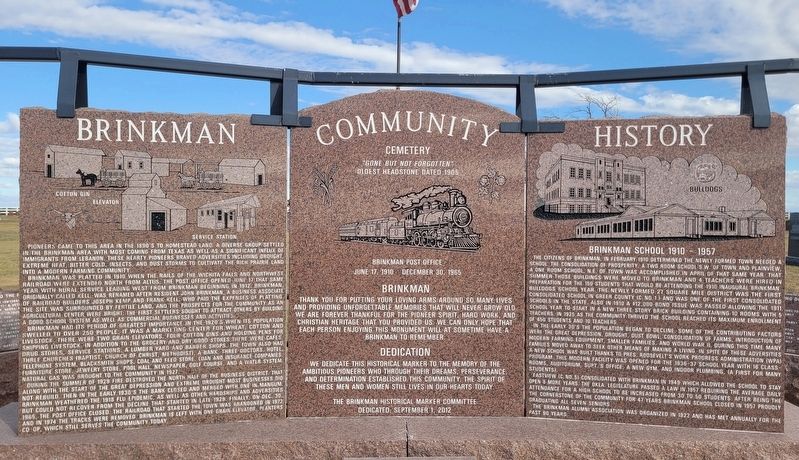
1. Brinkman Community History Marker
Brinkman was platted in 1910 when the rails of the Wichita Falls and Northwest Railroad were extended north from Altus. The post office opened June 17 that same year with rural service leading west from Brinkman beginning in 1912. Brinkman, originally called Kell, was renamed after resident John Brinkman, a business associate of railroad builders Joseph Kemp and Frank Kell, who paid the expenses of platting the site, was surrounded by fertile land, and the prospects for the community as an agricultural center were bright. The first settlers sought to attract others by building a good school system as well as commercial businesses and activities.
Brinkman had its period of greatest importance in the 1920's when its population swelled to over 250 people.
this page online
During the summer of 1929, fire destroyed the north half of the business district. That along with the start of the Great Depression and extreme drought, most businesses did not rebuild. Then in the early 1930's the bank closed and merged with one in Mangum. Brinkman weathered the 1918 flu epidemic, as well as other hardships and adversities but could not recover from the decline that started in late 1929. Finally, on Dec. 30, 1965, the post office closed. The railroad that started the town was abandoned in 1972 and in 1974 the tracks were
Photographed by James Hulse, October 28, 2025
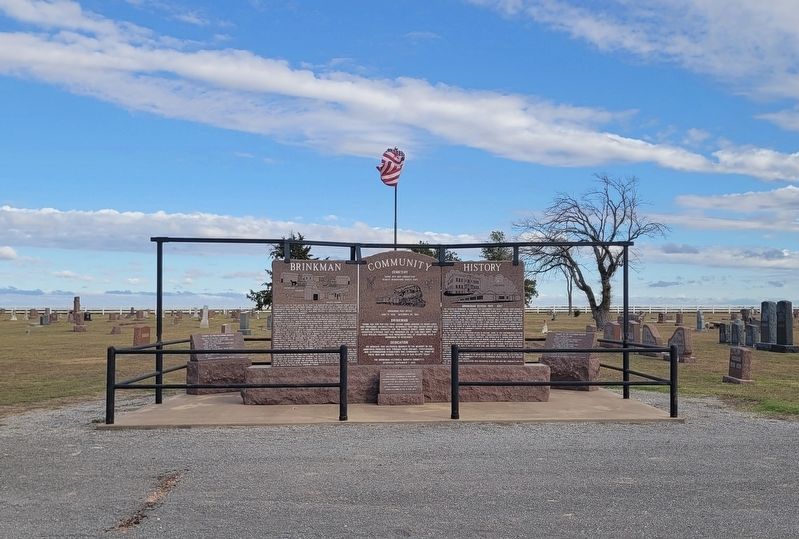
2. Brinkman Community History Marker
Brinkman School 1910 - 1957
The citizens of Brinkman, in February 1910 determined the newly formed town needed a school. The consolidation of Prosperity, a two room school S.W. of town and Plainview, a one room school, N.E. of town was accomplished in April of that same year. That summer those buildings were moved to Brinkman and 4 teachers were hired in preparation for the 150 students that would be attending the 1910 inaugural Brinkman Bulldogs school year. The newly formed 27 square mile district was the first consolidated school in Greer County (C. No. 1.) and was one of the first consolidated schools in the state. Also in 1910 a $12,000 bond issue was passed allowing the 1911 school year to start in a new three story brick building containing 10 rooms with 5 teachers. In 1925 as the community thrived the school reached its maximum enrollment of 450 students and 10 teachers.
In the early 30's the population began to decline. Some of the contributing factors were the Great Depression, drought, Dust Bowl, consolidation
Photographed by James Hulse, October 28, 2025
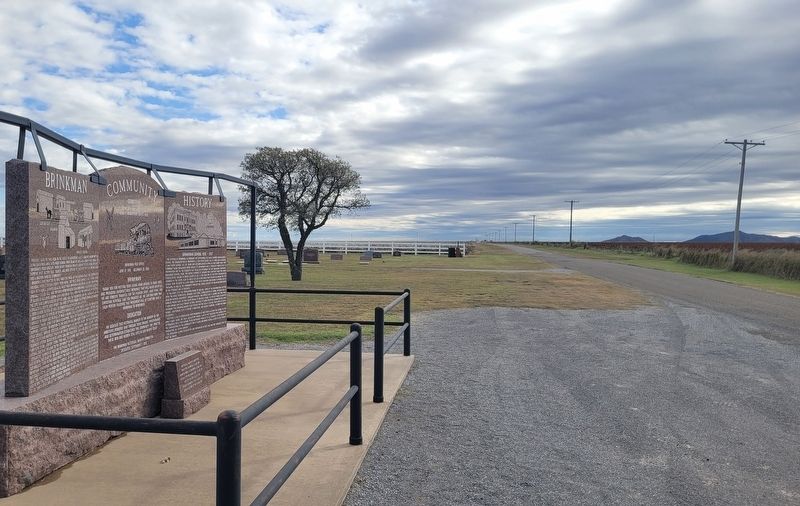
3. The view of the Brinkman Cemetery and marker along the cemetery fervent
Eastview (C. No. 5) consolidated with Brinkman in 1949 which allowed the school to stay open 8 more years. The Okla. Legislature passed a law in 1957 requiring the average daily attendance for a high school to be increased from 30 to 50 students. After being the cornerstone of the community for 47 years Brinkman School closed in 1957 proudly graduating all seven seniors.
The Brinkman Alumni Association was organized in 1922 and has met annually for the past 90 years.
Cemetery
"Gone But Not Forgotten"
Oldest Headstone Dated 1905
Brinkman Post Office
June 17, 1910 - December 30, 1965
Brinkman
Thank you for putting your loving arms around so many lives and providing
Photographed by James Hulse, October 28, 2025
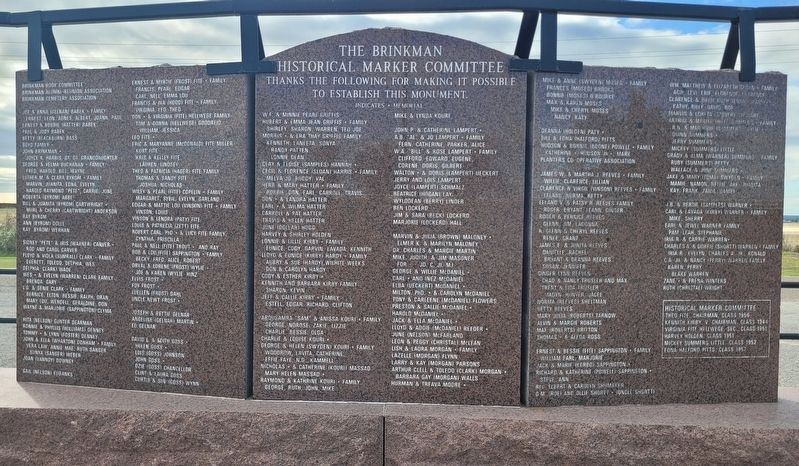
4. Brinkman Community History Marker - Reverse Side
Dedication
We dedicate this historical marker to the memory of the ambitious pioneers who through their dreams, perseverance, and determination established this community. The spirit of these men and women still lives in our hearts today.
Erected 2012 by Brinkman Historical Marker Committee.
Topics. This historical marker is listed in these topic lists: Agriculture • Education • Railroads & Streetcars • Settlements & Settlers. A significant historical month for this entry is February 1910.
Location. 35° 1.001′ N, 99° 30.596′ W. Marker is in Brinkman, Oklahoma, in Greer County. It is on East 1380 Road half a mile east of U.S. 287, on the right when traveling west. The marker is located at the entrance to the cemetery along the property line. Touch for map. Marker is at or near this postal address: E 1380 Rd, Willow OK 73673, United States of America. Touch for directions.

Regionally, this marker is in the Kiowa Tribe, in the Comanche Nation, and in Southwest Oklahoma—Great Plains Country. It is also in the American South, specifically on the prairies, and on the Southern Plains. Globally, it is in North America, the Western Hemisphere, the Western World, and the Anglosphere. Historically, it finds itself in what was once New Spain, the Comanchería, the territory of the Mississippian Culture, the Dust Bowl, and the Louisiana Purchase.
Other nearby markers. At least 8 other markers are within 10 miles of this marker, measured as the crow flies: First Shelterbelt in the United States (approx. one mile away); Lake Creek (approx. 5.6 miles away); Welcome to Comecos Cemetery (approx. 7.7 miles away); The 36th Infantry Division's 132nd Machine Gun Battalion (approx. 8.2 miles away); Granite Community Memorial (approx. 8.2 miles away); Edith Florence Kromer / Jewel Smoot Hood (approx. 9.9 miles away); William (Bill) Houston Pierson / Nancy Elizabeth Pierson (approx. 9.9 miles away); William Jones Petty / Charles Brown Overbey Sr. (approx. 9.9 miles away).
Credits. This page was last revised on November 20, 2025. It was originally submitted on November 17, 2025, by James Hulse of Medina, Texas. This page has been viewed 119 times since then and 75 times this year. Photos: 1, 2, 3. submitted on November 19, 2025, by James Hulse of Medina, Texas. 4. submitted on November 20, 2025, by James Hulse of Medina, Texas.
