St. James Farm in Warrenville in DuPage County, Illinois — The American Midwest (Great Lakes)
Dairy Operations
Photographed by Sean P. Flynn, November 14, 2025
1. Dairy Operations Marker
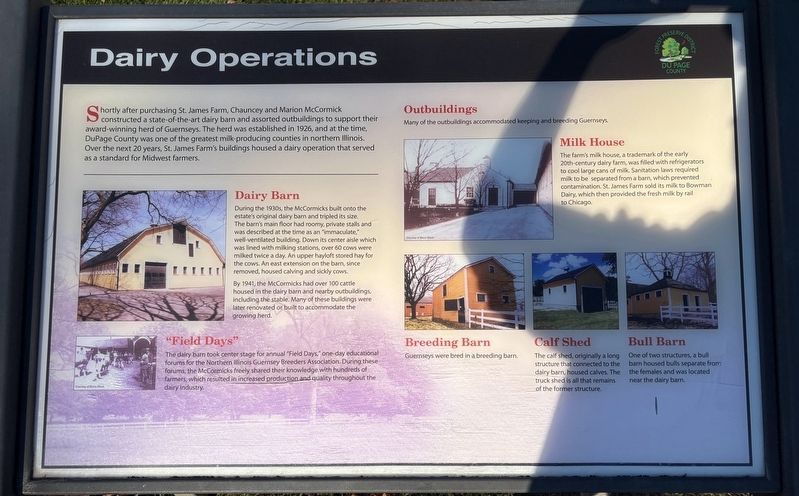
Dairy Barn
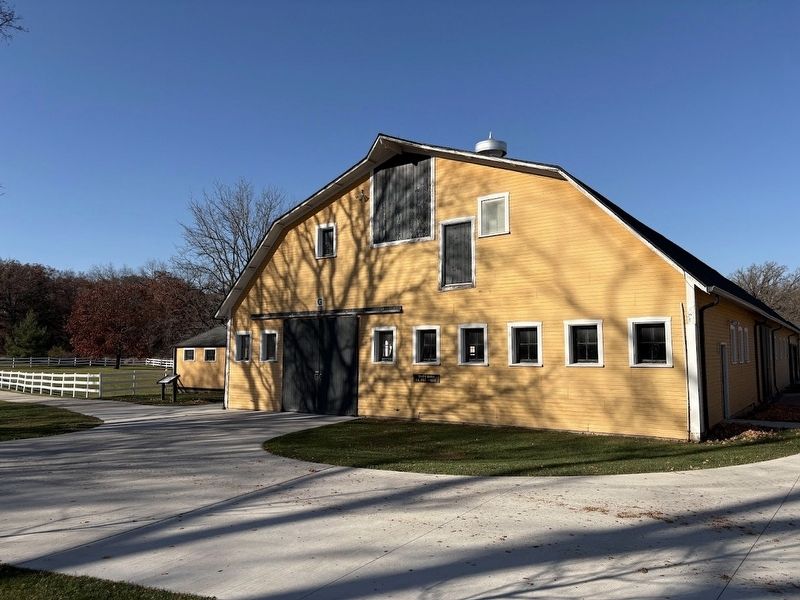
During the 1930s, the McCormicks built onto the estate's original dairy barn and tripled its size. The barn's main floor had roomy, private stalls and was described at the time as an "immaculate," well-ventilated building. Down its center aisle which was lined with milking stations, over 60 cows were milked twice a day. An upper hayloft stored hay for the cows. An east extension on the bam, since removed, housed calving and sickly cows.
By 1941, the McCormicks had over 100 cattle housed in the dairy barn and nearby outbuildings, including the stable. Many of these buildings were later renovated or built to accommodate the growing herd.
"Field Days"
The dairy barn
this page online
Outbuildings
Many of the outbuildings accommodated keeping and breeding Guernseys.
Milk House
The farm's milk house, a trademark of the early 20th-century dairy farm, was filled with refrigerators to cool large cans of milk. Sanitation laws required milk to be separated from a barn, which prevented contamination. St. James Farm sold its milk to Bowman Dairy, which then provided the fresh milk by rail to Chicago.
Breeding Barn
Guernseys were bred in a breeding barn.
Calf Shed
The calf shed, originally a long structure that connected to the dairy barn, housed calves. The truck shed is all that remains of the former structure.
Bull Barn
One of two structures, a bull barn housed bulls separate from the females and was located near the dairy barn.
Erected by Forest Preserve District of DuPage County.
Topics. This

Photographed by Sean P. Flynn, November 14, 2025
2. Dairy Operations Marker
Location. 41° 50.047′ N, 88° 9.698′ W. Marker is in Warrenville, Illinois, in DuPage County. It is in St. James Farm. It is on Winfield Road (at milepost 13) near Butterfield Road (Illinois Route 56). The marker is in St. James Farm Forest Preserve, near the dairy barns referenced in the text. Touch for map. Marker is at or near this postal address: 2S541 Winfield Road, Warrenville IL 60555, United States of America. Touch for directions.

Regionally, this marker is in Greater Chicago. It is also in the American Midwest. Globally, it is in North America, on the Great Lakes, in the Western Hemisphere, in the Western World, and in the Anglosphere. Historically, it finds itself in what was once the territory of the Mississippian Culture and also the Northwest Territory.
Other nearby markers. At least 8 other markers are within one mile of this marker, measured as the crow flies: A Love for Horses (within shouting distance of this marker); William Deering and Company Factory Doorway
Photographed by Sean P. Flynn, November 14, 2025
3. Dairy buildings at St. James Farm
Also see . . .
1. St. James Farm and McCormick’s Prized Guernseys. A reprint of a 1954 article in the Guernsey Breeders Journal.
Excerpt: "The name of Mr. and Mrs. Chauncey McCormick and St. James Farm are synonymous to the Guernsey breeders of Illinois. The great St. James Farm, through the influence and the interest of Mr. and Mrs. Chauncey McCormick, produced the great cow St. James Philosopher’s Dipper, grand champion at the National Dairy Show, at Memphis, in 1941, and junior champion at the National in 1940. Through the same interest and influence, also from St. James Farm came the immortal cow, remembered as St. James Philosopher’s Barbee, grand champion at the Dairy Cattle Congress, at Waterloo, in 1941, and again in 1942. Barbee is also the National Class Leader for production, with 1,055 lbs. butter fat at 11 years of age."(Submitted on November 20, 2025, by Sean P. Flynn of Oak Park, Illinois.)
2. History of Guernsey Cattle. An article on The Cattle Site about the Guernsey cow, which originated in the English Channel island of Guernsey.
Excerpt: "The Guernsey breed built its reputation for the production of quality milk from grass during the 19th and early 20th centuries and then exported cattle to found significant populations in several other countries. From an original mixed foundation, island breeders concentrated on improving the stock by eliminating faults and making their cattle more homogeneous. All this was based mainly on visual appearance supplemented by some milk recording."(Submitted on November 20, 2025, by Sean P. Flynn of Oak Park, Illinois.)
Credits. This page was last revised on November 20, 2025. It was originally submitted on November 20, 2025, by Sean P. Flynn of Oak Park, Illinois. This page has been viewed 73 times since then and 32 times this year. Photos: 1, 2, 3. submitted on November 20, 2025, by Sean P. Flynn of Oak Park, Illinois.
