Inglis in Riding Mountain West Municipality, Manitoba — Canada’s Prairie Region (North America)
Inglis Grain Elevators
Les Silos-Élévateurs d'Inglis
Photographed by Jimmy Emerson, 2013
1. Inglis Grain Elevators Marker

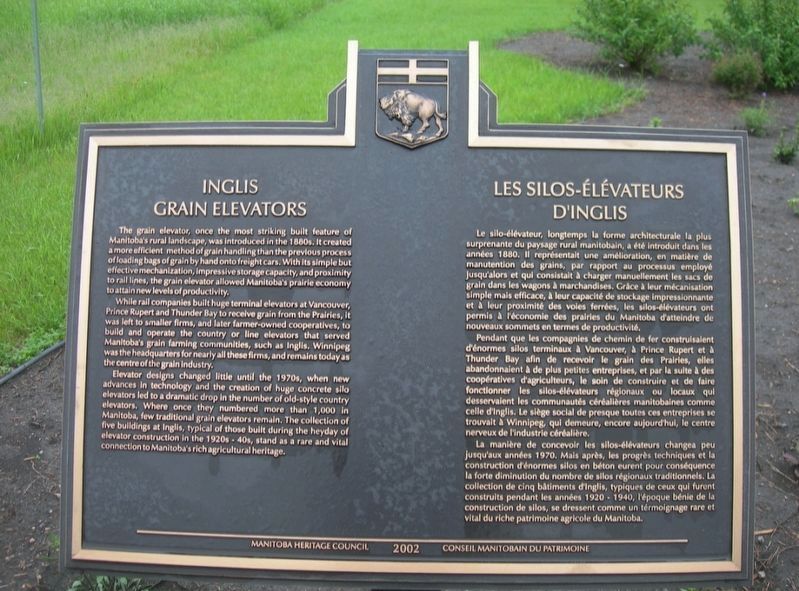
The grain elevator, once the most striking built feature of Manitoba's rural landscape, was introduced in the 1880s. It created a more efficient method of grain handling than the previous process of loading bags of grain by hand onto freight cars. With its simple but effective mechanization, impressive storage capacity, and proximity to rail lines, the grain elevator allowed Manitoba's prairie economy to attain new levels of productivity.
While rail companies built huge terminal elevators at Vancouver, Prince Rupert and Thunder Bay to receive grain from the Prairies, it was left to smaller firms, and later farmer-owned cooperatives, to build and operate the country or line elevators that served Manitoba's grain farming communities, such as Inglis. Winnipeg was the headquarters for nearly all these firms, and remains today as the centre of the grain industry.
Elevator designs changed little until the 1970s, when new advances in technology and the creation of huge concrete silo elevators led to a dramatic drop in the number of old-style country elevators. Where once they
this page online
Le silo-élévateur, longtemps la forme architecturale la plus surprenante du paysage rural manitobain, a été introduit dans les années 1880. Il représentait une amélioration, en matière de manutention des grains, par rapport au processus employé jusqu'alors et qui consistait à charger manuellement les sacs de grain dans les wagons à marchandises. Grâce à leur mécanisation simple mais efficace, à leur capacité de stockage impressionnante et à leur proximité des voies ferrées, les silos-élévateurs ont permis à l'économie des prairies du Manitoba d'atteindre de nouveaux sommets en termes de productivité.
Pendant que les compagnies de chemin de fer construisaient d'énormes silos terminaux à Vancouver, à Prince Rupert et à Thunder Bay afin de recevoir le grain des Prairies, elles abandonnaient à de plus
Photographed by Jimmy Emerson, 2013
2. Inglis Grain Elevators Marker
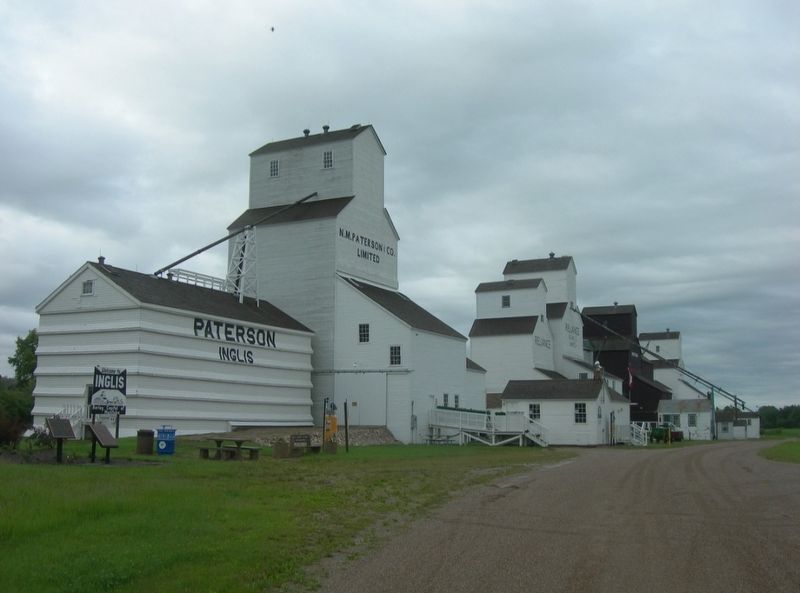
Markers are to the far left of the elevators
La manière de concevoir les silos-élévateurs changea peu jusqu'aux années 1970. Mais après, les progrès techniques et la construction d'énormes silos en béton eurent pour conséquence la forte diminution du nombre de silos régionaux traditionnels. La collection de cinq bâtiments d'Inglis, typiques de ceux qui furent construits pendant les années 1920-1940, l'époque bénie de la construction de silos, se dressent comme un térmoignage rare et vital du riche patrimoine agricole du Manitoba.
Erected 2002 by Manitoba Heritage Council.
Topics. This historical marker is listed in these topic lists: Agriculture • Architecture • Industry & Commerce. A significant historical year for this entry is 1920.
Location. 50° 56.698′ N, 101° 14.938′ W. Marker is in Inglis, Manitoba, in Riding Mountain West Municipality. It is on Anzac Avenue, on the right when traveling north. Touch for map. Marker is at or near this postal address: 121 Anzac Avenue, Inglis MB R0J 0X0, Canada. Touch for directions.

Regionally, this marker is in the Parkland Region. It is also in the Prairies. Globally, it is in North America, the Western Hemisphere, the Western World, and the Anglosphere. Historically, it finds itself in what was once a British colony, the Viceroyalty of New France, and Rupert’s Land.
Other nearby markers. At least 4 other markers are within 19 kilometers of this marker, measured as the crow flies: A different marker also named Inglis Grain Elevators (a few steps from this marker); Elevator Five - The Paterson Elevator (within shouting distance of this marker); The Reliance Grain Company - La Reliance Grain Company (within shouting distance of this marker); History of the Town of Russell (approx. 18.6 kilometers away).
Credits. This page was last revised on December 21, 2025. It was originally submitted on November 20, 2025, by Jimmy Emerson of Dalton, Georgia. This page has been viewed 50 times since then and 24 times this year. Photos: 1, 2. submitted on November 20, 2025, by Jimmy Emerson of Dalton, Georgia. • Andrew Ruppenstein was the editor who published this page.
