Izbat Al Bayyarah in Markaz Kom Ombo, Aswan Governorate, Egypt — مصر (Northeast Africa)
The Open-Air Courtyard
Photographed by James Hulse, October 12, 2024
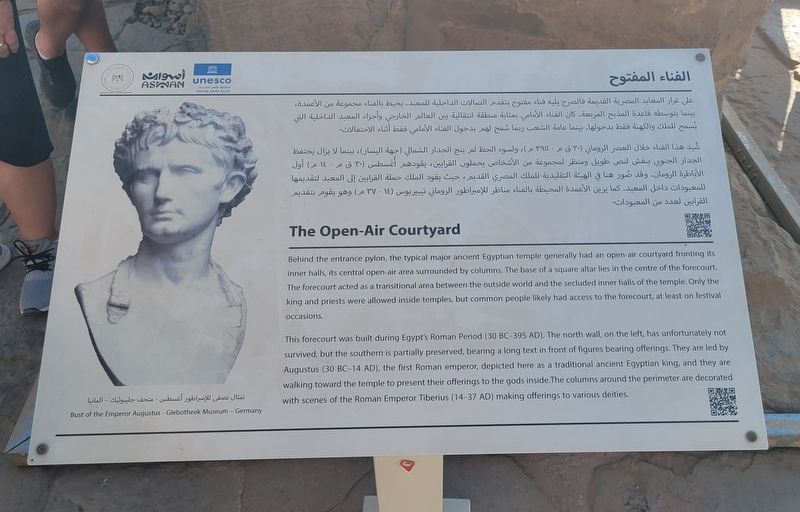
1. The Open-Air Courtyard Marker
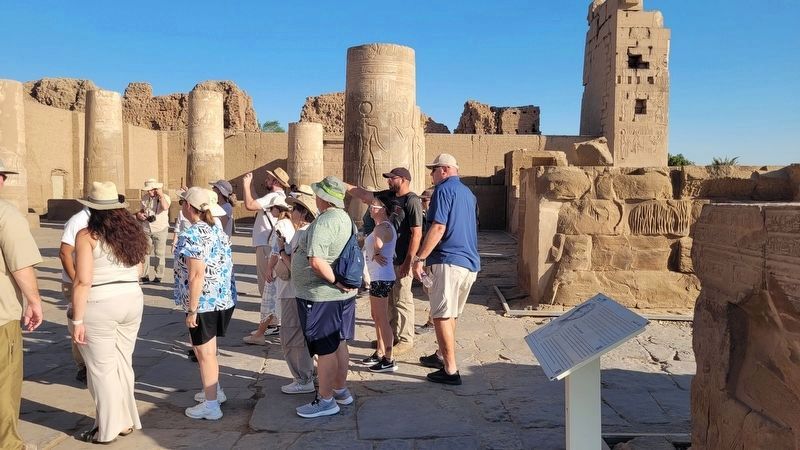
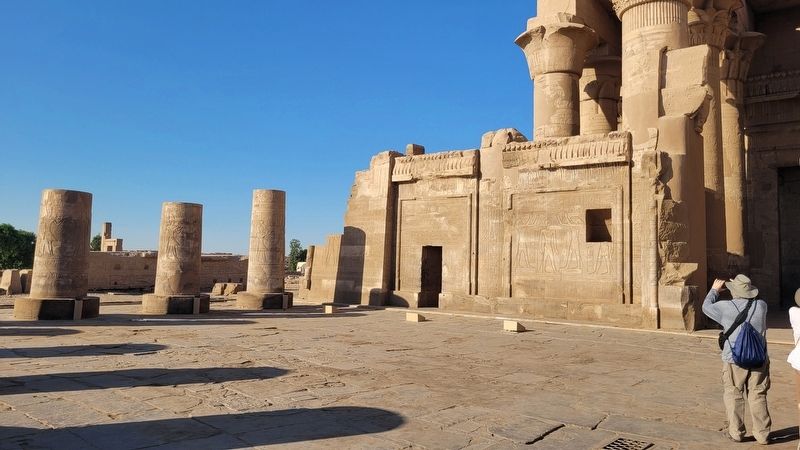
 Behind the entrance pylon, the typical major ancient Egyptian temple generally had an open-air courtyard fronting its inner halls, its central open-air area surrounded by columns. The base of a square altar lies in the centre of the forecourt. The forecourt acted as a transitional area between the outside world and the secluded inner halls of the temple. Only the king and priests were allowed inside temples, but common people likely had access to the forecourt, at least on festival occasions.
This forecourt was built during Egypt's Roman Period (30 BC-395 AD). The north wall, on the left, has unfortunately not survived, but the southern is partially preserved, bearing a long text in front of figures bearing offerings. They are led by Augustus (30 BC-14 AD), the first Roman emperor, depicted here as a traditional ancient Egyptian king, and they are walking toward the temple to present their offerings to the gods inside. The columns around the perimeter are decorated with scenes of the Roman Emperor Tiberius (14-37 AD) making offerings to various deities.
Captions
(Photo #1) Bust of the Emperor Augustus - Glebotheek Museum - Germany
الفناء المفتوح
على غرار المعابد المصرية القديمة فالصرح يليه فناء مفتوح يتقدم الصالات الداخلية للمعبد. يحيط بالفناء مجموعة من الأعمدة بينما يتوسطه قاعدة المذبح المربعة. كان الفناء الأمامي بمثابة منطقة انتقالية بين العالم الخارجي وأجزاء المعبد الداخلية التي يسمح للملك والكهنة فقط بدخولها بينما عامة الشعب ربما سمح لهم بدخول الفناء الأمامي فقط أثناء الاحتفالات.
شيد هذا الفناء خلال العصر الروماني (۳۰) ق م - ٣٩٥ م ) ، ولسوء الحظ لم ينج الجدار الشمالي (جهة اليسار)، بينما لا يزال يحتفظ الجدار الجنوبي بنقش لنص طويل ومنظر المجموعة من الأشخاص يحملون القرابين، يقودهم أغسطس (۳۰) ق م - ١٤ م) أول الأباطرة الرومان. وقد صور هنا في الهيئة التقليدية للملك المصري القديم، حيث يقود الملك حملة القرابين إلى المعبد لتقديمها للمعبودات داخل المعبد. كما يزين الأعمدة المحيطة بالفناء مناظر للإمبراطور الروماني تيبيريوس (١٤) - ۳۷) م ) وهو يقوم بتقديم القرابين لعدد من المعبودات.
(1) تمثال نصفى للإمبراطور أغسطس - متحف جليبوثيك - المانيا
Erected by Ministry of Tourism & Antiquity, Aswan and unesco.
Topics. This historical marker is listed in this topic list: Anthropology & Archaeology. A significant historical year for this entry is 30 BCE.
Location. 24° 27.109′ N, 32° 55.688′ E. Marker is in Izbat Al Bayyarah, Aswan Governorate, in Markaz Kom Ombo. It is on Tariaq Bedon Esm. The marker is located on the grounds of the Kom Ombo Temple. Touch for map. Marker is at or near this postal address: Tariaq Bedon Esm, Izbat Al Bayyarah, Aswan Governorate 12813-01, Egypt. Touch for directions.

Regionally, it is in Africa, specifically in North Africa, in the Middle East, on the Red Sea, and in a coastal Mediterranean country. Historically, it finds itself in what was once the Byzantine Empire, the Ottoman Empire, a British colony, and the Roman Empire.
Other nearby markers. At least 8 other markers are within walking distance of this marker: The Temple of Ombos / Le temple d’Ombos (a few steps from this marker); Outer Hypostyle Hall (a few steps from this marker); Birth House / بيت الولادة (within shouting distance of this marker); Kom Ombo Temple / معبد كوم امبو (within shouting distance of this marker); Inner Hypostyle Hall (within shouting distance of this marker); Chapel of Hathor / مقصورة حتحور (within shouting distance of this marker); Gate and Pylon (within shouting distance of this marker); Inner Halls and Twin Sanctuaries
this page online
Also see . . . Temple of Kom Ombo. Wikipedia
The building is unique because its 'double' design meant that there were courts, halls, sanctuaries and rooms duplicated for two sets of gods. The southern half of the temple was dedicated to the crocodile god Sobek, god of fertility and creator of the world with Hathor and Khonsu. Meanwhile, the northern part of the temple was dedicated to the falcon god Haroeris ("Horus the Elder"), along "with Tasenetnofret (the Good Sister, a special form of Hathor or Tefnut) and Panebtawy (Lord of the Two Lands)". The temple is atypical because everything is perfectly symmetrical along the main axis.(Submitted on November 24, 2025, by James Hulse of Medina, Texas.)
Photographed by James Hulse, October 12, 2024
2. The Open-Air Courtyard and Marker
Photographed by James Hulse, October 12, 2024
3. The Open-Air Courtyard
Photographed by James Hulse, October 12, 2024
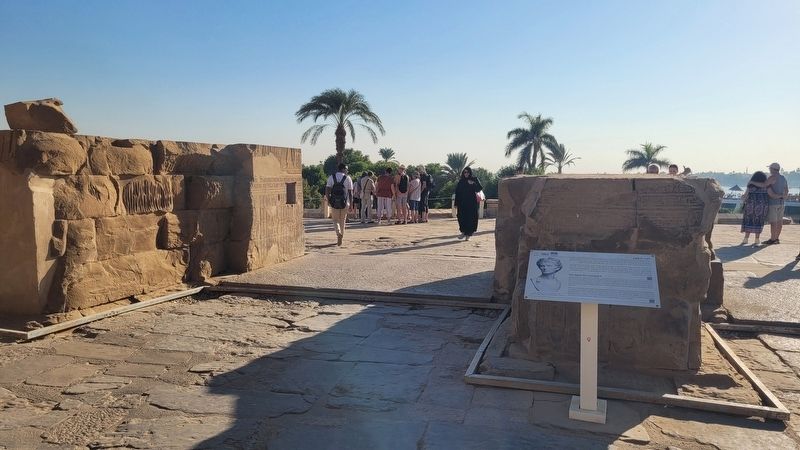
4. The view of the Open-Air Courtyard marker with the Nile River in the background
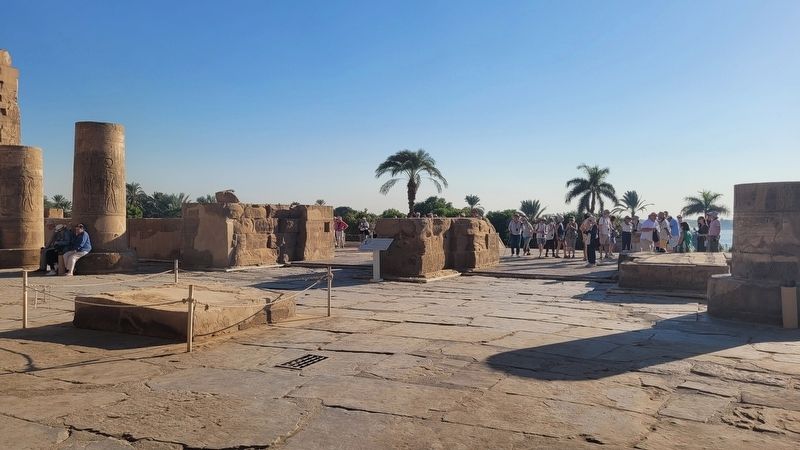
Photographed by James Hulse, October 12, 2024
5. The Open-Air Courtyard and Marker
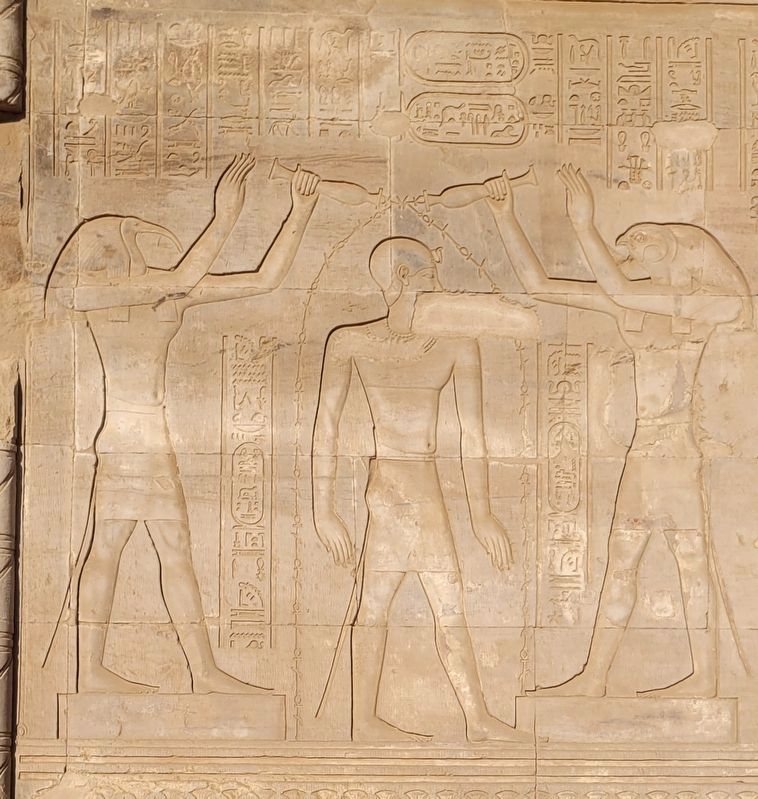
Photographed by James Hulse, October 12, 2024
6. The gods Thoth and Horus performing a ritual on a pharaoh
Credits. This page was last revised on November 24, 2025. It was originally submitted on November 21, 2025, by James Hulse of Medina, Texas. This page has been viewed 68 times since then and 43 times this year. Photos: 1, 2, 3, 4, 5, 6. submitted on November 24, 2025, by James Hulse of Medina, Texas.
