Izbat Al Bayyarah in Markaz Kom Ombo, Aswan Governorate, Egypt — مصر (Northeast Africa)
Outer Hypostyle Hall
Photographed by James Hulse, October 12, 2024
1. Outer Hypostyle Hall Marker
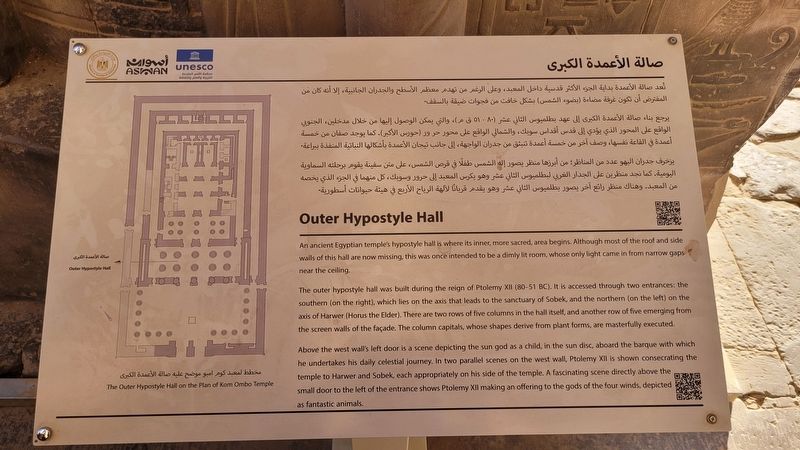
 An ancient Egyptian temple's hypostyle hall is where its inner, more sacred, area begins. Although most of the roof and side walls of this hall are now missing, this was once intended to be a dimly lit room, whose only light came in from narrow gaps near the ceiling.
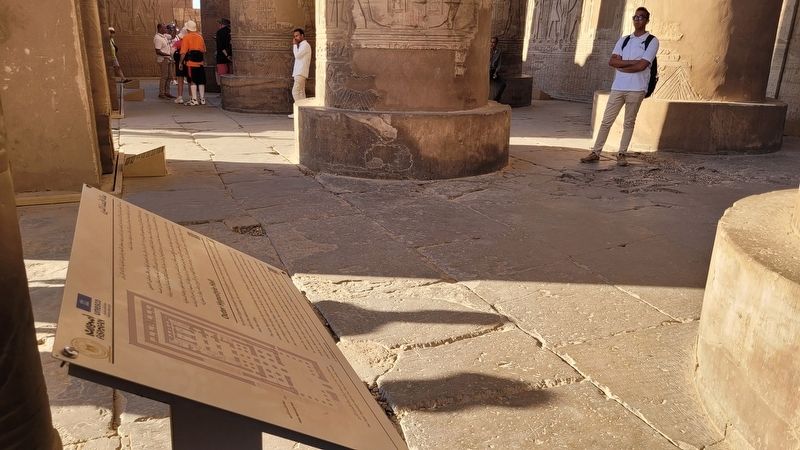
The outer hypostyle hall was built during the reign of Ptolemy XII (80-51 BC). It is accessed through two entrances: the southern (on the right), which lies on the axis that leads to the sanctuary of Sobek, and the northern (on the left) on the axis of Harwer (Horus the Elder). There are two rows of five columns in the hall itself, and another row of five emerging from the screen walls of the façade. The column capitals, whose shapes derive from plant forms, are masterfully executed.
Above the west wall's left door is a scene depicting the sun god as a child, in the sun disc, aboard the barque with which he undertakes his daily celestial journey. In two parallel scenes on the west wall, Ptolemy XII is shown consecrating the temple to Harwer and Sobek, each appropriately on his side of the temple. A fascinating scene directly above the small door to the left of the entrance shows Ptolemy XII making an offering to the gods of the four winds, depicted as fantastic animals.
Captions
(Photo #1) The Outer Hypostyle Hall on the Plan of Kom Ombo Temple
صالة الأعمدة الكبرى
تعد صالة الأعمدة بداية الجزء الأكثر قدسية داخل المعبد، وعلى الرغم من تهدم معظم الأسطح والجدران الجانبية، إلا أنه كان من المفترض أن تكون غرفة مضاءة بضوء الشمس بشكل خافت من فجوات ضيقة بالسقف.
يرجع بناء صالة الأعمدة الكبرى إلى عهد بطلميوس الثاني عشر (۸۰ - ۵۱) ق م ) ، والتي يمكن الوصول إليها من خلال مدخلين الجنوبي الواقع على المحور الذي يؤدي إلى قدس أقداس سويك، والشمالي الواقع على محور حر ور حورس الأكبر). كما يوجد صفان من خمسة أعمدة في القاعة نفسها، وصف آخر من خمسة أعمدة تنبثق من جدران الواجهة، إلى جانب تيجان الأعمدة بأشكالها النباتية المنفذة ببراعة.
يزخرف جدران البهو عدد من المناظر من أبرزها منظر يصور إله الشمس طفلا في قرص الشمس، على متن سفينة يقوم برحلته السماوية اليومية. كما نجد منظرين على الجدار الغربي لبطلميوس الثاني عشر وهو يكرس المعبد إلى حرور وسوبك، كل منهما في الجزء الذي يخصه من المعبد. وهناك منظر رائع آخر يصور بطلميوس الثاني عشر وهو يقدم قرباناً لآلهة الرياح الأربع في هيئة حيوانات أسطورية.
(1) مخطط لمعبد كوم امبو موضح عليه صالة الأعمدة الكبرى
Erected by Ministry of Tourism & Antiquity, Aswan and unesco.
Topics. This historical marker is listed in this topic list: Anthropology & Archaeology. A significant historical year for this entry is 80 BCE.
Location. 24° 27.117′ N, 32° 55.698′ E. Marker is in Izbat Al Bayyarah, Aswan Governorate, in Markaz Kom Ombo. It is on Tariaq Bedon Esm. The marker is located on the grounds of the Kom Ombo Temple. Touch for map. Marker is in this post office area: Izbat Al Bayyarah, Aswan Governorate 12813-01, Egypt. Touch for directions.

Regionally, it is in Africa, specifically in North Africa, in the Middle East, on the Red Sea, and in a coastal Mediterranean country. Historically, it finds itself in what was once the Byzantine Empire, the Ottoman Empire, a British colony, and the Roman Empire.
Other nearby markers. At least 8 other markers are within walking distance of this marker: The Temple of Ombos / Le temple d’Ombos (here, next to this marker); Inner Hypostyle Hall (a few steps from this marker); The Open-Air Courtyard
this page online
Also see . . . Temple of Kom Ombo. Wikipedia
The building is unique because its 'double' design meant that there were courts, halls, sanctuaries and rooms duplicated for two sets of gods. The southern half of the temple was dedicated to the crocodile god Sobek, god of fertility and creator of the world with Hathor and Khonsu. Meanwhile, the northern part of the temple was dedicated to the falcon god Haroeris ("Horus the Elder"), along "with Tasenetnofret (the Good Sister, a special form of Hathor or Tefnut) and Panebtawy (Lord of the Two Lands)". The temple is atypical because everything is perfectly symmetrical along the main axis.(Submitted on November 24, 2025, by James Hulse of Medina, Texas.)
Photographed by James Hulse, October 12, 2024
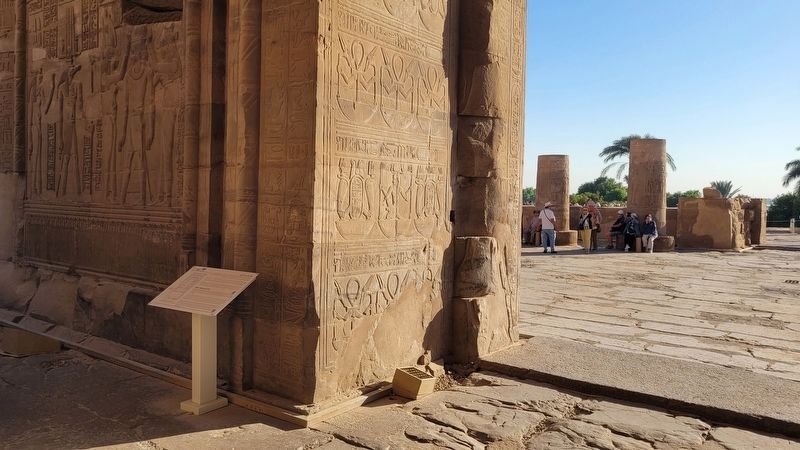
2. Outer Hypostyle Hall Marker
Photographed by James Hulse, October 12, 2024
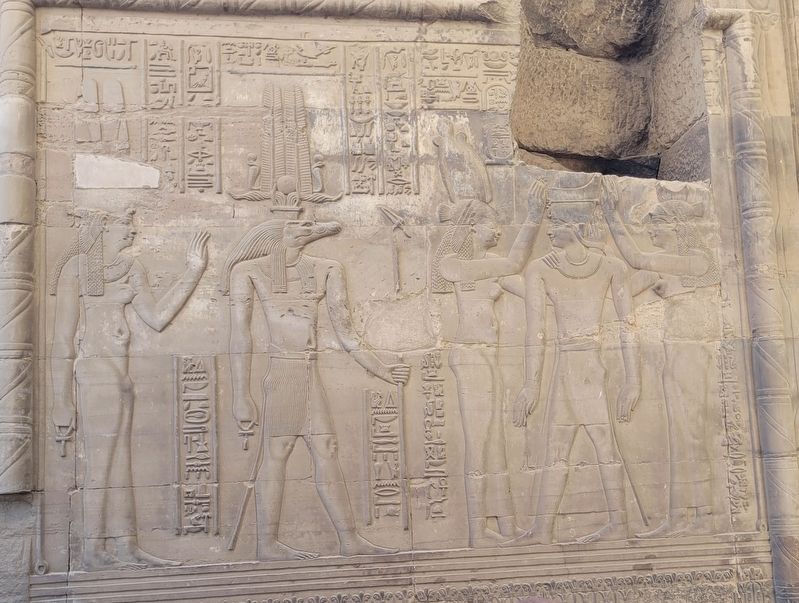
3. Relief showing the crocodile god Sobek watching as the pharaoh is crowned
Photographed by James Hulse, October 12, 2024
4. The columns of the Outer Hypostyle Hall and Marker
Credits. This page was last revised on November 29, 2025. It was originally submitted on November 21, 2025, by James Hulse of Medina, Texas. This page has been viewed 59 times since then and 30 times this year. Photos: 1, 2, 3, 4. submitted on November 29, 2025, by James Hulse of Medina, Texas.
