Lower Brule in Lyman County, South Dakota — The American Midwest (Upper Plains)
Kul Wicasa Oyate
Lower Brule Sioux Tribe
Photographed by Barry Swackhamer, July 19, 2025
1. Kul Wicasa Oyate Marker
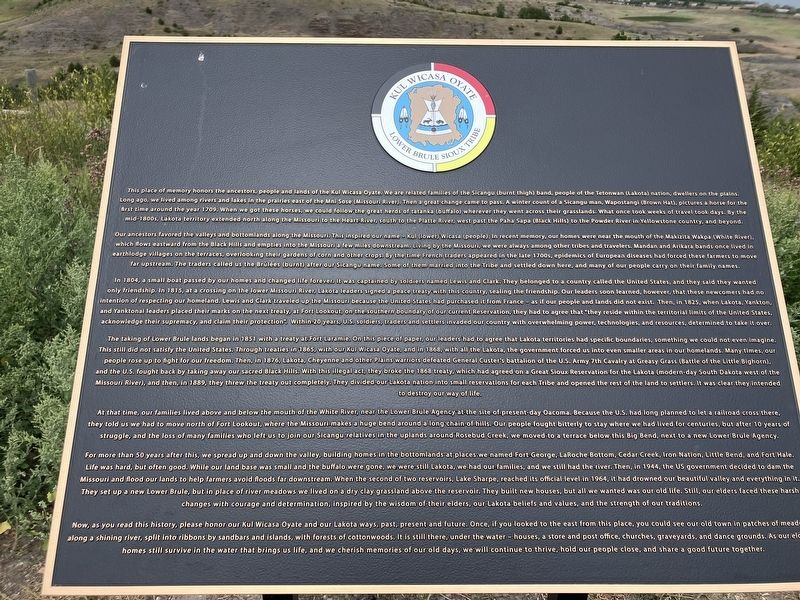
Our ancestors favored the valleys and bottomlands along the Missouri. This inspired our name - Kul (lower) Wicasa (people). In recent memory, our homes were near the mouth of the Makizita Wakpa (White River), which flows eastward from the Black Hills, and empties into the Missouri a few miles downstream.
this page online
In 1804, a small boat passed by our homes and changed life forever. It was captained by soldiers named Lewis and Clark. They belonged to a country called the United States, and they said they wanted only friendship. In 1815, at a crossing on the lower Missouri River, Lakota leaders signed a peace treaty with this country, sealing the friendship. Our leaders soon learned, however. that these newcomers had no intention of respecting our homeland. Lewis and Clark traveled up the Missouri because the United States had purchased it from France - as if our people and lands did not exist. Then, in 1825, when Lakota, Yankton, and Yanktonai
Photographed by Barry Swackhamer, July 19, 2025
2. Kul Wicasa Oyate Marker
The taking of Lower Brule lands began in 1851 with a treaty at Fort Laramie. On this piece of paper, our leaders had to agree that Lakota territories has specific boundaries, something we could not even imagine. This still did not satisfy the United States. Through treaties in 1865, with our Kul Wicasa Oyate, and in 1868, with all Lakota, the government forced us into even smaller areas in our homelands. Many times, our people rose up to fight for our freedom. Then, in 1876, Lakota, Cheyenne and other Plains warriors defeated General Custer's battalion of the U.S. Army 7th Cavalry at Greasy Grass (Battle of the Little Bighorn), and the U.S. fought back by takin away our sacred Black Hills. With this illegal act, they
Photographed by Barry Swackhamer, July 19, 2025
3. Kul Wicasa Oyate Marker
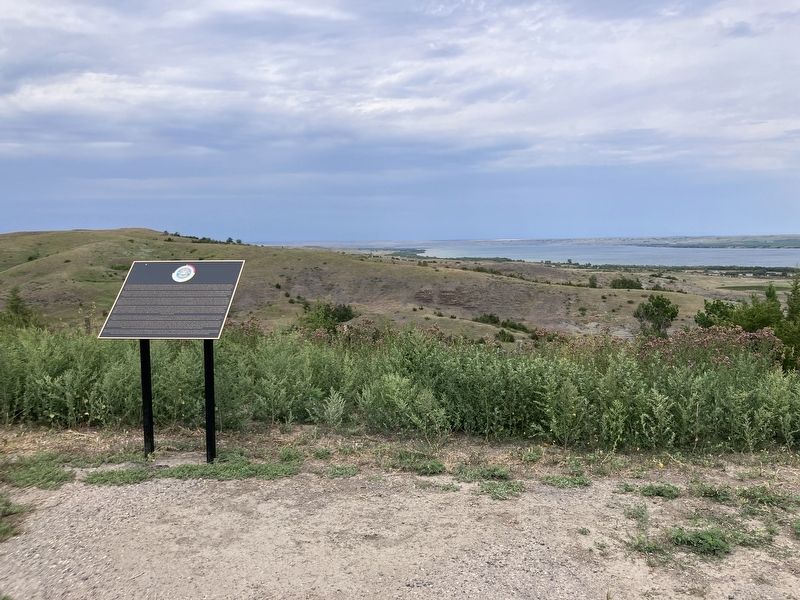
At that time, our families lived above and below the the mouth of the White River, near the Lower Brule Agency at the site of present-day Oacoma. Because the U.S. had long planned to let a railroad cross there, they told us we had to move north of Fort Lookout, where the Missouri makes a huge bend around a long chain of hills. Our people fought bitterly to stay where we had lived for centuries, but after 10 years of struggle, and the loss of many families who left us to join our Sicangu relatives in the uplands around Rosebud Creek, we moved to a terrace below this Big Bend, next to a new Lower Brule Agency .
For more than 50 years after this, we spread up and down the valley, building homes in the bottomland at places we name Fort George, LaRoche Bottom, Cedar Creek, Iron Nation, Little Bend, and Fort Hale. Life was hard, but often good. While our land base was small and the buffalo were gone, be were still Lakota, and we still had the river. Then, in 1944, the US government decided to dam the Missouri and flood our lands to help farmers avoid floods far downstream. When the second of two reservoirs, Lake Sharpe, reached its official level in 1964, it drowned our beautiful valley and everything in it. They set up a new Lower Brule, but in place of river meadows we lived on a dry clay grassland above the reserver. They built new houses, but all we wanted was our old life. Still, our elders faced these harsh changes with courage and determination, inspired by the wisdom of their elders, our Lakota beliefs and values, and the strength of our traditions.
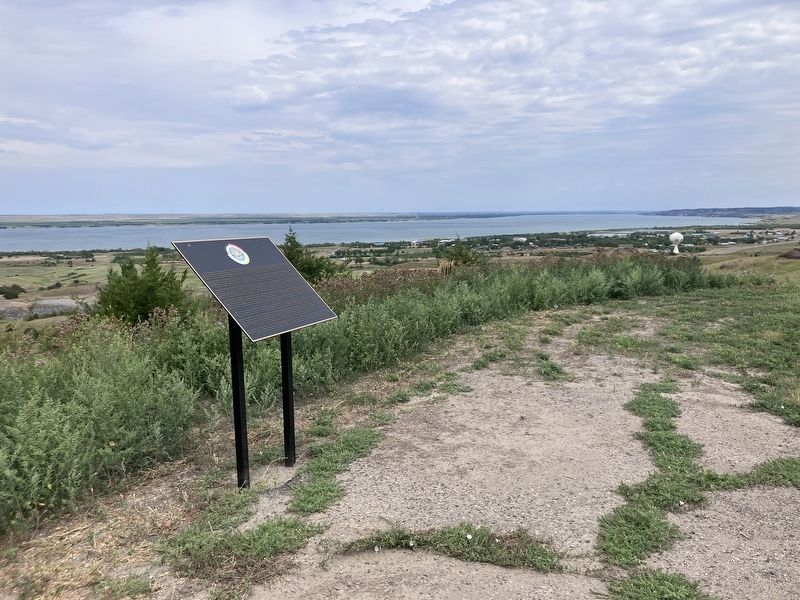
Now, as you read this history, please honor our Kul Wicasa Oyate and our Lakota ways, past, present and future. Once, it you looked to the east from this place, you could see our old town in patches of meadow along a shining river, split into ribbons by sandbars and islands, with forest of cottonwoods. It is still there, under the water - houses, a store and post office, churches. graveyards and dance grounds. As our elders' homes still survive in the water that brings us life, and we cherish memories of our old day, we will continue to thrive, hold our people close, and share a good future together.
Erected by Lower Brule Sioux Tribe.
Topics. This historical marker is listed in these topic lists: Indigenous Peoples and Communities • Settlements & Settlers.
Location. 44° 4.632′ N, 99° 36.069′ W. Marker is in Lower Brule, South Dakota, in Lyman County. It is on Bureau of Indian Affairs (B.I.A.) Route 10 near 22nd Avenue, on the left when traveling east. Touch for map. Marker is in this post office area: Lower Brule SD 57548, United States of America. Touch for directions.

Regionally, this marker is in the Lower Brule Sioux Tribe and in East River. It is also in the American Lewis & Clark Corridor, on the prairies, and on the Northern Plains. Globally, it is in North America, the Western Hemisphere, the Western World, and the Anglosphere. Historically, it finds itself in what was once Rupert’s Land and also the Louisiana Purchase.
Other nearby markers. At least 5 other markers are within 8 miles of this marker, measured as the crow flies: Head Chief Solomon Iron Nation (approx. 7 miles away); The Lower Brule Sioux Reservation (approx. 7.3 miles away); Spirit of the Circle Monument Stone (approx. 7.3 miles away); The Spirit of the Circle Monument (approx. 7.3 miles away); The Crow Creek Reservation (approx. 7.3 miles away).
Credits. This page was last revised on November 21, 2025. It was originally submitted on November 21, 2025, by Barry Swackhamer of Brentwood, California. This page has been viewed 75 times since then and 38 times this year. Photos: 1, 2, 3. submitted on November 21, 2025, by Barry Swackhamer of Brentwood, California.
