Montmartre in Paris in Département de Paris, Île-de-France, France — Western Europe
Cimetière Montmartre (1825)

Photographed by Andrew Ruppenstein, April 7, 2025
1. Cimetière Montmartre Marker

Ce cimetière constitue un important refuge urbain pour la faune et la flore sauvages favorisées par l'arrêt de l'utilisation de désherbants chimiques depuis 2015.
The Montmartre Cemetery was established on the site of a former burial ground, known as the Champ du Repos (“Field of Repose”). This ground, opened in 1798 on abandoned gypsum quarries, quickly became overcrowded. Extensive leveling and expansion work was carried out during the Restoration period. It then became the third largest cemetery in Paris (10.48 hectares) after Père Lachaise and Montparnasse. Nestled on the slopes of Montmartre, it offers a remarkable view of the capital along its 20-meter incline. 21,500 graves are gathered there in the shade of nearly 800 trees and the Caulaincourt Bridge, a distinction it has held since 1888.
This cemetery constitutes an important urban refuge for wild fauna and flora, a benefit fostered by the cessation of the use of chemical herbicides since 2015.
Erected by Ville de Paris.
Topics and series. This historical marker is listed in this topic list: Cemeteries & Burial Sites. In addition, it is included in the Parks and Squares of Paris
this page online
Location. 48° 53.123′ N, 2° 19.861′ E. Marker is in Paris, Île-de-France, in Département de Paris. It is in Montmartre. It is on Avenue Rachel, on the left when traveling north. Touch for map. Marker is in this post office area: Paris, Île-de-France 75018, France. Touch for directions.

Regionally, it is in the North Atlantic Region, Europe, the European Union, Atlantic Europe, the Schengen Area, Western Europe, a coastal Mediterranean country, and the Western World. Historically, it finds itself in what was once a French colony and also the Roman Empire.
Other nearby markers. At least 8 other markers are within walking distance of this marker: Le cimetiere Montmartre (a few steps from this marker); Le Gaumont-Palace illuminé la nuit (about 120 meters away, measured in a direct line); L’Hippo-Palace (about 120 meters away); Bernard-Marie Koltès (about 120 meters away); Raymond Souplex (about 120 meters away); Le boulevard de Clichy sous le neige (about 150 meters away); Copi (about 150 meters away); L’hôtel du comte d’Escalopier / Count Escalopier’s Mansion (about

Photographed by Andrew Ruppenstein, April 7, 2025
2. Cimetière Montmartre Marker - wide view
The marker is visible here to the left of the entrance gate.
Also see . . . Montmartre Cemetery (Wikipedia). Excerpt:
In the mid-18th century, overcrowding in the cemeteries of Paris had created numerous problems, from impossibly high funeral costs to unsanitary living conditions in the surrounding neighborhoods. In the 1780s, the Cimetière des Innocents was officially closed and citizens were banned from burying corpses within the city limits of Paris. During the early 19th century, new cemeteries were constructed outside the precincts of the capital: Montmartre in the north, Père Lachaise Cemetery in the east, Passy Cemetery in the west and Montparnasse Cemetery in the south.(Submitted on November 22, 2025.)
The Montmartre Cemetery was opened on 1 January 1825. It was initially known as le Cimetière des Grandes Carrières (Cemetery of the Large Quarries). The name referenced the cemetery's unique location, in an abandoned gypsum quarry. The quarry had previously been used during the French Revolution as a mass grave. It was built below street level, in the hollow of an abandoned gypsum quarry located west of the Butte near the beginning ofRue Caulaincourt in Place de Clichy. As is still the case today, its sole entrance was constructed on Avenue Rachel under Rue Caulaincourt.circa 19053. Cimetière Montmartre entrance ca. 1905
A popular tourist destination, Montmartre Cemetery is the final resting place of many famous artists who lived and worked in the Montmartre area.
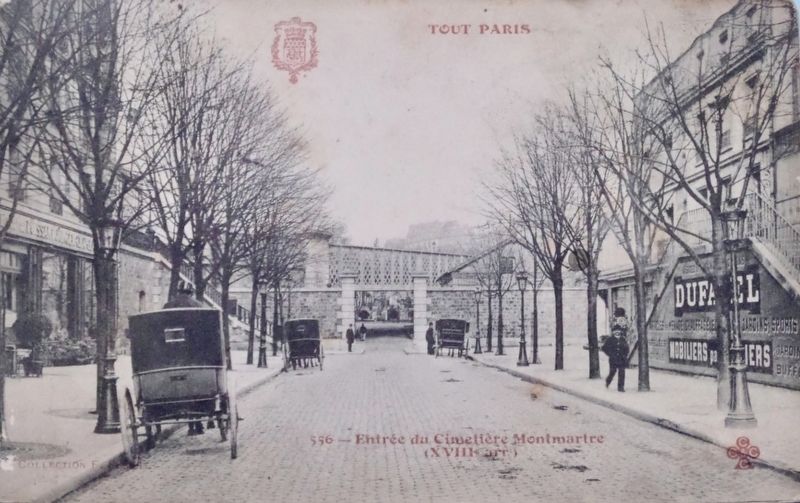

Photographed by A.f., circa 1905
4. Caulaincourt Bridge and the Cimetière Montmartre (looking north)
The cemetery entrance and marker would be in the lower right corner, just out of the picture. Visible in the background are the Moulin de la Galette (left) and the Basilique du Sacré-Cœur de Montmartre (right).
Credits. This page was last revised on November 22, 2025. It was originally submitted on November 22, 2025, by Andrew Ruppenstein of Lamorinda, California. This page has been viewed 122 times since then and 71 times this year. Photos: 1, 2. submitted on November 22, 2025, by Andrew Ruppenstein of Lamorinda, California. 3. submitted on November 22, 2025. 4. submitted on November 22, 2025, by Andrew Ruppenstein of Lamorinda, California.
