Greenfield in Hancock County, Indiana — The American Midwest (Great Lakes)
Historic National Road
⎯⎯⎯
Make History, Drive It
The Road that Built the Nation
Photographed by Duane and Tracy Marsteller, November 2, 2025
1. Historic National Road side of marker
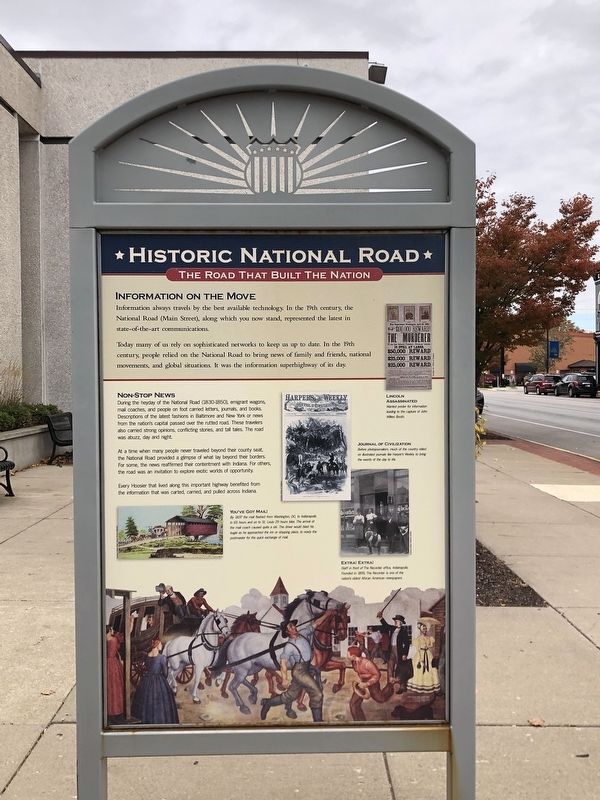
Information always travels by the best available technology. In the 19th century, the National Road (Main Street, along which you now stand, represented the latest in state-of-the-art communications.
Today many of us rely on sophisticated networks to keep us up to date. In the 19th century people relied on the National Road to bring news of family and friends, national movements, and global situations. It was the information superhighway of its day.
Non-Stop News
During the heyday of the National Road (1830-1850), emigrant wagons, mail coaches, and people on foot carried letters, journals, and books. Descriptions of the latest fashions in Baltimore and New York or news from the nation's capital passed over the rutted road. These travelers also carried strong opinions, conflicting stories, and tall tales. The road was abuzz, day and night.
At a time when many people never traveled beyond their county seat, the National Road provided a glimpse of what lay beyond their borders. For some, the news reaffirmed their contentment with Indiana. For others, the road was an
this page online
Every Hoosier that lived along this important highway benefited from the information that was carted, carried, and pulled across Indiana.
[Captions:]
Lincoln Assassinated
Wanted poster for information leading to the capture of John Wilkes Booth.
Journal of Civilization
Before photojournalism, much of the country relied on illustrated journals like Harper's Weekly to bring the events of the day to life.
You've Got Mail!
By 1837 the mail flashed from Washington, DC, to Indianapolis in 65 hours and on to St. Louis 29 hours later. The arrival of the mail coach caused quite a stir. The driver would blast his bugle as he approached the inn or stopping place, to ready the postmaster for the quick exchange of mail.
Extra! Extra!
Staff in front of The Recorder office, Indianapolis. Founded in 1895, The Recorder is one of the nation's oldest African American newspapers.
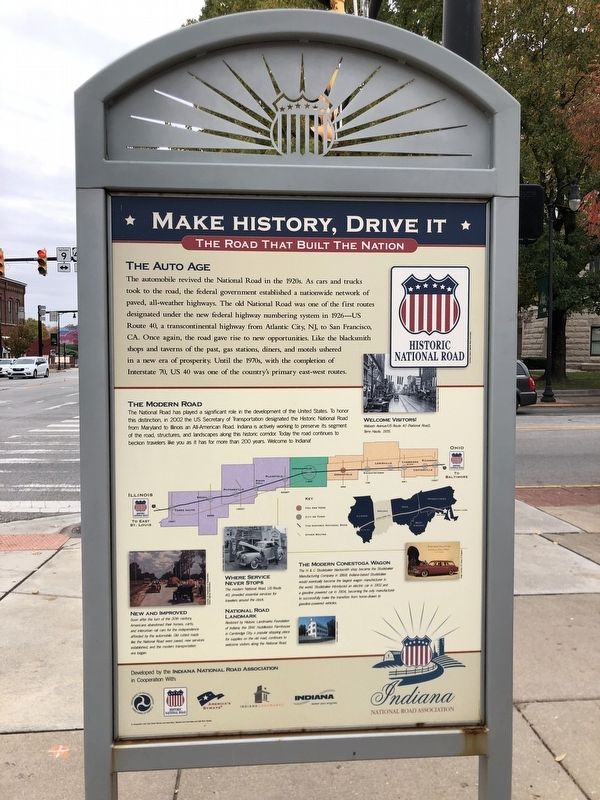
The automobile revived the National Road in the 1920s. As cars and trucks took to the road, the federal government established a nationwide network of paved, all-weather
Photographed by Duane and Tracy Marsteller, November 2, 2025
2. Make History, Drive It side of marker
The Modern Road
The National Road has played a significant role in the development of the United States. To honor this distinction, in 2002 the US Secretary of Transportation designated the Historic National Road from Maryland to Illinois an All-American Road. Indiana is actively working to preserve its segment of the road, structures, and landscapes along this historic corridor. Today the road continues to beckon travelers like you as it has for more than 200 years. Welcome to Indiana!
[Captions:]
Welcome Visitor!
Wabash Avenue/US Route 40 (National Road), Terre Haute, 1935.
New and Improved
Soon after the turn of the 20th century, Americans abandoned their horses, carts, and interurban rail cars for the independence afforded by the automobile. Old rutted roads like the National Road were paved, new services established, and the modern transportation era began.
Where Service Never Stops
The modern National Road, US Route 40, provided essential services for travelers around the clock.
National road Landmark
Restored by Historic Landmarks Foundation of Indiana, the 1841 Huddleston Farmhouse in Cambridge City, a popular stopping place for supplies on the old road, continues to welcome visitors along the National Road.
The Modern Conestoga Wagon
The H & C Studebaker blacksmith shop became the Studebaker Manufacturing Company in 1868. Indiana-based Studebaker would eventually become the largest wagon manufacturer in the world. Studebaker introduced an electric car in 1902 and gasoline powered car in 1904, becoming the only manufacturer to successfully make the transition from horse-drawn to gasoline-powered vehicles.
Erected by Indiana
Photographed by Duane and Tracy Marsteller, November 2, 2025
3. Historic National Road / Make History, Drive It Marker
Topics and series. This historical marker is listed in these topic lists: Communications • Industry & Commerce • Roads & Vehicles. In addition, it is included in the The Historic National Road series list. A significant historical year for this entry is 2002.
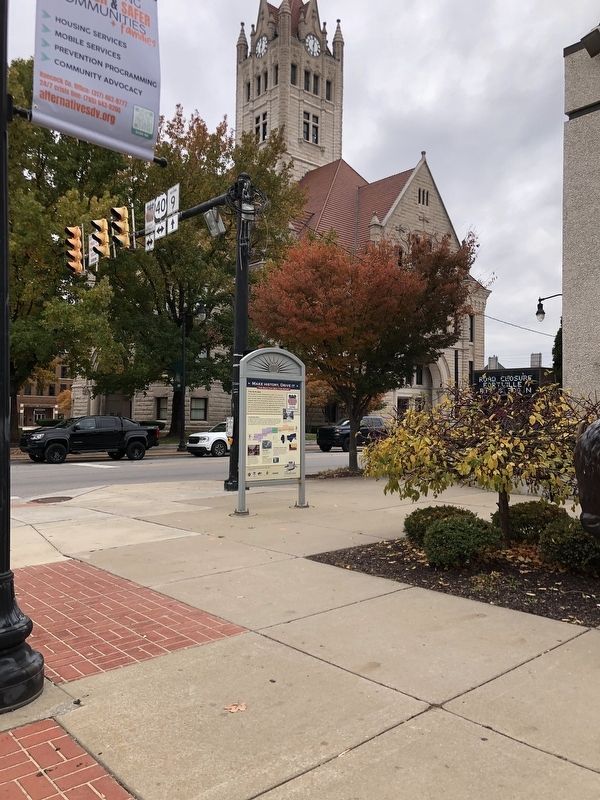
Location. 39° 47.106′ N, 85° 46.164′ W. Marker is in Greenfield, Indiana, in Hancock County. It is at the intersection of South State Street (Indiana Route 9) and West Main Street (U.S. 40), on the right when traveling south on South State Street. Touch for map. Marker is at or near this postal address: 10 S State St, Greenfield IN 46140, United States of America. Touch for directions.

Regionally, this marker is in Central Indiana and specifically in Greater Indianapolis. It is also in the American Midwest and in the Corn Belt. Globally, it is in North America, the Western Hemisphere, the Western World, and the Anglosphere. Historically, it finds itself in what was once the territory of the Mississippian Culture and also the Northwest Territory.
Other nearby markers. At least 8 other markers are within walking distance of this marker: Information on the Move (here, next to this marker); James Whitcomb Riley (within shouting distance of this marker); Hancock County, Indiana (within shouting distance of this marker); A Barefoot Boy (about 300 feet away, measured in a direct line); John William “Will” Vawter (about 300 feet away); Hancock County Veterans Park (about 300 feet away); John Henry Felt (about 300 feet away); Robert Frost (R.F.) Dagget (1875-1955) (about 300 feet away). Touch for a list and map of all markers in Greenfield.
Credits. This page was last revised on December 23, 2025. It was originally submitted on November 24, 2025, by Duane and Tracy Marsteller of Murfreesboro, Tennessee. This page has been viewed 84 times since then and 39 times this year. Photos: 1, 2, 3. submitted on November 24, 2025, by Duane and Tracy Marsteller of Murfreesboro, Tennessee. • Devry Becker Jones was the editor who published this page.
