
Near Fredericksburg in Spotsylvania County, Virginia — The American South (Mid-Atlantic)
Legends on Horseback
1862-1865
Photographed by Mike McKeown, November 11, 2025
1. Legends on Horseback Marker
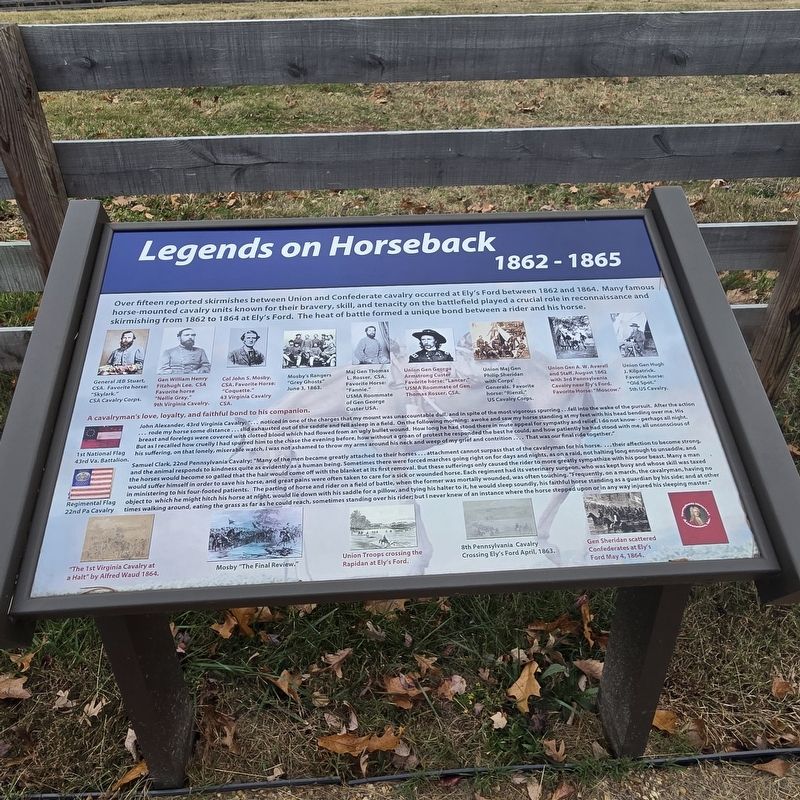
Over fifteen reported skirmishes between Union and Confederate cavalry occurred at Ely's Ford between 1862 and 1864. Many famous horse-mounted cavalry units known for their bravery, skill, and tenacity on the battlefield played a crucial role in reconnaissance and skirmishing from 1862 to 1864 at Ely's Ford. The heat of battle formed a unique bond between a rider and his horse.
A cavalryman's love, loyalty, and faithful bond to his companion.
John Alexander, 43rd Virginia Cavalry: "...noticed in one of the charges that my mount was unaccountable dull, and in spite of the most vigorous spurring ...fell into the wake of the pursuit. After the action ... rode my horse some distance ... slid exhausted out of the saddle and fell asleep in a field. On the following morning: awoke and saw my horse standing at my feet with his head bending over me. His breast and forelegs were covered with clotted blood which had flowed from an ugly bullet wound. How long he had stood there in mute appeal for sympathy and relief, I do not know- -perhaps all night. But as I recalled how cruelly I had spurred him to the chase the evening before,
this page online
Samuel Clark, 22nd Pennsylvania Cavalry: "Many of the men became greatly attached to their horses ... attachment cannot surpass that of the cavalryman tor his horse. ...their affection to become strong, and the animal responds to kindness quite as evidently as a human being. Sometimes there were forced marches going right on for days and nights, as on a raid, not halting long enough to unsaddle, and the horses would become so galled that the hair would come off with the blanket at its first removal. But these sufferings only caused the rider to more greatly sympathize with his poor beast. Many a man would suffer himself in order to save his horse, and great pains were often taken to care for a sick or wounded horse. Each regiment had its veterinary surgeon, who was kept busy and whose skill was taxed in ministering to his four-footed patients.
Photographed by Mike McKeown, November 11, 2025
2. Legends on Horseback Marker
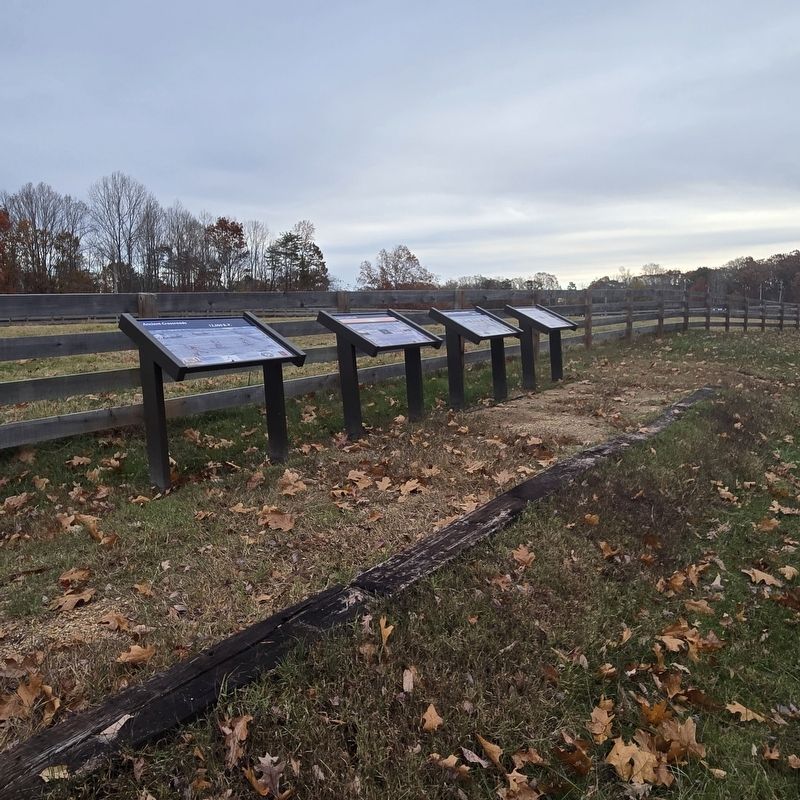
Marker is 3rd from the right
[Captions:]
General JEB Stuart, CSA. Favorite Horse: Skylark CSA Cavalry Corps. • Gen. William Henry Fitzhugh Lee, CSA Favorite Horse "Nellie Gray," 9th Virginia Cavalry. • Col John S. Mosby, CSA. Favorite Horse: "Coquette." 43 Virginia Cavalry CSA. • Mosby's Rangers "Grey Ghosts" June 3, 1863. • Maj Gen Thomas L. Rosser, CSA. Favorite Horse: "Fannie." USMA Roommate of Gen. George Custer USA. • Union Gen George Armstrong Custer Favorite horse: "Lancer." USMA Roommate of Gen. Thomas Rosser, CSA. • Union Maj Gen Philip Sheridan with Corps' Generals. Favorite horse: "Rienzi." US Cavalry Corps. • Union Gen A.W. Averell and Staff, August 1862 with 3rd Pennsylvania Cavalry near Ely's Ford. Favorite Horse: "Moscow." • Union Gen Hugh J. Kilpatrick. Favorite horse: "O1d Spot." 5th US Cavalry.
1st National Flag 43rd Va. Battalion. • Regimental Flag 22nd Pa Cavalry • "The 1st Virginia Cavalry at a Halt" by Alfred Waud 1864. • Mosby, "The Final Review." • Union Troops crossing the Rapidan at Ely's Ford. • 8th Pennsylvania Cavalry Crossing Ely's Ford April, 1863. • Gen Sheridan scattered Confederates at Ely' s Ford May 4,1864.
Erected by Spotsylvania
Photographed by Evan Dwyer, March 14, 2026
3. Legends on Horseback Marker
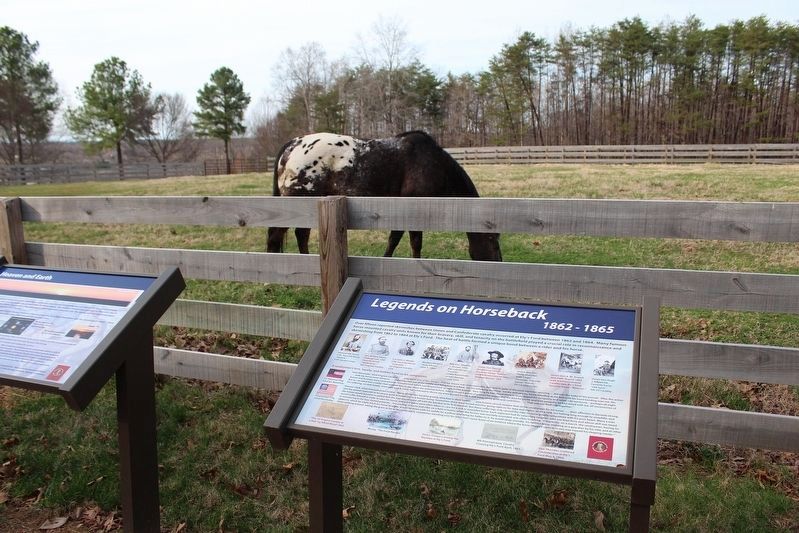
With, fittingly, a horse beyond.
Topics. This historical marker is listed in these topic lists: Animals • War, US Civil. A significant historical month for this entry is April 1863.
Location. 38° 21.38′ N, 77° 40.697′ W. Marker is near Fredericksburg, Virginia, in Spotsylvania County. It is on Elys Ford Road (County Road 610) 0.3 miles north of Rapidan Drive, on the right when traveling north. Touch for map. Marker is at or near this postal address: 10413 Elys Ford Rd, Fredericksburg VA 22407, United States of America. Touch for directions.

Regionally, this marker is in the Washington Metropolitan Area, in Northern Virginia, and in the Piedmont. It is also in the American South, specifically in the Upper South, in the Mid-Atlantic, and on the Eastern Seaboard. Globally, it is in the North Atlantic Region, North America, the Western Hemisphere, the Western World, and the Anglosphere. Historically, it finds itself in what was once the territory of the Mississippian Culture, one of the original Thirteen Colonies, one of the Confederate States of America, and the Antebellum South.
Other nearby markers. At least 8 other markers
Photographed by Evan Dwyer, March 14, 2026
4. Legends on Horseback Marker
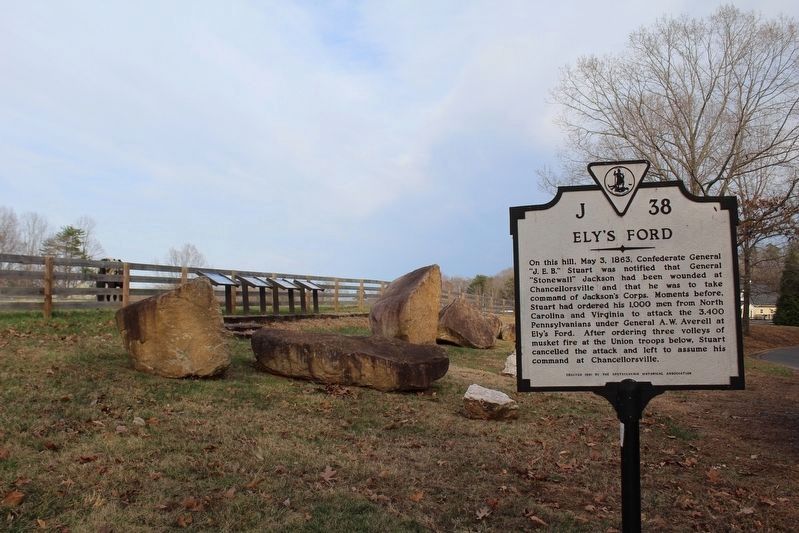
This marker is one of a total of five at this interpretive wayside.
Another marker is no longer nearby. The Flying Dutchmen (was approx. 2.8 miles away but has been replaced with another marker now near it).
Credits. This page was last revised on April 2, 2026. It was originally submitted on November 27, 2025, by Mike McKeown of Baltimore, Maryland. This page has been viewed 95 times since then and 49 times this year. Photos: 1, 2. submitted on November 27, 2025, by Mike McKeown of Baltimore, Maryland. 3, 4. submitted on April 2, 2026, by Evan Dwyer of Richmond, Virginia. • Bernard Fisher was the editor who published this page.
