
Hayes in Gloucester County, Virginia — The American South (Mid-Atlantic)
Duc de Lauzun and the Battle of the Hook
Photographed by Brandon D Cross
1. Duc de Lauzun and the Battle of the Hook Marker
The Volontaires-étrangers de Lauzun
The Foreign Volunteers of Lauzun
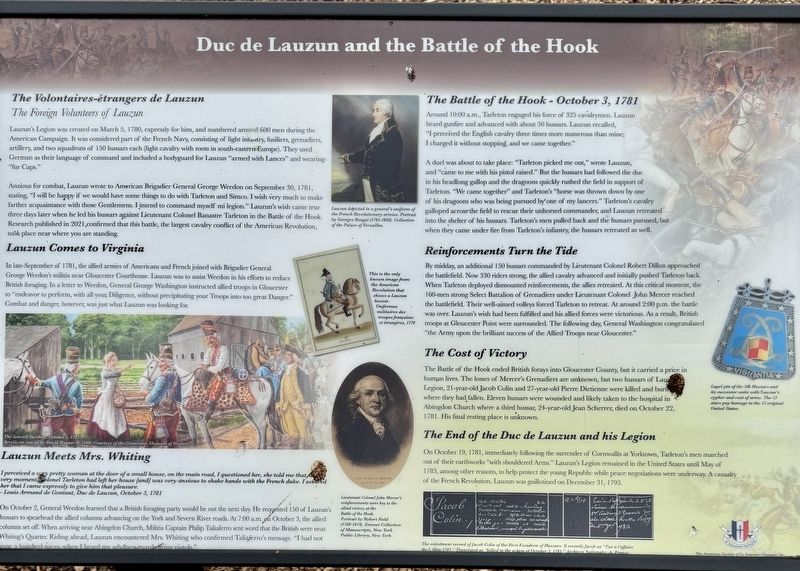
Lauzun's Legion was created on March 5, 1780, expressly for him, and numbered around 600 men during the American Campaign. It was considered part of the French Navy, consisting of light infantry, fusiliers, grenadiers, artillery, and two squadrons of 150 hussars each (light cavalry with roots in south-eastern Europe). They used German as their language of command and included a bodyguard for Lauzun "armed with Lances" and wearing, "fur Caps."
Anxious for combat, Lauzun wrote to American Brigadier General George Weedon on September 30, 1781, stating, "I will be happy if we would have some things to do with Tarleton and Simco. I wish very much to make farther acquaintance with those Gentlemens. I intend to command myself mi legion." Lauzun's wish came true three days later when he led his hussars against Lieutenant Colonel Banastre Tarleton in the Battle of the Hook. Research published in 2021 confirmed that this battle, the largest cavalry conflict of the American Revolution, took place near where you are standing.
Lauzun Comes to Virginia
In
this page online
Lauzun Meets Mrs. Whiting
I perceived a very pretty woman at the door of a small house, on the main road, I questioned her, she told me that at the very moment, Colonel Tarleton had left her house [and] was very anxious to shake hands with the French Duke. I assured her that I came expressly to him that pleasure. - Louis Armand de Gontaut, Duc de Lauzun, October 3, 1781
The Battle of the Hook - October 3, 1781
Around 10:00 a.m., Tarleton engaged his force of 325 cavalrymen. Lauzun heard gunfire and advanced with about 50 hussars. Lauzun recalled, "I perceived the English cavalry three times more numerous than mine; I charged it without stopping, and we came together."
A duel was about to take place: "Tarleton picked me out," wrote Lauzun, and "came to me with his pistol raised." But the hussars had followed the duc in his headlong gallop and the dragoons quickly rushed the field in support of Tarleton. "We came together” and Tarleton’s horse was thrown down by the of his dragoons who was being pursued by one of my lancers." Tarleton's cavalry galloped across the field to rescue their unhorsed commander, and Lauzun retreated" into the shelter of his hussars. Tarleton's men pulled back and the hussars pursued, but when they came under fire from Tarleton's infantry, the hussars retreated as well.
Reinforcements Turn the Tide
By midday, an additional 150 hussars commanded by Lieutenant Colonel Robert Dillon approached the battlefield. Now 330 riders strong, the allied cavalry advanced and initially pushed Tarleton back. When Tarleton deployed dismounted reinforcements, the allies retreated. At this critical moment, the 160-men strong Select Battalion of Grenadiers under Lieutenant Colonel John Mercer reached the battlefield. Their well-aimed volleys forced Tarleton to retreat. At around 2:00 p.m. the battle was over. Lauzun's wish had been fulfilled and his allied forces were victorious. As a result, British troops at Gloucester Point were surrounded. The following day, General Washington congratulated “the Army upon the brilliant success of the Allied Troops near Gloucester."
The Cost of Victory
The Battle of the Hook ended British forays into Gloucester County, but it carried a price in human lives. The losses of Mercer's Grenadiers are unknown, but two hussars of Lauzon’s Legion, 21-year-old Jacob Colin and 27-year-old Pierre Dietienne were killed and buried where they had fallen. Eleven hussars were wounded and likely taken to the hospital in Abingdon Church where a third hussar, 24-year-old Jean Scherrer, died on October 22, 1781. His final resting place is unknown.
The End of the Duc de Lauzun and his Legion
On October 19, 1781, immediately following the surrender of Cornwallis at Yorktown, Tarleton's men marched out of their earthworks "with shouldered Arms." Lauzun's Legion remained in the United States until May of 1783, among other reasons, to help protect the young Republic while peace negotiations were underway. A casualty of the French Revolution, Lauzun was guillotined on December 31, 1793.
(captions)
The Seawell Incident, October 3, 1781. Acrylic on canvas by David Wagner (b. 1940). Courtesy of the Gloucester Museum of History
Lauzun depicted in a general's uniform of the French Revolutionary armies. Portrait by Georges Rouget (1783-1869). Collection of the Palace of Versailles.
This is the only known image from the American Revolution that shows a Lauzun hussar. Uniformes militaires des troupes françaises et étrangères, 1779
Lieutenant Colonel John Mercer's reinforcements were key to the allied victory at the Battle of the Hook. Portrait by Robert Field (1769-1819). Emmet Collection of Manuscripts, New York Public Library, New York
Lapel pin of the 5th Hussars and its successor units with Lauzun's cypher and coat of arms. The 13 stars pay homage to the 13 original United States.
The enlistment record of Jacob Colin of the First Escadron of Hussars. It records Jacob as "Tué à l'affaire du 3. 8bre 1781." Translated as "Killed in the action of October 3, 1781." Archives Nationales de France
The American Society of Le Souvenir Francais, Inc.
Erected 2023
Photographed by Brandon D Cross
2. Duc de Lauzun and the Battle of the Hook Marker
Topics. This historical marker is listed in these topic lists: War, US Revolutionary • Waterways & Vessels. A significant historical date for this entry is October 3, 1781.
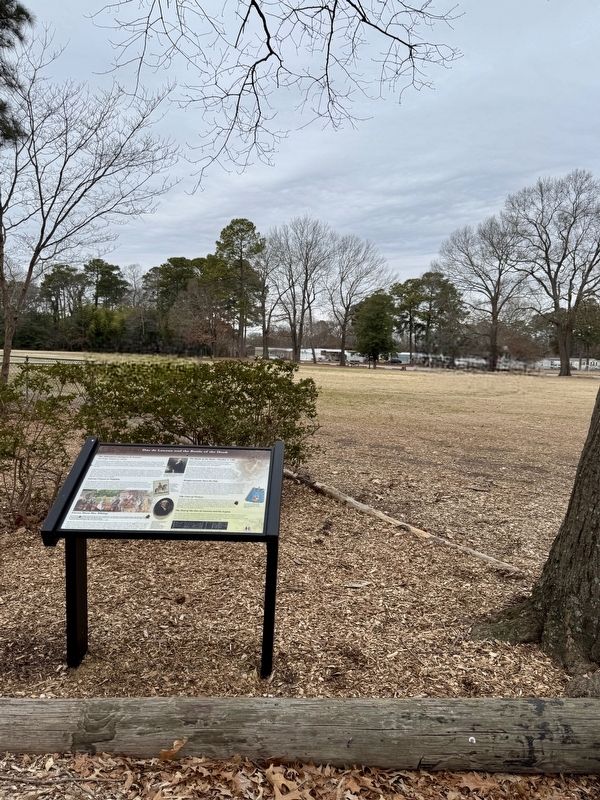
Location. 37° 17.489′ N, 76° 30.89′ W. Marker is in Hayes, Virginia, in Gloucester County. It can be reached from Powhatan Drive west of Pigeon Hill Road, on the right when traveling west. The marker is located within Abington Park. Touch for map. Marker is at or near this postal address: 7023 Powhatan Drive, Hayes VA 23072, United States of America. Touch for directions.

Regionally, this marker is on the Middle Peninsula and in the Hampton Roads Metropolitan Area. It is also in the American South, specifically in the Upper South, in the Tidewater, in the Chesapeake Bay Region, and on the Eastern Seaboard. Globally, it is in the North Atlantic Region, North America, the Western Hemisphere, the Western World, and the Anglosphere. Historically, it finds itself in what was once the territory of the Mississippian Culture, one of the original Thirteen Colonies, one of the Confederate States
Photographed by Brandon D Cross
3. Abington Park Sign
Other nearby markers. At least 8 other markers are within 2 miles of this marker, measured as the crow flies: French Soldiers Killed at the Battle of the Hook (here, next to this marker); The Siege of Gloucester Point, 1781 (here, next to this marker); Powhatan’s Chimney (approx. 0.9 miles away); The Irene Morgan Story Begins (approx. 1.2 miles away); Timberneck House Renovation at Machicomoco State Park (approx. 1.2 miles away); Early Timberneck Graveyard (approx. 1.2 miles away); Battle of the Hook (approx. 1.3 miles away); "The Hook" (approx. 1.3 miles away). Touch for a list and map of all markers in Hayes.
Also see . . .
1. Cavalry Clash at the Hook. (Submitted on February 6, 2025, by Brandon D Cross of Flagler Beach, Florida.)
2. Gloucester Point in the Siege of Yorktown 1781. (Submitted on February 6, 2025, by Brandon D Cross of Flagler Beach, Florida.)
3. Newly unveiled markers tell story of the Battle of the Hook in Gloucester County. (Submitted on February 6, 2025, by Brandon D Cross of Flagler Beach, Florida.)
Credits. This page was last revised on November 28, 2025. It was originally submitted on February 6, 2025, by Brandon D Cross of Flagler Beach, Florida. This page has been viewed 406 times since then and 111 times this year. Last updated on November 28, 2025, by Thierry Chaunu of New York, New York. Photos: 1, 2, 3. submitted on February 6, 2025, by Brandon D Cross of Flagler Beach, Florida. • Devry Becker Jones was the editor who published this page.
