Palacio in Madrid, Spain — Southwestern Europe (Iberian Peninsula)
Los Caños del Peral

Photographed by Andrew Ruppenstein, April 18, 2022
1. Los Caños del Peral Marker

El manantial que abastecia a la fuente fue aprovechado en época medieval por una población asentada en torno a una de las puertas de la muralla cristiana, la puerta de Balnadu.
Mencionadas en los documentos historicos desde el siglo XVI, la fuente y la plazuela donde se ubicaba, cobran singular importancia para una poblacion en creciente aumento. Este espacio urbano fue objeto de numerosas reformas hasta la primera mitad del siglo XIX, momento en el que quedo sepultado por tierras y escombros.
Las obras de reforma promovidas por metro de madrid han permitido recuperar parte del antiguo entramado urbano e integrarlo en la nueva Estacion de Opera.
In this same spot, eight meters underground, lies the Canos del Peral fountain, a monumental public fountain in the Renaissance style, built during the reign of Philip II for the adornment and use of this town.
The
this page online
Mentioned in historical documents since the 16th century, the fountain and the small square where it was located held particular importance for a rapidly growing population. This urban space underwent numerous renovations until the first half of the 19th century, at which point it was buried under earth and rubble.
The renovation works undertaken by Metro de Madrid have allowed for the recovery of part of the old urban fabric and its integration into the new Opera Station.
Topics. This historical marker is listed in this topic list: Man-Made Features.
Location. 40° 25.086′ N, 3° 42.549′ W. Marker is in Madrid. It is in Palacio. It is on Plaza de Isabel II, on the left when traveling north. Touch for map. Marker is at or near this postal address: Plaza de Isabel II 8, Madrid 28013, Spain. Touch for directions.

Regionally, it is in the North Atlantic Region, in Europe, in the European Union, in Atlantic Europe, on the Iberian Peninsula,

Photographed by Andrew Ruppenstein, April 19, 2022
2. Los Caños del Peral Marker - wide view
The marker is visible here on the left, and in the center is a bit of the Opera Metro Station, with the Teatro Real visible in the background.
Other nearby markers. At least 8 other markers are within walking distance of this marker: Caños del Peral (a few steps from this marker); Tomas Breton (about 120 meters away, measured in a direct line); Puerta de Valnadú / Valnadú Gate (about 120 meters away); "Frascuelo" (about 150 meters away); Juan Valera y Alcalá-Galliano (about 150 meters away); Julian Gayarre (about 180 meters away); Francisco de Quevedo (about 180 meters away); Vicente Huidobro (about 180 meters away). Touch for a list and map of all markers in Madrid.
Also see . . . Fountain of the Pear Tree Canals (Wikipedia). Excerpt:
The Fountain of the Pear Tree Canals (Spanish: Fuente de los Caños del Peral) is an ancient fountain discovered buried under the Plaza de Isabel II in Madrid, Spain, in 2009. The name comes from a 13th-century pear tree that shaded the source spring at the fountain's location. The fountain is also known as the Spanish: Lavadero de los Caños del Peral (Laundry of the Pear Tree Canals).
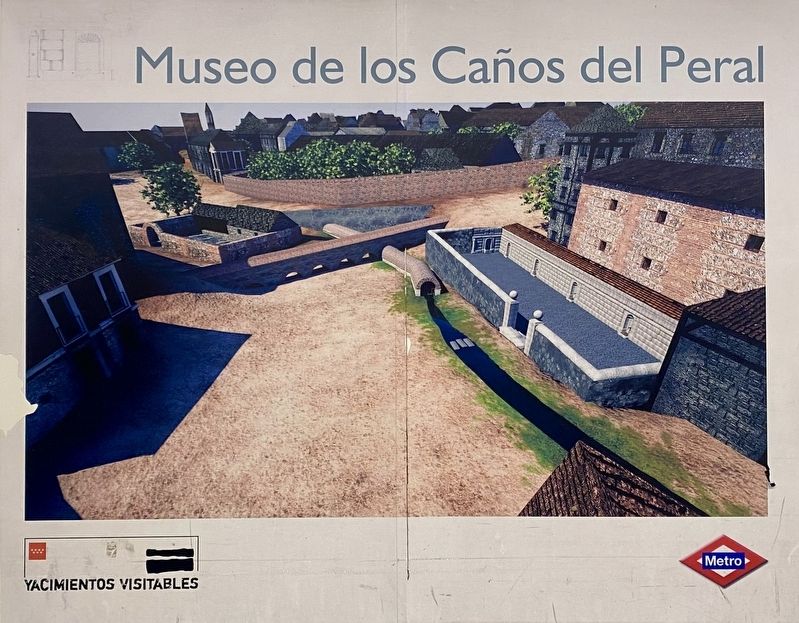
Photographed by Andrew Ruppenstein, April 18, 2022
3. Los Caños del Peral illustration
Beneath the plaza, in the Opera Metro Station, is a display of what the fountain area may have looked like (this illustration), as well as a small museum showcasing the area’s archaeological findings around the fountain.
Credits. This page was last revised on November 29, 2025. It was originally submitted on November 28, 2025, by Andrew Ruppenstein of Lamorinda, California. This page has been viewed 59 times since then and 25 times this year. Photos: 1, 2. submitted on November 28, 2025, by Andrew Ruppenstein of Lamorinda, California. 3. submitted on November 29, 2025, by Andrew Ruppenstein of Lamorinda, California.
