St. Augustine in St. Johns County, Florida — The American South (South Atlantic)
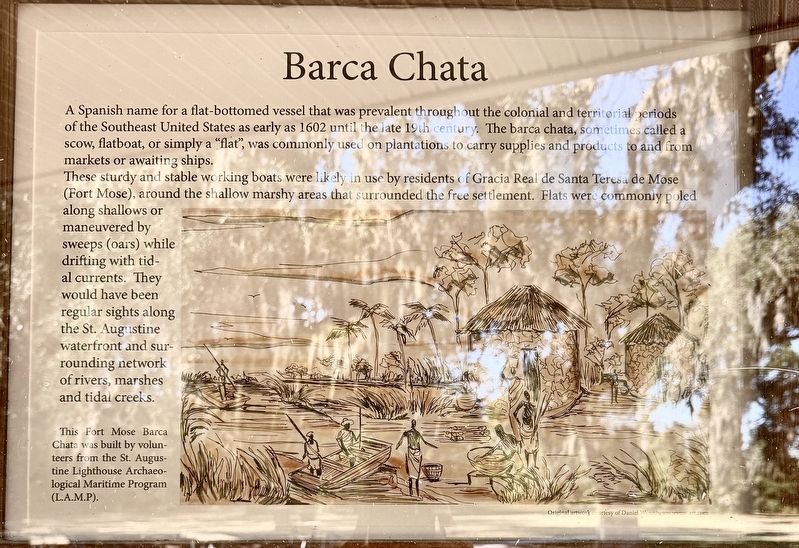
Barca Chata
| — | Fort Mose Historical State Park | — |
Photographed by Brandon D Cross, December 3, 2025
1. Barca Chata Marker
These sturdy and stable working boats were likely in use by residents of Gracia Real de Santa Teresa de Mose (Fort Mose), around the shallow marshy areas that surrounded the free settlement. Flats were commonly poled along shallows or maneuvered by sweeps (oars) while drifting with tidal currents. They would have been regular sights along the St. Augustine waterfront and surrounding network of rivers, marshes and tidal creeks.
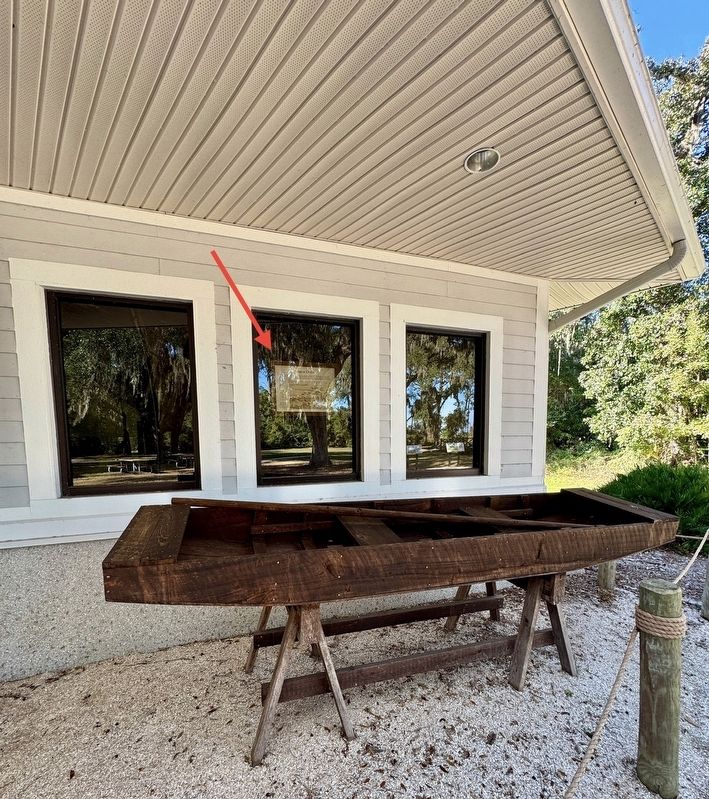
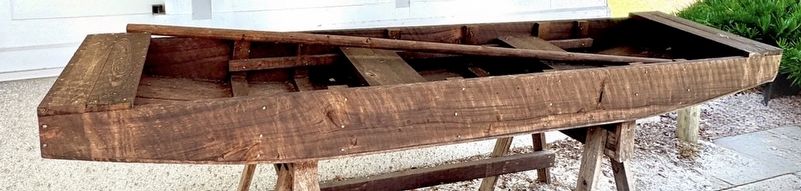
This Fort Mose Barca Chata was built by volunteers from the St. Augustine Lighthouse Archaeological Maritime Program (L.A.M.P).
Erected 2025 by Florida State Parks.
Topics. This historical marker is listed in these topic lists: Industry & Commerce • Settlements & Settlers • Waterways & Vessels.
Location. 29° 55.768′ N,
this page online

Regionally, this marker is in First Coast and in Greater Jacksonville. It is also in the American South and on the Eastern Seaboard. Globally, it is in the North Atlantic Region, North America, a Gulf of Mexico state, the Western Hemisphere, the Western World, and the Anglosphere. Historically, it finds itself in what was once New Spain, the territory of the Mississippian Culture, one of the Confederate States of America, and the Antebellum South.
Other nearby markers. At least 8 other markers are within walking distance of this marker: On Watch (a few steps from this marker); Women of Fort Mose (within shouting distance of this marker); Conclusion (within shouting distance of this marker); Fort Mose Site (within shouting distance
Photographed by Brandon D Cross
2. Barca Chata Marker
Other markers no longer nearby. Evacuation (was within shouting distance of this marker but has been permanently removed); Fort Mose II (was within shouting distance of this marker but has been permanently removed).
Also see . . .
1. A new Barca Chata and a History of Boatbuilding in St. Augustine. (Submitted on December 4, 2025, by Brandon D Cross of Flagler Beach, Florida.)
2. Fort Mose Historic State Park. (Submitted on December 4, 2025, by Brandon D Cross of Flagler Beach, Florida.)
Photographed by Brandon D Cross, December 3, 2025
3. Barca Chata reproduction
Credits. This page was last revised on December 4, 2025. It was originally submitted on December 4, 2025, by Brandon D Cross of Flagler Beach, Florida. This page has been viewed 75 times since then and 43 times this year. Photos: 1, 2, 3. submitted on December 4, 2025, by Brandon D Cross of Flagler Beach, Florida. • Bernard Fisher was the editor who published this page.
