St. Augustine in St. Johns County, Florida — The American South (South Atlantic)
Fort Mose I
| — | Fort Mose Historic State Park | — |
Photographed by Cosmos Mariner, December 10, 2014
1. Fort Mose I Marker
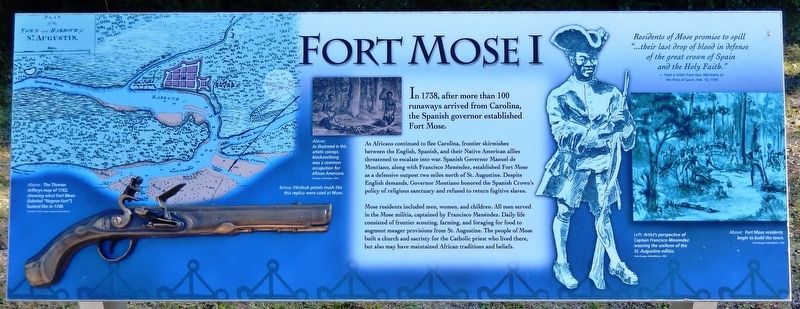
As Africans continued to flee Carolina, frontier skirmishes between the English, Spanish, and their Native American allies threatened to escalate into war. Spanish Governor Manuel de Montiano, along with Francisco Menéndez, established Fort Mose as a defensive outpost two miles north of St. Augustine. Despite English demands, Governor Montiano honored the Spanish Crown's policy of religious sanctuary and refused to return fugitive slaves.
Mose residents included men, women, and children. All men served in the Mose militia, captained by Francisco Menéndez. Daily life consisted of frontier scouting, farming, and foraging for food to augment meager provisions from St. Augustine. The people of Mose built a church and sacristy for the Catholic priest who lived there, but also may have maintained African traditions and beliefs.
Erected by Fort Mose Historic State Park.
Topics. This historical marker is listed in these topic lists: African Americans • Colonial Era • Forts and Castles • Settlements & Settlers. A significant historical year for this entry is 1738.
Location. Marker
this page online
We have been informed that this marker is no longer there and will not be replaced. This page is an archival view of what was.
Regionally, this marker was in First Coast and in Greater Jacksonville. It was also in the American South and on the Eastern Seaboard. Globally, it was in the North Atlantic Region, North America, a Gulf of Mexico state, the Western Hemisphere, the Western World, and the Anglosphere. Historically, it found itself in what was once New Spain, the territory of the Mississippian Culture, one of the Confederate States of America, and the Antebellum

Courtesy of P.K. Yonge Library, Gainesville, FL
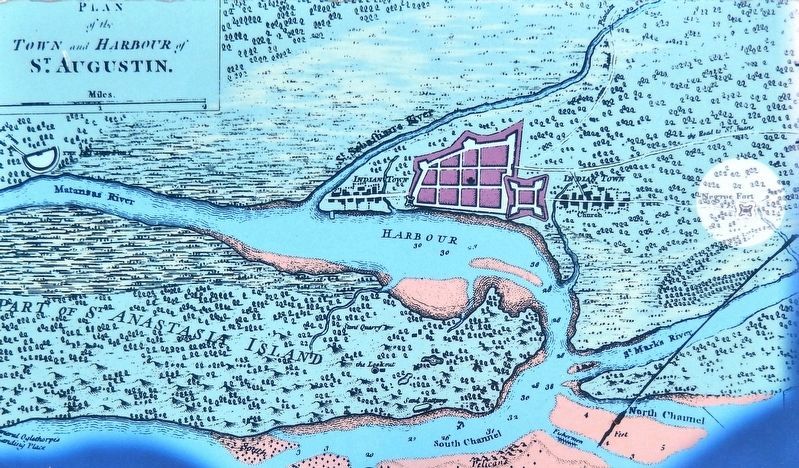
2. Marker detail: The Thomas Jefferys map of 1762
The Thomas Jefferys map of 1762, showing what Fort Mose (labeled “Negroe Fort”) looked like in 1740.
Other nearby markers. At least 8 other markers are within walking distance of this location: El Pueblo de Gracia Real de Santa Teresa de Mose (a few steps from this marker); Escape & Flight (a few steps from this marker); Bloody Mose (a few steps from this marker); Fort Mose Site (within shouting distance of this marker); Women of Fort Mose (within shouting distance of this marker); Barca Chata (about 300 feet away, measured in a direct line); On Watch (about 300 feet away); “Slave Catchers” (about 300 feet away). Touch for a list and map of all markers in St. Augustine.
Other markers no longer nearby. Fort Mose II (was a few steps from this marker but has been permanently removed); British Enslavement (was a few steps from this marker but has been permanently removed); Evacuation (was within shouting distance of this marker but has been permanently removed); Middle Passage (was within shouting distance of this marker but has been permanently removed); African Origins (was within shouting distance of this marker but has been permanently removed).
More about this marker. The marker has been permanently removed.
from Deagan & MacMahon, 1995
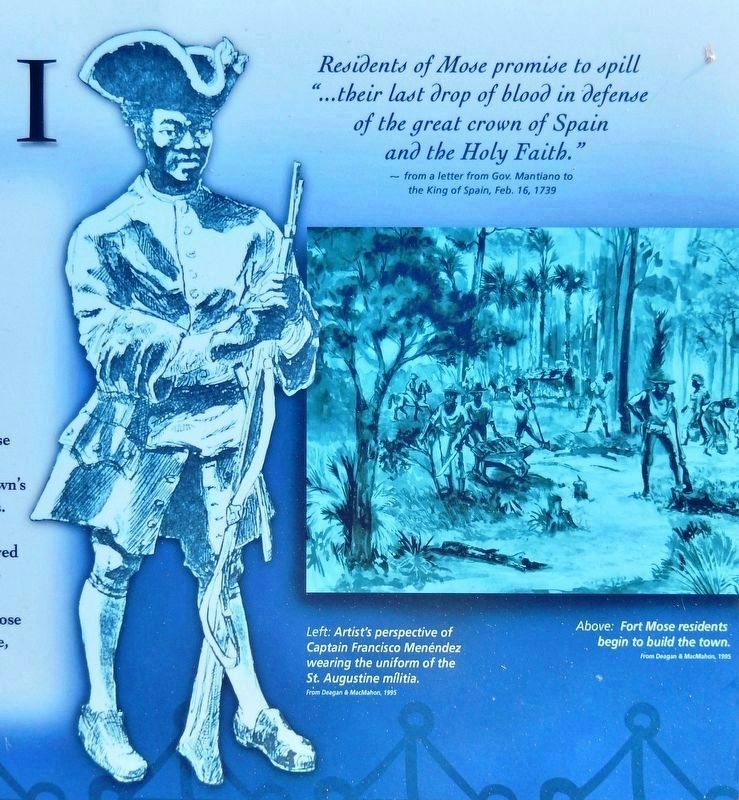
3. Marker detail: Captain Francisco Menéndez wearing the uniform of the St. Augustine militia
Residents of Mose promise to spill “their last drop of blood in defense of the great crown of Spain and the Holy Faith.”
from a letter from Gov. Mantiano to the King of Spain, Feb 16, 1739
(left) Artist’s perspective of Captain Francisco Menéndez wearing the uniform of the St. Augustine militia.
(above) Fort Mose residents begin to build the town.
from a letter from Gov. Mantiano to the King of Spain, Feb 16, 1739
(left) Artist’s perspective of Captain Francisco Menéndez wearing the uniform of the St. Augustine militia.
(above) Fort Mose residents begin to build the town.
The Fort Mose Historical State Park recently went through extensive renovations. The park reopened in May, 2025. During the renovation process all historical markers were replaced with different markers containing additional more current information.
Related markers. Click here for a list of markers that are related to this marker. Fort Mose Historic State Park
Also see . . .
1. The journey of Africans to St. Augustine: Fort Mose. Fort Mose guarded the northern land and water approaches to St. Augustine, and the Fort Mose militia, a community-based free black militia, had primary responsibility for scouting and information gathering on the frontier. They mastered the intricacies of European warfare, and integrated elements from their own traditions. Residents of Fort Mose came from diverse cultures in the Caribbean, and West Africa their skilled labor, technology, art, music, ideas, and traditions served as valuable resources to the Spanish residents of nearby St. Augustine. A mosaic of people with diverse origins in Africa, the Caribbean, Florida, and the Carolinas made Mose their home. Documents tell of intermarriage
Photographed by Cosmos Mariner, December 10, 2014
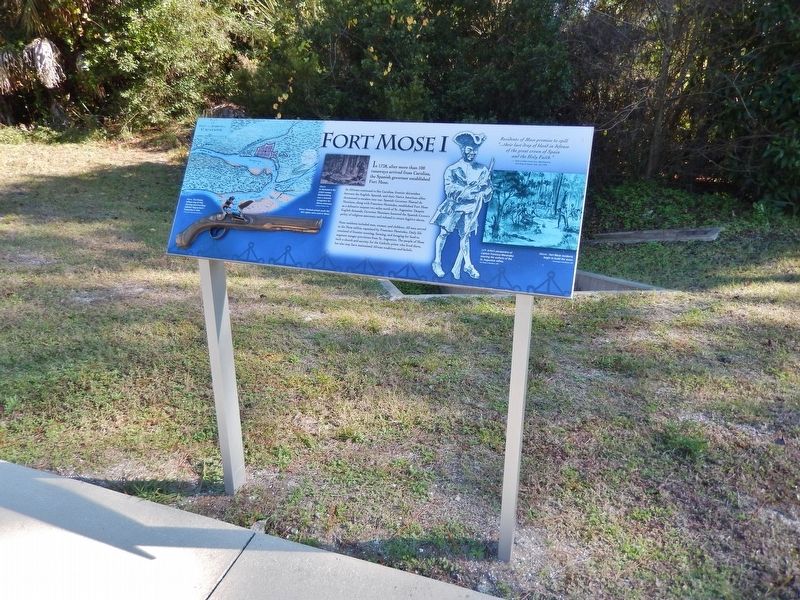
4. Fort Mose I Marker (wide view)
2. Fort Mose Historic State Park. Florida Department of Environmental Protection (Submitted on December 3, 2018.)
Credits. This page was last revised on December 7, 2025. It was originally submitted on December 1, 2018, by Cosmos Mariner of Cape Canaveral, Florida. This page has been viewed 1,115 times since then and 89 times this year. Last updated on December 6, 2025, by Brandon D Cross of Flagler Beach, Florida. Photos: 1. submitted on December 1, 2018, by Cosmos Mariner of Cape Canaveral, Florida. 2, 3, 4. submitted on December 2, 2018, by Cosmos Mariner of Cape Canaveral, Florida. • Bernard Fisher was the editor who published this page.
