St. Augustine in St. Johns County, Florida — The American South (South Atlantic)
Evacuation
| — | Fort Mose Historic State Park | — |
Photographed by Cosmos Mariner, December 10, 2014
1. Evacuation Marker
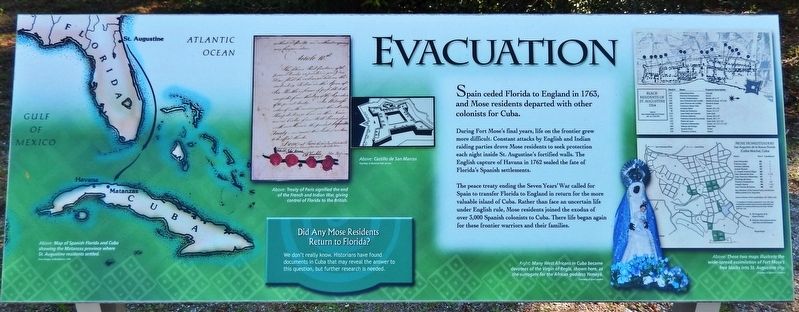
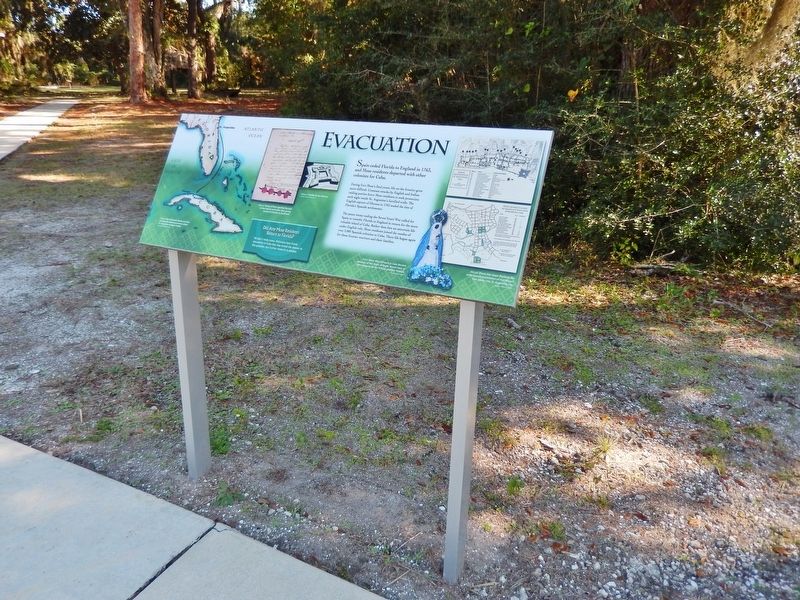
Spain ceded Florida to England in 1763, and Mose residents departed with other colonists for Cuba.
During Fort Mose's final years, life on the frontier grew more difficult. Constant attacks by English and Indian raiding parties drove Mose residents to seek protection each night inside St. Augustine's fortified walls. The English capture of Havana in 1762 sealed the fate of Florida's Spanish settlements.
The peace treaty ending the Seven Years' War called for Spain to transfer Florida to England in return for the more valuable island of Cuba. Rather than face an uncertain life under English rule, Mose residents joined the exodus of over 3,000 Spanish colonists to Cuba. There life began again for these frontier warriors and their families.
Did Any Mose Residents Return to Florida?
We don't really know. Historians have found documents in Cuba that may reveal the answer to this question, but further research is needed.
Erected by Fort Mose Historic State Park.
Topics. This historical marker is listed in these topic lists: African Americans • Colonial Era • Forts and Castles • Settlements & Settlers. A significant historical year for this entry is 1763.
Location. Marker
this page online
We have been informed that this marker is no longer there and will not be replaced. This page is an archival view of what was.
Regionally, this marker was in First Coast and in Greater Jacksonville. It was also in the American South and on the Eastern Seaboard. Globally, it was in the North Atlantic Region, North America, a Gulf of Mexico state, the Western Hemisphere, the Western World, and the Anglosphere. Historically, it found itself in what was once New Spain, the territory of the Mississippian Culture, one of the Confederate States of America, and the Antebellum South.

Photographed by Cosmos Mariner, December 10, 2014
2. Evacuation Marker (wide view)
Other nearby markers. At least 8 other markers are within walking distance of this location: Bloody Mose (a few steps from this marker); Fort Mose Site (a few steps from this marker); El Pueblo de Gracia Real de Santa Teresa de Mose (a few steps from this marker); Escape & Flight (within shouting distance of this marker); Women of Fort Mose (within shouting distance of this marker); On Watch (within shouting distance of this marker); Barca Chata (within shouting distance of this marker); “Slave Catchers” (about 300 feet away, measured in a direct line). Touch for a list and map of all markers in St. Augustine.
Other markers no longer nearby. Fort Mose II (was a few steps from this marker but has been permanently removed); Fort Mose I (was within shouting distance of this marker but has been permanently removed); British Enslavement (was within shouting distance of this marker but has been permanently removed); Middle Passage (was within shouting distance of this marker but has been permanently removed); African Origins (was within shouting distance of this marker but has been permanently removed).
More about this marker. This marker has been permanently removed.
The Fort Mose Historical State Park recently went through extensive renovations. The park reopened in May, 2025. During the renovation process all historical markers were replaced with different markers containing additional more current information.
Related markers. Click here for a list of markers that are related to this marker. Fort Mose Historic State Park
Also see . . .
1. Fort Mose Historic State Park. Florida State Parks website entry (Submitted on December 3, 2018.)
2. Francisco Menéndez. Wikipedia entry:
Together with most of the Spanish colonists from St. Augustine and the Fort Mosé community, Francisco Menéndez was evacuated by the Spanish crown to Cuba. There he established a similar community called St. Augustine of the New Florida. (Submitted on December 2, 2018, by Cosmos Mariner of Cape Canaveral, Florida.)
Credits. This page was last revised on January 23, 2026. It was originally submitted on December 1, 2018, by Cosmos Mariner of Cape Canaveral, Florida. This page has been viewed 3,747 times since then and 3,142 times this year. Last updated on December 7, 2025, by Brandon D Cross of Flagler Beach, Florida. Photos: 1. submitted on December 1, 2018, by Cosmos Mariner of Cape Canaveral, Florida. 2. submitted on December 2, 2018, by Cosmos Mariner of Cape Canaveral, Florida. • Bernard Fisher was the editor who published this page.
