
Città Antica in Verona in Provincia di Verona, Venetia, Italy — Southern and Western Europe (Mediterranean)
Arena
(secolo I d.C.)
⎯⎯⎯
(1st century AD)
Photographed by James Hulse, June 11, 2025
1. Arena Marker

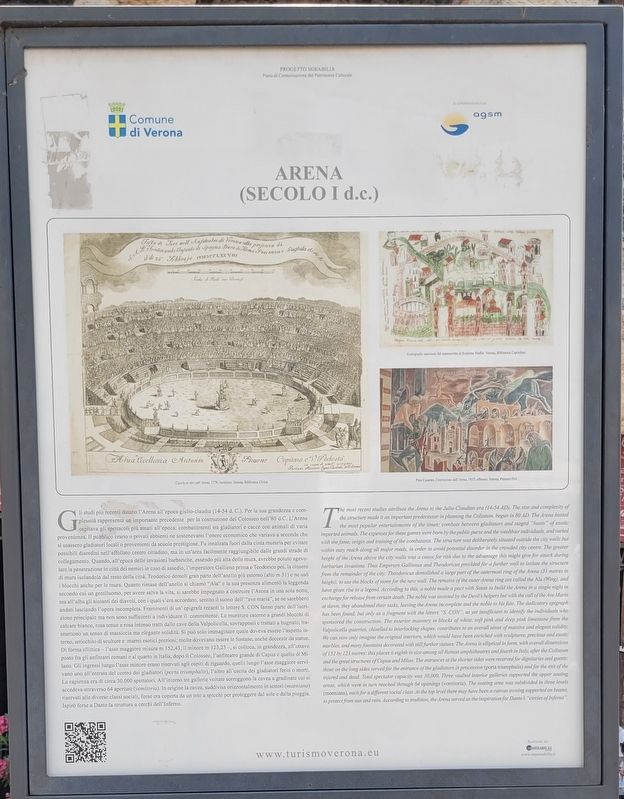
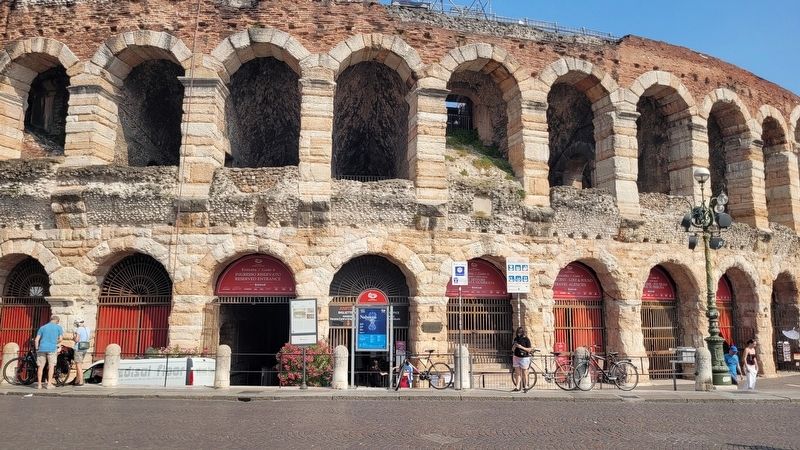
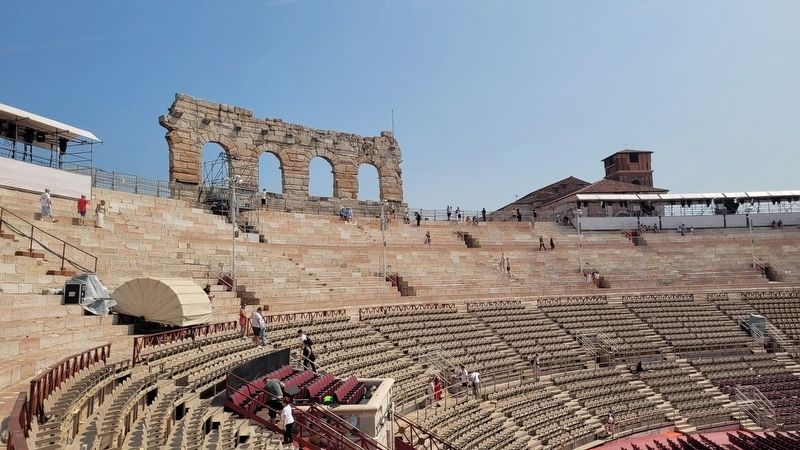
Gli studi più recenti datano l'Arena all'epoca giulio-claudia (14-54 d.C.). Per la sua grandezza e complessità rappresenta un importante precedente per la costruzione del Colosseo nell'80 d.C. L'Arena ospitava gli spettacoli più amati all'epoca: combattimenti tra gladiatori e cacce con animali di varia provenienza. Il pubblico erario o privati abbienti ne sostenevano l'onere economico che variava a seconda che si usassero gladiatori locali o provenienti da scuole prestigiose. Fu innalzata fuori dalla cinta muraria per evitare possibili disordini nell'affollato centro cittadino, ma in un'area facilmente raggiungibile dalle grandi strade di collegamento. Quando, all'epoca delle invasioni barbariche, essendo più alta delle mura, avrebbe potuto agevolare la penetrazione in città dei nemici in caso di assedio, l'imperatore Gallieno prima e Teodorico poi, la cinsero di mura isolandola dal resto della città. Teodorico demolì gran parte dell'anello più esterno (alto m 31) e ne usò i blocchi anche per le mura. Quanto rimase dell'anello si chiamò "Ala" e la sua presenza alimentò la leggenda secondo cui un gentiluomo, per avere salva la vita, si sarebbe impegnato a costruire l'Arena in una sola notte, ma all'alba gli aiutanti dei diavoli, con i quali s'era accordato, sentito il suono dell' "ave maria", se ne sarebbero andati lasciando l'opera incompleta. Frammenti di un'epigrafe recanti le lettere S. CON fanno parte dell'iscrizione principale ma non sono sufficienti a individuare il committente. Le murature esterne a grandi blocchi di calcare bianco, rosa tenue e rosa intenso tratti dalle cave della Valpolicella, sovrapposti e trattati a bugnato, trasmettono un senso di massiccia ma elegante solidità. Si può solo immaginare quale doveva essere l'aspetto interno, arricchito di sculture e marmi esotici preziosi; molte dovevano essere le fontane, anche decorate da statue. Di forma ellittica - l'asse maggiore misura m 152,43, il minore m 123,23 -, si colloca, in grandezza, all'ottavo posto fra gli anfiteatri romani e al quarto in Italia, dopo il Colosseo, l'anfiteatro grande di Capua e quello di Milano. Gli ingressi lungo l'asse minore erano riservati agli ospiti di riguardo, quelli lungo l'asse maggiore servivano uno all'entrata del corteo dei gladiatori (porta triumphalis), l'altro all'uscita dei gladiatori feriti o morti. La capienza era di circa 30.000 spettatori. All'interno tre gallerie voltate sorreggono la cavea a gradinate cui si accedeva attraverso 64 aperture (vomitoria). In origine la cavea, suddivisa orizzontalmente in settori (moeniana) riservati alle diverse classi sociali, forse era coperta da un telo a spicchi per proteggere dal sole e dalla pioggia. Ispirò forse a Dante la struttura a cerchi dell'Inferno.
Didascalie
(Foto #1) Caccia ai tori nell'Arena, 1778, incisione. Verona, Biblioteca Civica
(Foto #2) Iconografia rateriana dal manoscritto di Scipione Maffei. Verona, Biblioteca Capitolare
(Foto #3) Pino Casarini, Costruzione dell'Arena, 1937, affresco. Verona, Palazzo INA
The most recent studies attribute the Arena to the Julio-Claudian era (14-54 AD). The size and complexity of the structure made it an important predecessor in planning the Coliseum, begun in 80 AD. The Arena hosted the most popular entertainments of the times: combats between gladiators and staged "hunts" of exotic imported animals. The expenses for these games were born by the public purse and the wealthier individuals, and varied with the fame, origin and training of the combatants. The structure was deliberately situated outside the city walls but within easy reach along all major roads, in order to avoid potential disorder in the crowded city centre. The greater height of the Arena above the city walls was a cause for risk due to the advantage this might give for attack during barbarian invasions. Thus Emperors Gallienus and Theodoricus provided for a further wall to isolate the structure from the remainder of the city: Theodoricus demolished a large part of the outermost ring of the Arena (31 metres in height), to use the blocks of stone for the new wall. The remains of the outer Arena ring are called the Ala (Wing), and have given rise to a legend. According to this, a noble made a pact with Satan to build the Arena in a single night in exchange for release from certain death. The noble was assisted by the Devil's helpers but with the call of the Ave Maria at dawn, they abandoned their tasks, leaving the Arena incomplete and the noble to his fate. The dedicatory epigraph has been found, but only as a fragment with the letters "S. CON", as yet insufficient to identify the individuals who sponsored the construction. The exterior masonry in blocks of white, soft pink and deep pink limestone from the Valpolicella quarries, chiselled to interlocking shapes, contributes to an overall sense of massive and elegant solidity. We can now only imagine the original interiors, which would have been enriched with sculptures, precious and exotic marbles, and many fountains decorated with still further statues. The Arena is elliptical in form, with overall dimensions of 152 by 123 metres: this places it eighth in size among all Roman amphitheatres and fourth in Italy, after the Coliseum and the great structures of Capua and Milan. The entrances at the shorter sides were reserved for dignitaries and guests: those on the long sides served for the entrance of the gladiators in procession (porta triumphalis) and for the exit of the injured and dead. Total spectator capacity was 30,000. Three vaulted interior galleries supported the upper seating areas, which were in turn reached through 64 openings (vomitoria). The seating area was subdivided in three levels (moeniana), each for a different social class. At the top level there may have been a canvas awning supported on beams, to protect from sun and rain. According to tradition, the Arena served as the inspiration for Dante's "circles of Inferno".
Captions
(Photo #1) Bull hunting in the Arena, 1778, engraving. Verona, Civic Library.
(Photo #2) Ratherian iconography from the manuscript of Scipione Maffei. Verona, Biblioteca Capitolare.
(Photo #3) Pino Casarini, Construction of the Arena, 1937, fresco. Verona, Palazzo INA
Erected by City
this page online
Topics. This historical marker is listed in these topic lists: Anthropology & Archaeology • Entertainment. A significant historical year for this entry is 14 CE.
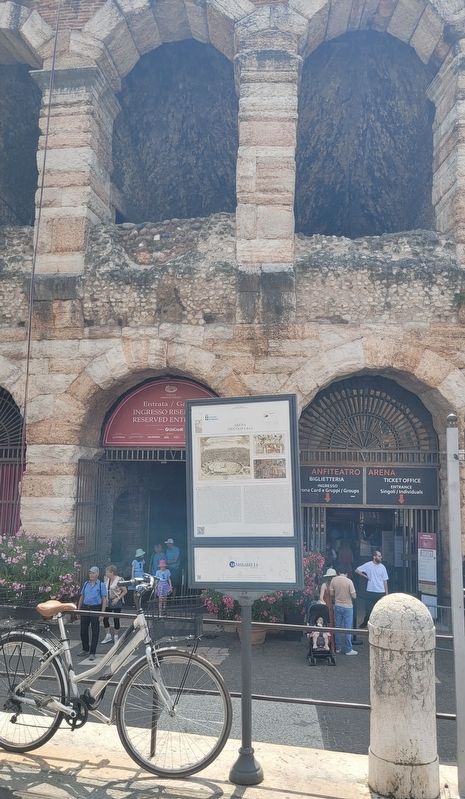
Location. 45° 26.364′ N, 10° 59.623′ E. Marker is in Verona, Veneto (Venetia), in Provincia di Verona. It is in Città Antica. It is at the intersection of Via Dietro Anfiteatro and Via Giuseppe Mazzini, on the right when traveling east on Via Dietro Anfiteatro. The marker is located along the fence in front of the visitors entrance to the Arena. Touch for map. Marker is at or near this postal address: Via Dietro Anfiteatro 10, Verona, Veneto 37121, Italy. Touch for directions.

Regionally, it is in Europe, the European Union, the Schengen Area, a coastal Mediterranean country, and the Western World. Historically, it finds itself in what was once the Roman Empire and specifically also the Holy Roman Empire.
Other nearby markers. At least 8 other markers are within walking distance of this marker: Monumento ai Deportati nei Campi Nazisti / Monument to the Deportees in the Nazi Camps (about 90 meters away, measured in a direct line); Vittorio Emanuele II (about 120 meters away); The City of Verona (about 120 meters away); Roma o Morte / Rome or Death! (about 120 meters away); Monumento ai Caduti in Libia / Monument to the Fallen in Libya (about 150 meters away); Alle aquile del 6º Alpini / To the Eagles of the 6th Alpini (about 180 meters away); Ai sottufficiali di tutte le armi e corpi armati dello Stato (about 180 meters away); Ai Granatieri di Sardegna caduti per la patria (about 180 meters away). Touch for a list and map of all markers in Verona.
Also see . . . Verona Arena. Wikipedia
The Verona Arena is a Roman amphitheatre located in the historic center of Verona, Italy, an iconic symbol of the Venetian city alongside the figures of Romeo and Juliet. It stands as one of the grand structures that defined Roman architecture and is among the best-preserved ancient amphitheatres to have survived into the modern era. This remarkable state of preservation is largely due to systematic restoration efforts that began in the 16th century; as a result, despite numerous transformations over time, the Arena allows visitors to easily grasp the design of such buildings. These structures were meticulously engineered for their intended purpose yet possessed an essential, understated beauty.(Submitted on December 8, 2025, by James Hulse of Medina, Texas.)
Photographed by James Hulse, June 11, 2025
2. Arena Marker
Photographed by James Hulse, June 11, 2025
3. The Arena and Marker
Photographed by James Hulse, June 11, 2025
4. The view inside the Arena
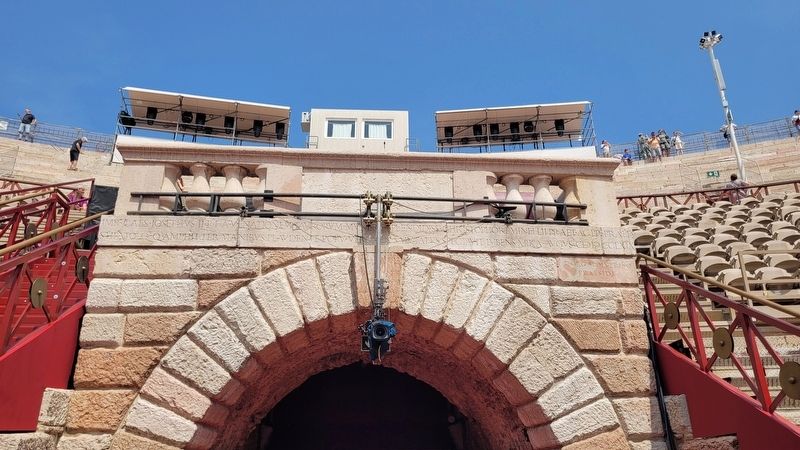
Photographed by James Hulse, June 11, 2025
5. A view of one of the interior entrance to Arena
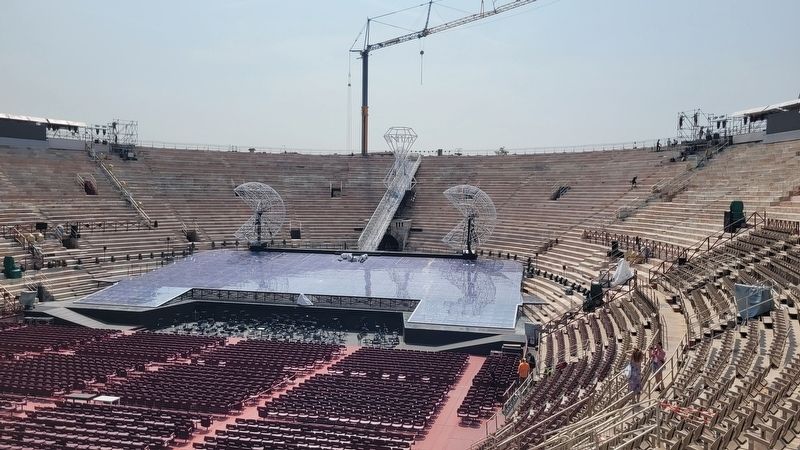
Photographed by James Hulse, June 11, 2025
6. The main view of the interior of the Arena
The Arena is being setup for an entertainment event or concert.
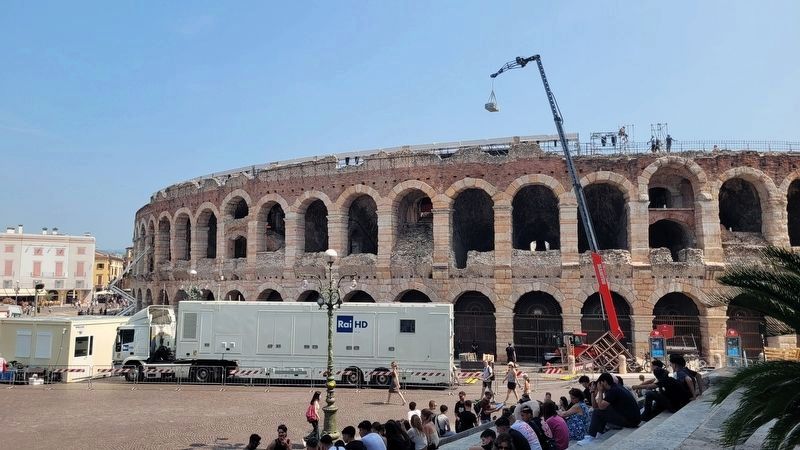
Photographed by James Hulse, June 11, 2025
7. The wide exterior view of the Arena
The Arena is being setup for a entertainment event or concert.
Credits. This page was last revised on December 8, 2025. It was originally submitted on December 8, 2025, by James Hulse of Medina, Texas. This page has been viewed 46 times since then and 21 times this year. Photos: 1, 2, 3, 4, 5, 6, 7. submitted on December 8, 2025, by James Hulse of Medina, Texas.
