
Città Antica in Verona in Provincia di Verona, Venetia, Italy — Southern and Western Europe (Mediterranean)
Dante Alighieri a Verona: il Paradiso dedicato a Cangrande della Scala
Dante Alighieri in Verona: The Paradiso Dedicated to Cangrande della Scala
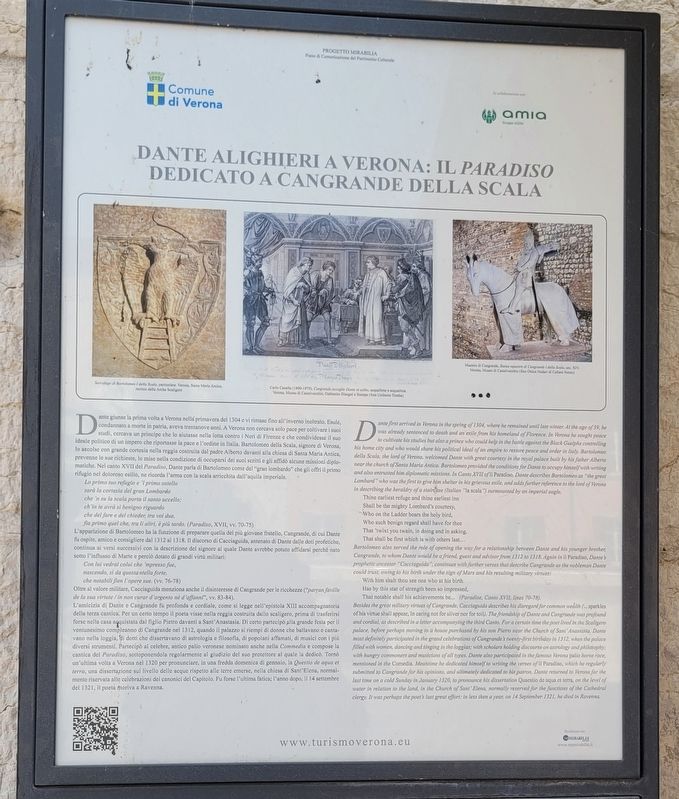
Photographed by James Hulse, June 11, 2025
1. Dante Alighieri a Verona: il Paradiso dedicato a Cangrande della Scala Marker

Dante giunse la prima volta a Verona nella primavera del 1304 e vi rimase fino all'inverno inoltrato. Esule, condannato a morte in patria, aveva trentanove anni. A Verona non cercava solo pace per coltivare i suoi studi, cercava un principe che lo aiutasse nella lotta contro i Neri di Firenze e che condividesse il suo ideale politico di un impero che riportasse la pace e l'ordine in Italia. Bartolomeo della Scala, signore di Verona, lo accolse con grande cortesia nella reggia costruita dal padre Alberto davanti alla chiesa di Santa Maria Antica, prevenne le sue richieste, lo mise nella condizione di occuparsi dei suoi scritti e gli affidò alcune missioni diplomatiche. Nel canto XVII del Paradiso, Dante parla di Bartolomeo come del "gran lombardo" che gli offrì il primo rifugio nel doloroso esilio, ne ricorda l'arma con la scala arricchita dall'aquila imperiale.
Lo primo tuo refugio e 'l primo ostelloL'apparizione di Bartolomeo ha la funzione di preparare quella del più giovane fratello, Cangrande, di cui Dante fu ospite, amico e consigliere dal 1312 al 1318. Il discorso di Cacciaguida, antenato di Dante dalle doti profetiche, continua ai versi successivi con la descrizione del signore al quale Dante avrebbe potuto affidarsi perché nato sotto l'influsso di Marte e perciò dotato di grandi virtù militari:
sarà la cortesia del gran Lombardo
che 'n su la scala porta il santo uccello;
ch'in te avrà sì benigno riguardo
che del fare e del chieder, tra voi due,
fia primo quel che, tra li altri, è più tardo. (Paradiso, XVII, vv. 70-75)
Con lui vedrai colui che 'mpresso fue,Oltre al valore militare, Cacciaguida menziona anche il disinteresse di Cangrande per le ricchezze ("parran faville de la sua virtute/in non curar d'argento né d'affanni", vv. 83-84).
nascendo, si da questa stella forte,
che notabili fien l'opere sue. (vv. 76-78)
L'amicizia di Dante e Cangrande fu profonda e cordiale, come si legge nell'epistola XIII accompagnatoria della terza cantica. Per un certo tempo il poeta visse nella reggia costruita dallo scaligero, prima di trasferirsi forse nella casa acquistata dal figlio Pietro davanti a Sant' Anastasia. Di certo partecipò alla grande festa per il ventunesimo compleanno di Cangrande nel 1312, quando il palazzo si riempi di donne che ballavano e cantavano nella loggia, di dotti che dissertavano di astrologia e filosofia, di popolani affamati, di musici con i più diversi strumenti. Partecipò al celebre, antico palio veronese nominato anche nella Commedia e compose la cantica del Paradiso, sottoponendola regolarmente al giudizio del suo protettore al quale la dedicò. Tornò un'ultima volta a Verona nel 1320 per pronunciare, in una fredda domenica di gennaio, la Questio de aqua et terra, una dissertazione sul livello delle acque rispetto alle terre emerse, nella chiesa di Sant'Elena, normalmente riservata alle celebrazioni dei canonici del Capitolo. Fu forse l'ultima fatica; l'anno dopo, il 14 settembre del 1321, il poeta moriva a Ravenna.
Didascalie
(Foto #1) Sarcofago di Bartolomeo I della Scala, particolare, Verona, Santa Maria Antics, recinto delle Arche Scaligere
(Foto #2) Carlo Canella (1800-1879), Cangrande accoglie Dante in esilio, acquaforte e acquatinta, Verona, Museo di Castelvecchio, Gabinetto Disegni e Stampe (foto Umberto Tomba)
(Foto #3) Maestro di Cangrande, Statua equestre di Cangrande I della Scala, sec. XIV, Verona, Museo di Castelvecchio (foto Ottica Nodari di Caliaro Nereo)
Dante first arrived in Verona in the spring of 1304, where he remained until late winter. At the age of 39, he was already sentenced to death and an exile from his homeland of Florence. In Verona he sought peace to cultivate his studies but also a prince who could help in the battle against the Black Guelphs controlling his home city and who would share his political ideal of an empire to restore peace and order in Italy, Bartolomeo della Scala, the lord of Verona, welcomed Dante with great courtesy in the royal palace built by his father Alberto near the church of Santa Maria Antica. Bartolomeo provided the conditions for Dante to occupy himself with writing and also entrusted him diplomatic missions. In Canto XVII of il Paradiso, Dante describes Bartolomeo as "the great Lombard" who was the first to give him shelter in his grievous exile, and adds further reference to the lord of Verona in describing the heraldry of a staircase (Italian "la scala") surmounted by an imperial eagle.
Thine earliest refuge and thine earliest innBartolomeo also served the role of opening the way for a relationship between Dante and his younger brother, Cangrande, to whom Dante would be a friend, guest and advisor from 1312 to 1318. Again in il Paradiso, Dante's prophetic ancestor "Cacciagulda", continues with further verses that describe Cangrande as the nobleman Dante could trust, owing to his birth under the sign of Mars and his resulting military virtues:
Shall be the mighty Lombard's courtesy,
Who on the Ladder bears the holy bird,
Who such benign regard shall have for thee
That 'twixt you twain, in doing and in asking,
That shall be first which is with others last...
With him shalt thou see one who at his birthBesides the great military virtues of Cangrande, Cacciaguida describes his disregard for common wealth (...sparkles of his virtue shall appear, In caring not for silver nor for toil). The friendship of Dante and Cangrande was profound and cordial, as described in a letter accompanying the third Canto. For a certain time the poet lived in the Scaligero palace, before perhaps moving to a house purchased by his son Pietro near the Church of Sant' Anastasia. Dante most definitely participated in the grand celebrations of Cangrande's twenty-first birthday in 1312, when the palace filled with women, dancing and singing in the loggias; with scholars holding discourse on astrology and philosophy: with hungry commoners and musicians of all types. Dante also participated in the famous Verona palio horse race, mentioned in the Comedia. Meantime he dedicated himself to writing the verses of il Paradiso, which he regularly submitted to Cangrande for his opinions, and ultimately dedicated to his patron. Dante returned to Verona for the last time on a cold Sunday in January 1320, to pronounce his dissertation Quaestio de aqua et terra, on the level of water in relation to the land, in the Church of Sant' Elena, normally reserved for the functions of the Cathedral clergy. It was perhaps the poet's last great effort: in less then a year, on 14 September 1321, he died in Ravenna.
Has by this star of strength been so impressed,
That notable shall his achievements be... (Paradise, Canto XVII, lines 70-78).
Captions
(Photo #1) Sarcophagus of Bartolomeo I della Scala, detail, Verona, Santa Maria Antica, enclosure of the Arche Scaligere
(Photo #2) Carlo Canella (1800-1879), Cangrande welcomes Dante in exile, etching and aquatint, Verona, Castelvecchio Museum, Drawings and Prints Cabinet (photo by Umberto Tomba).
(Photo #3) Master of Cangrande, equestrian statue of Cangrande I della Scala, 14th century, Verona, Castelvecchio Museum (photo by Ottica Nodari of Caliaru Nereo).
Erected by City
this page online
Topics. This historical marker is listed in these topic lists: Anthropology & Archaeology • Architecture • Arts, Letters, Music. A significant historical year for this entry is 1304.
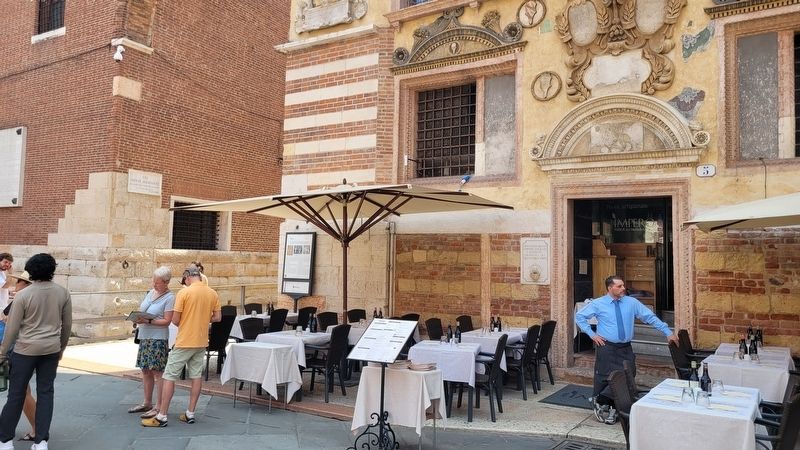
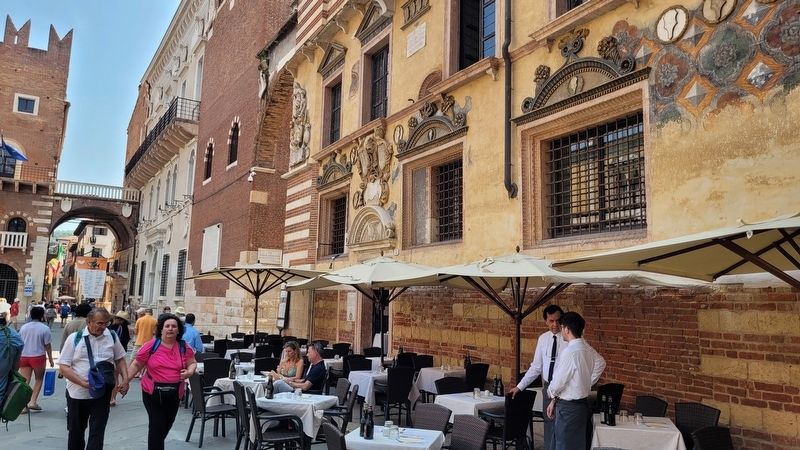
Location. 45° 26.597′ N, 10° 59.889′ E. Marker is in Verona, Veneto (Venetia), in Provincia di Verona. It is in Città Antica. It is at the intersection of Piazza dei Signori and Via Dante Alighieri, on the right when traveling east on Piazza dei Signori. The marker is located at the corner of the building in the Piazza dei Signori. Touch for map. Marker is at or near this postal address: Piazza dei Signori 5, Verona, Veneto 37121, Italy. Touch for directions.

Regionally, it is in Europe, the European Union, the Schengen Area, a coastal Mediterranean country, and the Western World. Historically, it finds itself in what was once the Roman Empire and specifically also the Holy Roman Empire.
Other nearby markers. At least 8 other markers are within walking distance of this marker: Torre dei Lamberti / Lamberti Tower (within shouting distance of this marker); Cansignorio della Scala (within shouting distance of this marker);
Photographed by James Hulse, June 11, 2025
2. Dante Alighieri a Verona: il Paradiso dedicato a Cangrande della Scala Marker
The marker is located along the wall of the building behind the outdoor restaurant.
Also see . . . Dante Alighieri. Wikipedia
Dante Alighieri (Italian: [ˈdante aliˈɡjɛːri]; most likely baptized Durante di Alighiero degli Alighieri; c. May 1265 – September 14, 1321), widely known mononymously as Dante, was an Italian[c] poet, writer, and philosopher. His Divine Comedy, originally called Comedìa (modern Italian: Commedia) and later christened Divina by Giovanni Boccaccio, is widely considered one of the most important poems of the(Submitted on December 10, 2025, by James Hulse of Medina, Texas.)Middle Ages and the greatest literary work in the Italian language.Photographed by James Hulse, June 11, 20253. The view of the marker along the street
Photographed by James Hulse, June 11, 2025
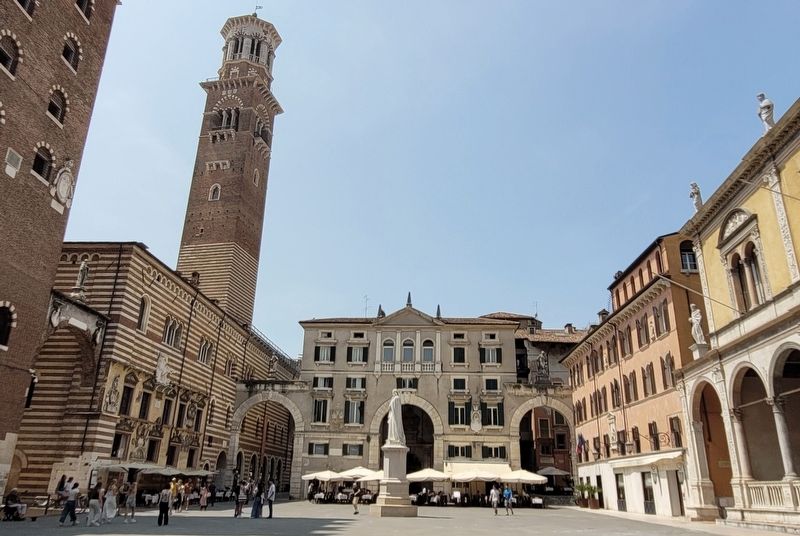
4. The view of the Piazza dei Signori
The marker is located at the far left corner of the building on the left side.
Credits. This page was last revised on December 10, 2025. It was originally submitted on December 8, 2025, by James Hulse of Medina, Texas. This page has been viewed 72 times since then and 31 times this year. Photos: 1, 2, 3, 4. submitted on December 10, 2025, by James Hulse of Medina, Texas.
