Near Italy in Ellis County, Texas — The American South (West South Central)
Shawnee Cattle Trail
Photographed by James Hulse, December 9, 2025
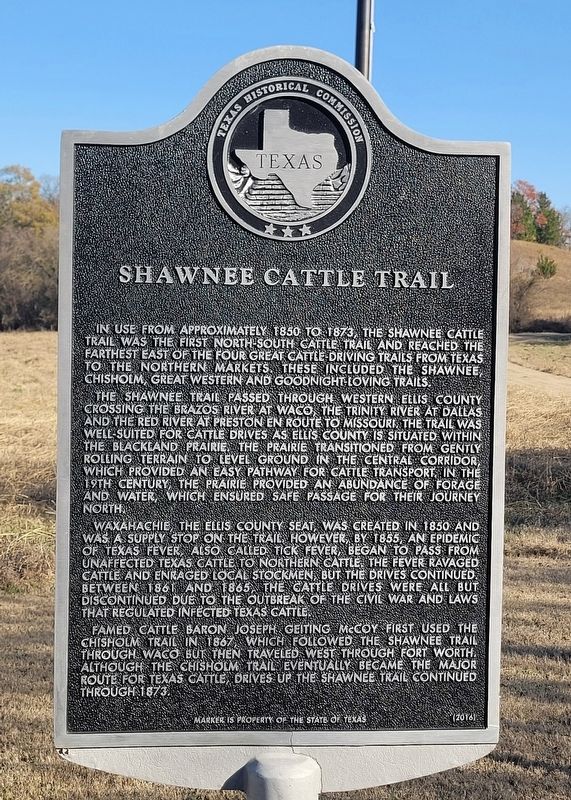
1. Shawnee Cattle Trail Marker
The Shawnee Trail passed through western Ellis County crossing the Brazos River at Waco, the Trinity River at Dallas and the Red River at Preston en route to Missouri. The trail was well-suited for cattle drives as Ellis County is situated within the Blackland Prairie. The prairie transitioned from gently rolling terrain to level ground in the central corridor which provided an easy pathway for cattle transport. In the 19th century, the prairie provided an abundance of forage and water, which ensured safe passage for their journey north.
Waxahachie, the Ellis County seat, was created in 1850 and was a supply stop on the trail. However, by 1855, an epidemic of Texas Fever also called Tick Fever, began to pass from unaffected Texas cattle to northern cattle. The fever ravaged cattle and enraged local stockmen, but the drives continued.
this page online
Famed cattle baron Joseph Geiting McCoy first used the Chisholm Trail in 1867, which followed the Shawnee Trail through Waco but then traveled west through Fort Worth. Although the Chisholm Trail eventually became the major route for Texas cattle, drives up the Shawnee Trail continued through 1873.
Erected 2016 by Texas Historical Commission. (Marker Number 18360.)
Topics. This historical marker is listed in these topic lists: Animals • Industry & Commerce • Roads & Vehicles. A significant historical year for this entry is 1850.
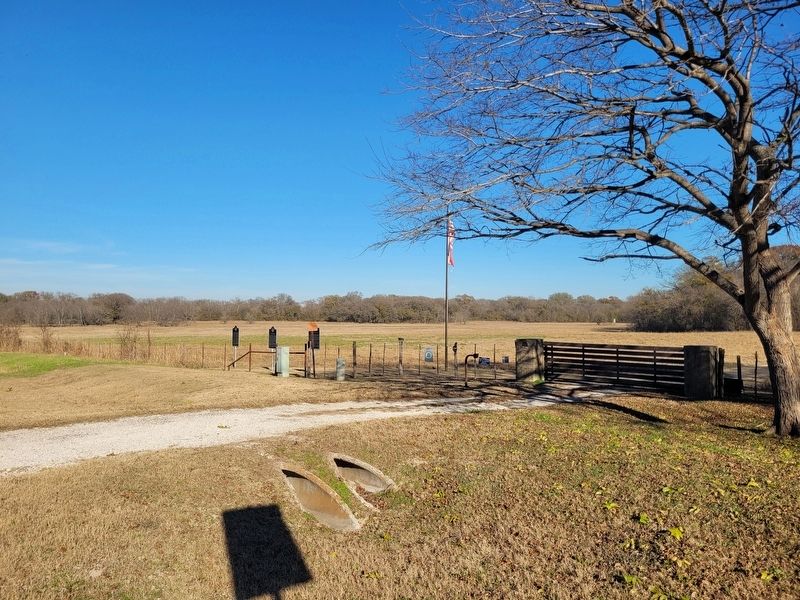
Location. 32° 14.442′ N, 96° 55.224′ W. Marker is near Italy, Texas, in Ellis County. It is on L R Campbell Road (Farm to Market Road 876) 0.1 miles south of Bell Branch Road, on the right when traveling north. The marker is located at the entrance to Pecan Springs Ranch, alongside two other Texas Historical Commission markers. Touch for map. Marker is at or near this postal address: 1900 L.R Campbell Rd, Italy TX 76651, United States of America.
Photographed by James Hulse, December 9, 2025
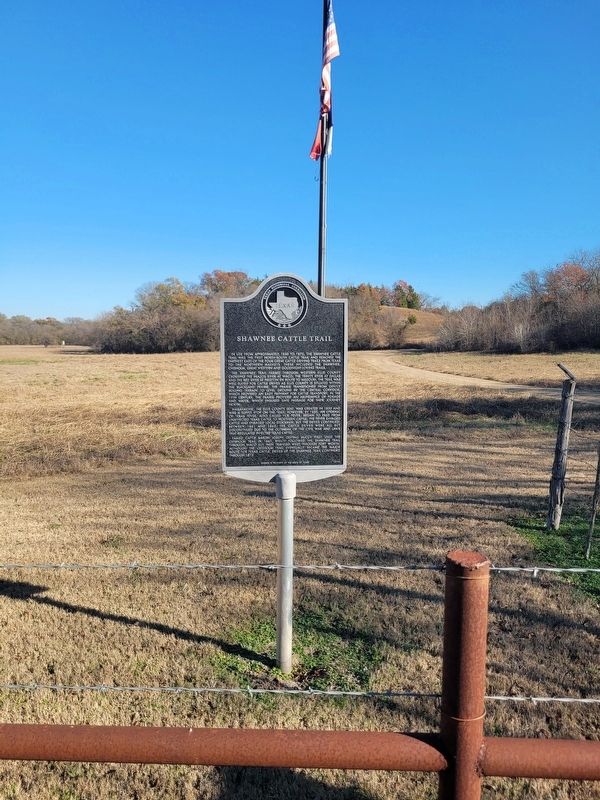
2. Shawnee Cattle Trail Marker

Regionally, this marker is in the Prairies & Lakes Region and in the Dallas-Fort Worth Metropolitan Area. Globally, it is in North America, a Gulf of Mexico state, the Western Hemisphere, the Western World, and the Anglosphere. Historically, it finds itself in what was once New Spain, the Republic of Texas, and one of the Confederate States of America.
Other nearby markers. At least 8 other markers are within 5 miles of this marker, measured as the crow flies: The Sims Family of Ellis County (here, next to this marker); Cotton Industry in Ellis County (a few steps from this marker); Chambers' Creek (approx. 3 miles away); Bethel Cemetery (approx. 3.8 miles away); Bethel Methodist Church (approx. 3.8 miles away); John Marr Hardeman (approx. 4.2 miles away); Greathouse Community, Church, and Cemetery (approx. 4.3 miles away); General Edward H. Tarrant (approx. 4½ miles away). Touch for a list and map of all markers in Italy.
Also see . . . The Shawnee Trail: A Historical Route for Texas Longhorn Cattle. Texas State Historical Association (TSHA)
Of the principal routes by which Texas longhorn(Submitted on December 9, 2025, by James Hulse of Medina, Texas.)cattle were taken afoot to railheads to the north, the earliest and easternmost was the Shawnee Trail. Used before and just after the Civil War, the Shawnee Trail gathered cattle from east and west of its main stem, which passed through Austin, Waco, and Dallas. It crossed the Red River at Rock Bluff, near Preston, and led north along the eastern edge of what became Oklahoma, a route later followed closely by the Missouri-Kansas-Texas Railroad. The drovers took over a trail long used by Indians in hunting and raiding and by southbound settlers from the Midwest; the latter called it the Texas Road. North of Fort Gibson the cattle route split into terminal branches that ended in such Missouri points as St. Louis, Sedalia, Independence, Westport, and Kansas City, and in Baxter Springs and other towns in eastern Kansas. Early drovers referred to their route as the cattle trail, the Sedalia Trail, the Kansas Trail, or simply the trail. Why some began calling it the Shawnee Trail is uncertain, but the name may have been suggested by a Shawnee village on the Texas side of the Red River just below the trail crossing or by the Shawnee Hills,Photographed by James Hulse, December 9, 20253. Shawnee Cattle Trail Marker (right side marker)which the route skirted on the eastern side before crossing the Canadian River.Photographed by James Hulse, December 9, 20254. The view of the markers at the entrance to the Pecan Springs Ranch

Credits. This page was last revised on December 10, 2025. It was originally submitted on December 9, 2025, by James Hulse of Medina, Texas. This page has been viewed 180 times since then and 126 times this year. Photos: 1, 2, 3, 4. submitted on December 10, 2025, by James Hulse of Medina, Texas.
