Ronald Reagan Washington National Airport in Arlington in Arlington County, Virginia — The American South (Mid-Atlantic)
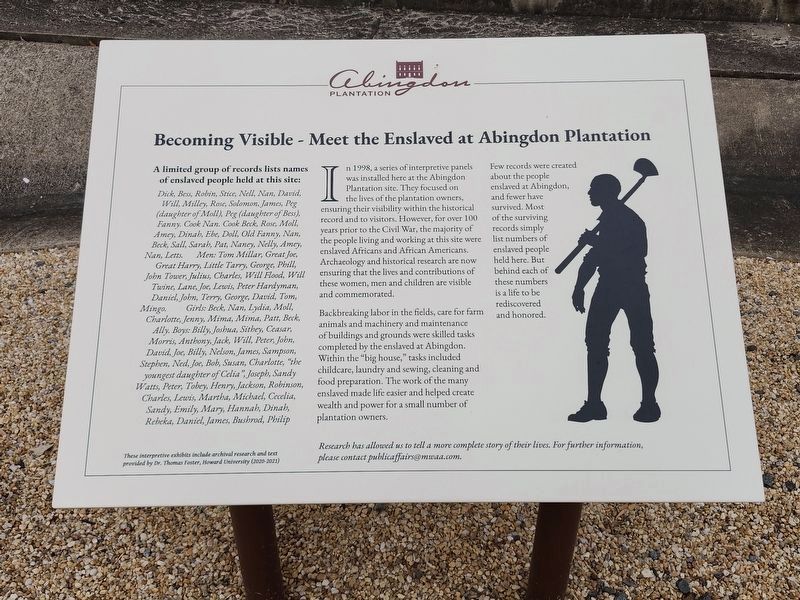
Becoming Visible - Meet the Enslaved at Abingdon Plantation
Photographed by J. Makali Bruton, December 10, 2025
1. Becoming Visible - Meet the Enslaved at Abingdon Plantation Marker
A limited group of records lists names of enslaved people held at this site:
Dick, Beo, Robin, Stice, Nell, Nan, David Will, Milley, Rose, Solomon, James, Peg (daughter of Moll), Peg (daughter of Bess), Fanny, Cook Nan. Cook Beck, Rose, Moll Amey, Dinal, Ebe, Doll, Old Fanny, Nan, Beck, Sall, Sarah, Pat, Nancy, Nelly, Amey, Nan, Letts. Men: Tom Millar, Great Joe, Great Harry, Little Tarry, George, Phill, John Tower, Julius, Charles, Will Flood, Will Twine, Lane, Joe, Lewis, Peter Hardyman, Daniel, John, Terry, George, David, Tom, Mingo. Girls Beck, Nan, Lydia, Moll, Charlotte, Jenny, Mima, Mima, Patt, Beck, Ally. Boys Billy Joshua, Sithey, Ceasar, Morris, Anthony, Jack, Will, Peter, John, David, Joe, Billy, Nelson, James, Sampson, Stephen, Ned, Jor, Bob, Susan, Charlotte, "the youngest daughter of Celia" Joseph, Sandy Watts, Peter, Tobey, Henry, Jackson, Robinson, Charles, Lewis, Martha, Michael, Cecelia, Sandy, Emily, Mary, Hannah, Dinah, Rebeka, Daniel, James, Bushrod, Philip
These interpretive exhibits include archival research and text provided by Thomas Foster, Howard University (2020-2021)
In 1998, a series
this page online
Few records were created about the people enslaved at Abingdon, and fewer have survived. Most of the surviving records simply list numbers of enslaved people held here. But behind each of these numbers is a life to be rediscovered.
Backbreaking labor in the fields, care for farm animals and machinery and maintenance of buildings and grounds were skilled tasks completed by the enslaved at Abingdon. Within the "big house," tasks included childcare, laundry and sewing, cleaning and food preparation. The work of the many enslaved made life easier and helped create wealth and power for a small number of plantation owners.
Research has allowed us to tell a more complete story of their lives. For more information, please contact [email protected]
Erected by Metropolitan
Photographed by J. Makali Bruton, December 10, 2025
2. Becoming Visible - Meet the Enslaved at Abingdon Plantation Marker
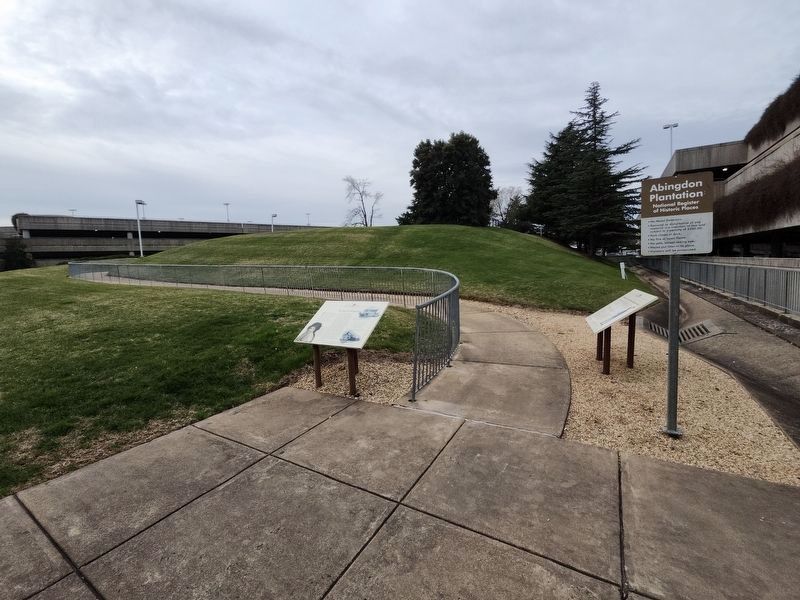
The marker is on the right.
Topics. This historical marker is listed in these topic lists: African Americans • Agriculture. A significant historical year for this entry is 1998.
Location. 38° 51.102′ N, 77° 2.644′ W. Marker is in Arlington, Virginia, in Arlington County. It is in Ronald Reagan Washington National Airport. It can be reached from National Avenue north of Smith Boulevard, on the left when traveling north. Touch for map. Marker is at or near this postal address: 2400 National Ave, Arlington VA 22202, United States of America. Touch for directions.

Regionally, this marker is in the Washington Metropolitan Area and in Northern Virginia. It is also in the American South, specifically in the Upper South, in the Mid-Atlantic, and on the Eastern Seaboard. Globally, it is in the North Atlantic Region, North America, the Western Hemisphere, the Western World, and the Anglosphere. Historically, it finds itself in what was once the territory of the Mississippian Culture, one of the original Thirteen Colonies, one of the Confederate States of America, and the Antebellum South.
Other nearby markers. At least 8 other markers are within walking distance of this marker: The Ages of Abingdon (here, next to this marker); The Stable Manager - Rented to George Washington (within shouting distance of this marker); The Alexander Family (within shouting distance of this marker); The Dress (within shouting distance of this marker); Abingdon Plantation Restoration (within shouting distance of this marker); Abingdon (within shouting distance of this marker); The Industrial Age (within shouting distance of this marker); Abingdon and John Alexander (within shouting distance of this marker). Touch for a list and map of all markers in Arlington.
Also see . . . Abingdon Plantation (Wikipedia article). (Submitted on April 28, 2026, by Bernard H. Berne of Arlington, Virginia.)
Credits. This page was last revised on April 29, 2026. It was originally submitted on December 10, 2025, by J. Makali Bruton of Washington, District of Columbia. This page has been viewed 99 times since then and 63 times this year. Last updated on April 29, 2026, by Bernard H. Berne of Arlington, Virginia. Photos: 1. submitted on December 10, 2025, by J. Makali Bruton of Washington, District of Columbia. 2. submitted on February 15, 2026, by J. Makali Bruton of Washington, District of Columbia. • Devry Becker Jones was the editor who published this page.
