
Città Antica in Verona in Provincia di Verona, Venetia, Italy — Southern and Western Europe (Mediterranean)
Arche degli Scaligeri (secolo XIV)
⎯⎯⎯
The Scaliger Tombs (14th century)

Photographed by James Hulse, June 11, 2025
1. Arche degli Scaligeri (secolo XIV) / The Scaliger Tombs (14th century) Marker

La trasformazione del cimitero parrocchiale di Santa Maria Antica in sepolcro monumentale della famiglia Della Scala tra la fine del XIII e il XIV secolo, fu lenta. Le tombe dei primi signori, Mastino I, ucciso da una congiura, Alberto I, vero iniziatore della signoria nel 1277, Bartolomeo I e Alboino, sono infatti semplici sarcofagi in marmo rosso con coperchio a doppio spiovente. Anche la prima sepoltura di Cangrande, morto avvelenato a Treviso nel 1329, è una semplice arca, arricchita soltanto da una decorazione scultorea del Maestro dell'Arca Dussaimi che lo ritrae a cavallo e in ginocchio. Il passaggio alle tombe monumentali avvenne quando Mastino II, nipote di Cangrande, qualche anno dopo fece traslare il corpo, avvolto in meravigliosi tessuti orientali, nella tomba a baldacchino sopra la porta di Santa Maria Antica. Sul fronte del sarcofago fece scolpire le conquiste del grande signore: Belluno, Feltre, Padova e Vicenza. La copertura tronco conica e la statua equestre furono commissionate da Mastino II più tardi, quando decise di far erigere anche la sua arca, affidandone la decorazione a un grande scultore, ancora anonimo. Fu il nipote a scegliere, per lo zio, la postura equestre, il volto sorridente, il cimiero con il cane alato che in realtà Cangrande non aveva mai usato. I due cavalieri sembrano dialogare, proseguendo in perfetta armonia un disegno divino affidato alla famiglia. Mastino II si fece ritrarre con il volto nascosto dal cimiero, evocando l'usanza dei Longobardi di coprirsi con maschere a forma di teste di cane per spaventare i nemici e accreditandosi in tal modo come loro successore. L'arca di Cansignorio, nell'angolo del sepolcreto, supera in ricchezza e grandiosità le altre tombe. Figlio di Mastino II e Taddea da Carrara, Cansignorio si era impadronito del potere assassinando i fratelli. Prima di morire, a trentasei anni, aveva commissionato l'arca a Bonino da Campione. Di forma esagonale, la tomba è custodita da sei santi e decorata con sei episodi evangelici. Sul basamento della statua, entro nicchie, stanno sei virtù, le quattro cardinali e due teologali, la Speranza e la Carità. La Fede, non raffigurata, è personificata da Cansignorio stesso. La presenza del doppio ritratto in tutti e tre i sepolcri significa che il corpo del signore è morto sul cataletto ma l'anima è ascesa al cielo. Le statue di Cangrande e Mastino II sono copie degli originali esposti al Museo di Castelvecchio. Intorno al 1382 Antonio della Scala, ultimo rappresentante della signoria, fece costruire il recinto di raccordo tra le Arche e la chiesa (rifatto in buona parte tra Otto e Novecento) e collocare su quattro piedestalli le personificazioni di Verona e Vicenza, Temperanza e Giustizia in veste di Giuditta (ora al Museo di Castelvecchio). Nelle Arche è conservata anche la tomba di Giovanni, cugino di Mastino II, qui trasferita nel 1831 dalla chiesa di San Fermo Maggiore.
Didascalie
(Foto #1) Sarcofago di Bartolomeo I della Scala, fronte. Verona, Santa Maria Antica, recinto delle Arche Scaligere
(Foto #2) Maestro dell'arca di Mastino II della Scala, Caino e Abele. Arca di Mastino II della Scala, timpano sud. Verona, recinto delle Arche Scaligere
(Foto #3) Bonino da Campione e collaboratori, Statua equestre di Cansignorio della Scala (particolare), Arca di Cansignorio della Scala. Verona, recinto delle Arche Scaligere
The work of reshaping the Santa Maria parish cemetery as a monument to the Della Scala family was a slow process, conducted through the late 1200s and the 1300s. The bodies of the first lords were placed in simple sarcophagi in red marble with peaked lids, such as furnished for Mastino I, a victim of conspiracy, for Alberto I, who became the first true lord of Verona in 1277, and for Bartholomew I and Alboino. The first tomb of Cangrande, poisoned at Treviso in 1329, was also a simple ark, embellished only with sculptural decoration by Dussaimi (the "Master of the Ark"), showing the ruler kneeling and on horseback. The conversion to grander structures began under Mastino II, a nephew, who transferred Cangrande's body, wrapped in sumptuous oriental fabrics, to a new monumental tomb in tabernacle at the very doors of Santa Maria Antica. For the front of the sarcophagus he ordered carvings of Cangrande's victories over Belluno, Feltre, Padua and Vicenza. The truncated pyramidal baldachin and equestrian statue were commissioned later, at the same time as Mastino II erected his own tomb, from a master sculptor still unknown by name. Thus it was the nephew who chose the equestrian pose for his uncle, complete with smiling face and the heraldry of the winged dog, which in fact Cangrande had never used. The two armed horsemen seem engaged in conservation, while together pursuing the divine duties assigned to the family. For his own sculpture, Mastino II commissioned a depiction with his face hidden by a visor, suggesting the practices of the Lombard conquerors that covered their heads with "dog's-head" helmets to frighten their enemies: symbolism intended to claim greater credit as their successor. The ark of Cansignorio, placed at a corner of the tomb complex, exceeds the others in richness and grandeur. Son of Mastino II and Taddea of Carrara, Cansignorio seized power through the assassination of his brothers. He commissioned the tomb from Bonino da Campione prior to his own death, at the age of 37. Hexagonal in shape, the tomb is guarded by six saints and decorated with six episodes of the Gospel. In the niches at the base are the four cardinal virtues and two of the theological virtues, Hope and Charity. Faith, not portrayed, is personified by Cansignorio himself. The use of the double portrait on all three tombs signifies that the body of the ruler lies dead in the coffin but his soul has ascended to heaven. The statues of Cangrande and Mastino II are copies of the originals, now conserved at the Castelvecchio Museum. Antonio della Scala, the last in the line of the lords, built the enclosure that connects the Arks with the church, which was itself largely rebuilt in the 19th and 20th centuries. Here, on four pedestals, he also placed elegant personifications of the cities of Verona and Vicenza, and of Temperance and Justice as Judith (currently conserved in the Castelvecchio Museum). The monument also includes the tomb of Giovanni, cousin of Mastino II, whose remains were transferred here from the church of San Fermo Maggiore in 1831.
Captions
(Photo #1) Sarcophagus of Bartolomeo I della Scala, front view. Verona, Santa Maria Antica, enclosure of the Scaliger Tombs.
(Photo #2) Master of the Ark of Mastino II della Scala, Cain and Abel. Ark of Mastino II della Scala, south tympanum. Verona, Scaliger Tombs enclosure.
(Photo #3) Bonino da Campione and collaborators, Equestrian statue of Cansignorio della Scala (detail), Tomb of Cansignorio della Scala. Verona, Scaliger Tombs enclosure.
Erected by City
this page online
Topics. This historical marker is listed in this topic list: Cemeteries & Burial Sites. A significant historical year for this entry is 1277.
Location. 45° 26.613′ N, 10° 59.933′ E. Marker is in Verona, Veneto (Venetia), in Provincia di Verona. It is in Città Antica. It is at the intersection of Via Santa Maria Antica and Via Arche Scaligere, on the right when traveling east on Via Santa Maria Antica. The marker is located near the entrance to the church. Touch for map. Marker is at or near this postal address: Via S Maria Antica 4, Verona, Veneto 37121, Italy. Touch for directions.

Regionally, it is in Europe, the European Union, the Schengen Area, a coastal Mediterranean country, and the Western World. Historically, it finds itself in what was once the Roman Empire and specifically also the Holy Roman Empire.
Other nearby markers. At least 8 other markers are within walking distance of this marker: Chiesa di Santa Maria Antica (secolo XII) / Church of Santa Maria Antica (12th century) (here, next to this marker); Cansignorio della Scala (within shouting distance of this marker); Palazzo del Governo, già Reggia Scaligera (secolo XIV)

Photographed by James Hulse, June 11, 2025
2. The Scaliger Tombs (14th century) and Marker
Photographed by James Hulse, June 11, 2025
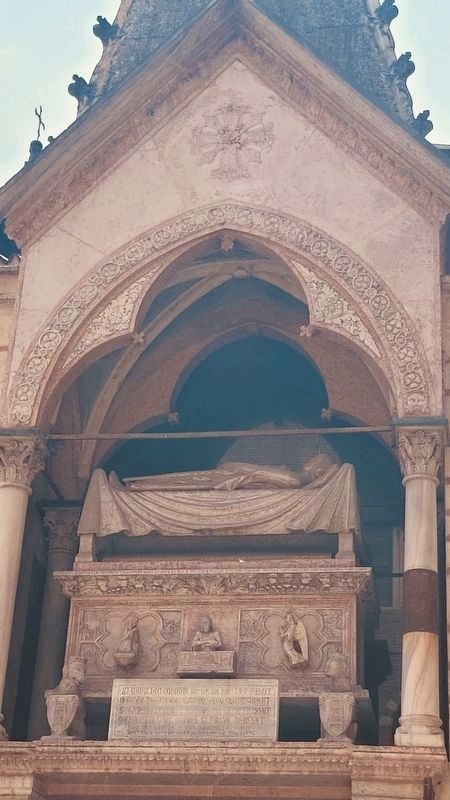
3. The sarcophagus and effigy of Cangrande I over the front entrance to the church

Photographed by James Hulse, June 11, 2025
4. Church of Santa Maria Antica

Photographed by James Hulse, June 11, 2025
5. The Scaliger Tombs
Credits. This page was last revised on December 11, 2025. It was originally submitted on December 10, 2025, by James Hulse of Medina, Texas. This page has been viewed 63 times since then and 40 times this year. Photos: 1, 2, 3, 4, 5. submitted on December 11, 2025, by James Hulse of Medina, Texas.
