Downtown in Evansville in Vanderburgh County, Indiana — The American Midwest (Great Lakes)
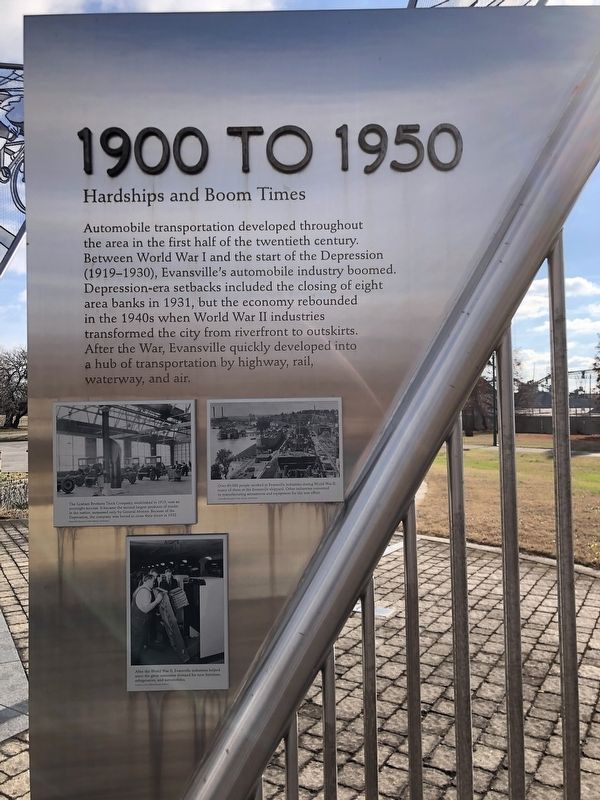
1900 to 1950
Hardships and Boom Times
⎯⎯⎯
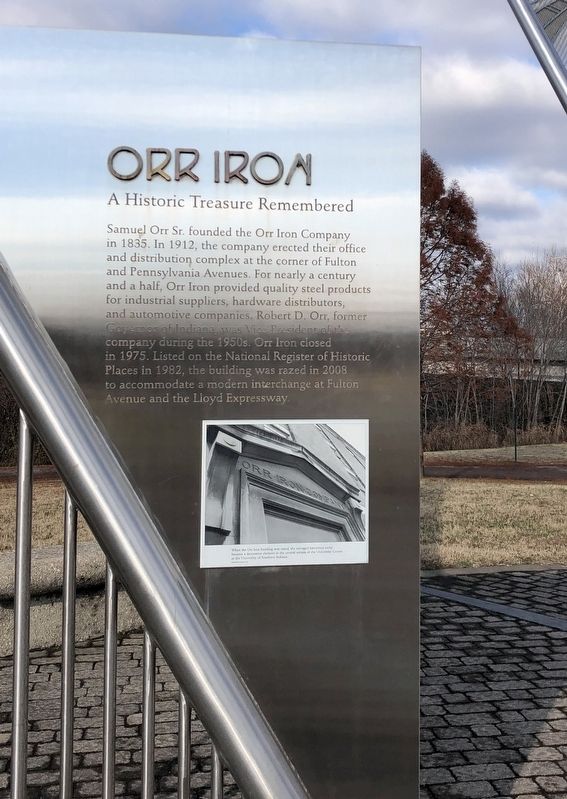
Orr Iron
A Historic Treasure Remembered
Photographed by Duane and Tracy Marsteller, November 30, 2025
1. 1900 to 1950 side of marker
1900 to 1950. Hardship and Boom Times. Automobile transportation developed throughout the area in the first half of the twentieth century. Between World War I and the start of the Depression (1919-1930), Evansville's automobile industry boomed. Depression-era setbacks included the closing of eight area banks in 1931, but the economy rebounded in the 1940s when World War II industries transformed the city from riverfront to outskirts. After the War, Evansville quickly developed into a hub of transportation by highway, rail, waterway, and air.
Orr Iron. A Historic Treasure Remembered. Samuel Orr Sr. founded the Orr Iron Company in 1835. In 1912, the company erected their office and distribution complex at the corner of Fulton and Pennsylvania Avenues. For nearly a century and a half, Orr Iron provided quality steel products for industrial suppliers, hardware distributors, and automotive companies. Robert D. Orr, former Governos of Indiana, was Vice Presidential company during the 1950s. Orr Iron closed in 1975. Listed on the National Register of Historic Places in 1982, the building was razed in 2008 to accommodate a
this page online
Topics. This historical marker is listed in these topic lists: Industry & Commerce • Roads & Vehicles. A significant historical year for this entry is 1931.
Location. 37° 58.633′ N, 87° 35.153′ W. Marker is in Evansville, Indiana, in Vanderburgh County. It is in Downtown. It is on South 7th Avenue west of Ohio River Scenic Byway, on the left when traveling west. Touch for map. Marker is at or near this postal address: 201 S 7th Ave, Evansville IN 47708, United States of America. Touch for directions.

Regionally, this marker is in the Tri-State Region and in Southern Indiana. It is also in the American Midwest, in the Ohio River Valley, and in the Corn Belt. Globally, it is in North America, the Western Hemisphere, the Western World, and the Anglosphere. Historically, it finds itself in what was once the territory of the Mississippian Culture and also the Northwest Territory.
Other nearby markers. At least 8 other markers are within walking distance of this marker: 1950 to 2000 / General Waste (here, next to this marker); 2000 & Beyond (here, next to this
Photographed by Duane and Tracy Marsteller, November 30, 2025
2. Orr Iron side of marker
Another marker is no longer nearby. Joan Marchand Bridge (was about 600 feet away but has been confirmed missing).
Photographed by Duane and Tracy Marsteller, November 30, 2025
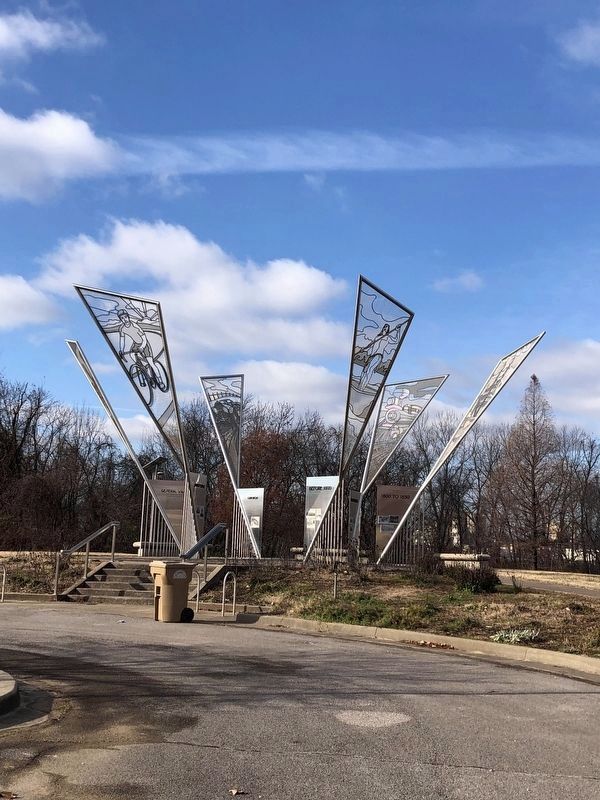
3. 1900 to 1950 / Orr Iron Marker
Credits. This page was last revised on December 23, 2025. It was originally submitted on December 11, 2025, by Duane and Tracy Marsteller of Murfreesboro, Tennessee. This page has been viewed 63 times since then and 26 times this year. Photos: 1, 2, 3. submitted on December 11, 2025, by Duane and Tracy Marsteller of Murfreesboro, Tennessee. • Devry Becker Jones was the editor who published this page.
