Walker in Cass County, Minnesota — The American Midwest (Upper Plains)
"Unity"
Photographed by Cosmos Mariner, September 6, 2023
1. "Unity" Marker
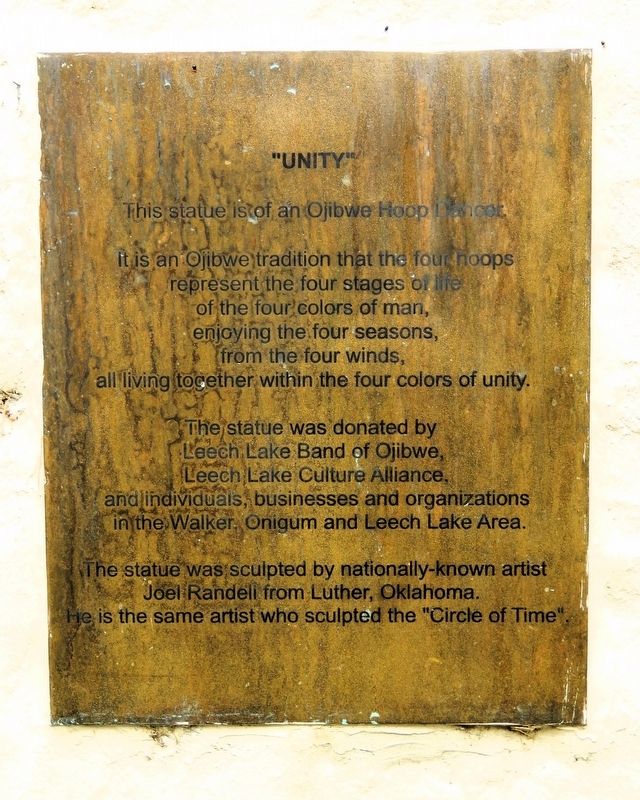
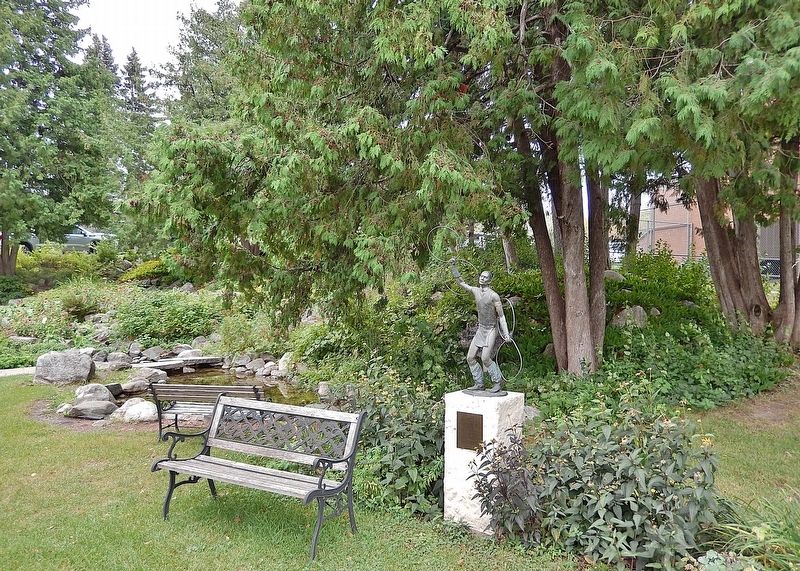
This statue is of an Ojibwe Hoop Dancer.
It is an Ojibwe tradition that the four hoops represent the four stages of life of the four colors of man, enjoying the four seasons, from the four winds, all living together within the four colors of unity.
The statue was donated by Leech Lake Band of Ojibwe, Leech Lake culture Alliance, and individuals, businesses and organizations in the Walker, Onigum and Leech Lake Area.
The statue was sculpted by nationally known artist Joel Randell from Luther, Oklahoma. He is the same artist who sculpted the “Circle of Time.”
Topics. This historical marker is listed in these topic lists: Arts, Letters, Music • Indigenous Peoples and Communities.
Location. 47° 6.074′ N, 94° 34.728′ W. Marker is in Walker, Minnesota, in Cass County. It can be reached from the intersection of Minnesota Avenue West (State Highway 200/371) and 3rd Street, on the right when traveling east. Touch for map. Marker is at or near this postal address: 205 Minnesota Avenue West, Walker MN 56484, United States of America. Touch for directions.

Regionally, this marker
this page online
Other nearby markers. At least 8 other markers are within walking distance of this marker: Cass County War Memorial (within shouting distance of this marker); "God Bless America" (within shouting distance of this marker); "The Wind Beneath Our Wings" (within shouting distance of this marker); "More Than Just A Fish Camp!" (within shouting distance of this marker); "Big Enough to Keep" (within shouting distance of this marker); Statue of Justicia (within shouting distance of this marker); "Respect for Human Life" (within shouting distance of this marker); "Spare That Tree" (within shouting distance of this marker). Touch for a list and map of all markers in Walker.
Also see . . .
1. Native American Hoop Dance (Wikipedia).
Excerpt: Like other(Submitted on December 13, 2025, by Cosmos Mariner of Cape Canaveral, Florida.)native dances, hoop dance is not acrobatic but restrained. The dancer usually takes small steps when performing the dance. Hoop dance, an individual dance, is a "show dance" in some tribes. Native American Hoop dance usually focuses on very rapid moves, but sometimes speed and creativeness balance the scoring between Hoop dancers who use only four hoops but dance to extremely fast songs, versus dancers with 20 or more hoops who danced to a slower drumbeat. Some dancers mimic animals such as birds or working of hunting, fishing, planting and harvesting. In elaborate sequences of moves, the hoops are made to interlock, and in such a way they can be extended from the body of the dancer to form appendages such as wings and tails. Today, many contemporary hoop dancers will color their hoops in four colors to represent the four directions.Photographed by Cosmos Mariner, September 6, 20232. "Unity" Marker & Sculpture

2. Hoop dance performance: Lisa Odjig (Youtube). World champion hoop dancer and Seneca Alumna Lisa Odjig, a member of the Ojibwe Nation, performs a traditional hoop dance. (Submitted on December 13, 2025, by Cosmos Mariner of Cape Canaveral, Florida.)

Photographed by Cosmos Mariner, September 6, 2023
3. "Unity" Sculpture
Photographed by Cosmos Mariner, September 6, 2023
4. "Unity" Marker & Sculpture
Credits. This page was last revised on December 13, 2025. It was originally submitted on December 13, 2025, by Cosmos Mariner of Cape Canaveral, Florida. This page has been viewed 49 times since then and 18 times this year. Photos: 1, 2, 3, 4. submitted on December 13, 2025, by Cosmos Mariner of Cape Canaveral, Florida.
