Chinatown in Manhattan in New York County, New York — The American Northeast (Mid-Atlantic)
Chinese Railroad Workers
| — | Chinese Railroad Workers in North America Project at Stanford University | — |
Photographed by Sean P. Flynn, June 5, 2025
1. Chinese Railroad Workers Marker
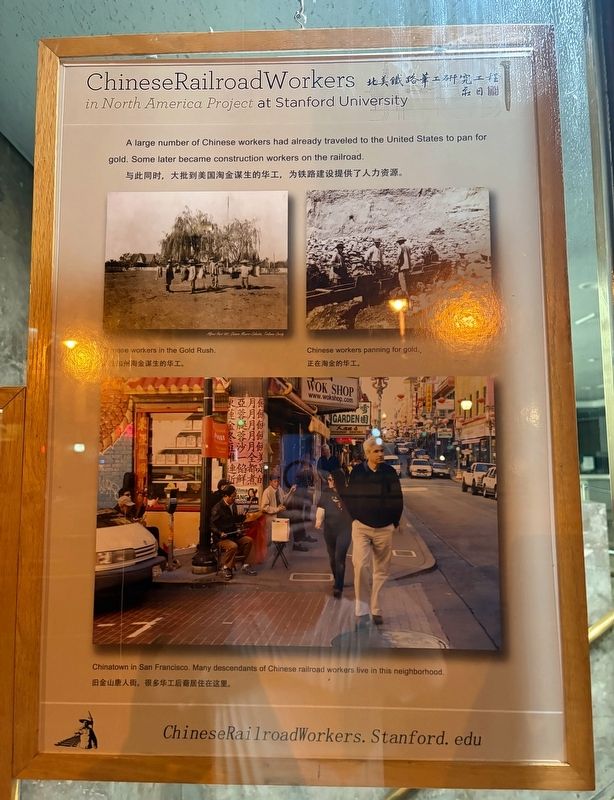
与此同时,大批到美国淘金谋生的华工,为铁路建设提供了人力资源。
[Captions for photos:]
23 Chinese workers in the Gold Rush.
前往加州淘金谋生的华工。
Chinese workers panning for gold.
正在淘金的华工。
Chinatown in San Francisco. Many descendants of Chinese railroad workers live in this neighborhood.
旧金山唐人街。很多华工后裔居住在这里。
Erected by Chinese Railroad Workers in North America Project.
Topics and series. This historical marker is listed in these topic lists: Asian Americans • Immigration • Railroads & Streetcars. In addition, it is
this page online
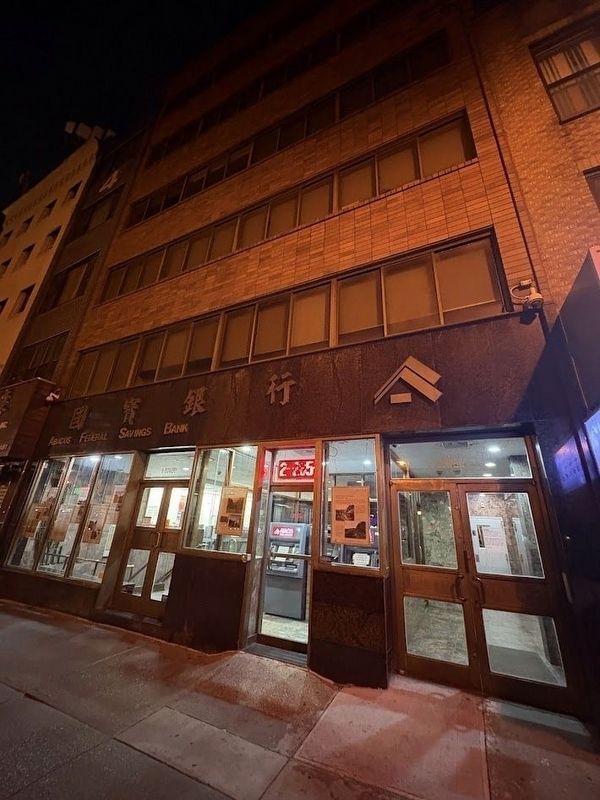
Location. 40° 42.86′ N, 73° 59.853′ W. Marker is in Manhattan, New York, in New York County. It is in Chinatown. It is on Bowery north of Doyers Street, on the right when traveling south. The marker is in the window of Abacus Federal Savings Bank. Touch for map. Marker is at or near this postal address: 6 Bowery, New York NY 10002, United States of America. Touch for directions.

Regionally, this marker is in New York City. It is also in the American Northeast, in the Mid-Atlantic, and on the Eastern Seaboard. Globally, it is in the North Atlantic Region, North America, the Western Hemisphere, the Western World, and the Anglosphere. Historically, it finds itself in what was once New Netherland and also one of the original Thirteen Colonies.
Other nearby markers. At least 8 other markers are within walking distance of this marker: Building the Transcontinental Railroad (here, next to this marker); The Chinese Workers' First Challenge (here, next to this marker); Bloomer Cut (here, next to this marker); The Starting Point
Photographed by Sean P. Flynn, June 5, 2025
2. Abacus Federal Savings Bank
Eight markers about Chinese workers on the railways are in the windows of the bank.
Also see . . . The Chinese Railroad Workers in North America Project.
Excerpt: "The wealth that enabled Leland Stanford to found Stanford University was, to a large extent, the result of his being an owner of the Central Pacific Railroad, the Western portion of the first Transcontinental Railroad across the United States. Ninety percent of the ten to fifteen thousand workers who built the railroad, completed in 1869, came from China. Their key place in American history and in the history of Stanford University was never fully acknowledged before this Project was undertaken. Indeed, at the 100th anniversary of the completion of the railroad in 1969, the role of the Chinese in its construction was almost completely ignored. The Chinese Railroad Workers in North America Project was created to ensure that the place of the Chinese in this chapter of the past not be ignored ever again."(Submitted on December 15, 2025, by Sean P. Flynn of Oak Park, Illinois.)
Credits. This page was last revised on December 15, 2025. It was originally submitted on December 15, 2025, by Sean P. Flynn of Oak Park, Illinois. This page has been viewed 68 times since then and 36 times this year. Photos: 1, 2. submitted on December 15, 2025, by Sean P. Flynn of Oak Park, Illinois.
