Regierungsvierte in Berlin in Mitte, Germany — Northeast German Plain (The European Plain)
Denkmal zur Erinnerung an die Bücherverbrennung
‘Bibliothek’
⎯⎯⎯
Book Burning Memorial
“The Empty Library”
Photographed by Andrew Ruppenstein, August 27, 2025
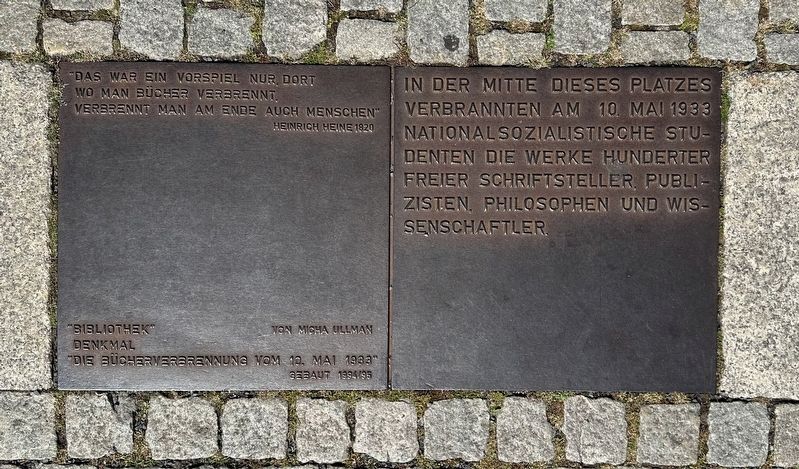
1. Denkmal zur Erinnerung an die Bücherverbrennung / Book Burning Memorial Marker

Heinrich Heine 1820
In der Mitte dieses Platzes verbrannten am 10 mai 1933 nationalsozialistische Studenten die Werke hunderter freier Schriftsteller, Publizisten, Philosophen und Wissenschaftler.
"That was only a prelude; where they burn books, they will ultimately burn people as well."
Heinrich Heine, 1820
In the center of this square, on May 10, 1933, National Socialist students burned the works of hundreds of independent writers, journalists, philosophers, and scientists.
Erected 1994.
Topics. This historical marker and memorial is listed in these topic lists: Arts, Letters, Music • Notable Events. A significant historical date for this entry is May 10, 1933.
Location. 52° 30.987′ N, 13° 23.638′ E. Marker is in Berlin, in Mitte. It is in Regierungsvierte. It is on Bebelplatz, in the median. Touch for map. Marker is at or near this postal address: Bebelplatz 1, Berlin 10117, Germany. Touch for directions.

Regionally, it is in Europe, the European Union, Atlantic Europe, Central
this page online
Other nearby markers. At least 8 other markers are within walking distance of this marker: Bücherverbrennung vom 10. Mai 1933 / The Book Burning of May 10, 1933 (within shouting distance of this marker); König Willem I der Niederlande / King William I of the Netherlands (about 120 meters away, measured in a direct line); Governeurshaus / Governor’s Residence (about 120 meters away); Max Planck (about 150 meters away); Verein für die Geschichte Berlins / Berlin Historical Society (about 210 meters away); Carl Gotthard Langhans (about 240 meters away); Haus der Demokratie / House of Democracy (approx. 0.4 kilometers away); Die Berliner Mauer - The Berlin Wall (approx. 0.4 kilometers away). Touch for a list and map of all markers in Berlin.
Related markers. Click here for a list of markers that are related to this marker.
Also see . . .
1. The Empty Library (Wikipedia). Excerpt:
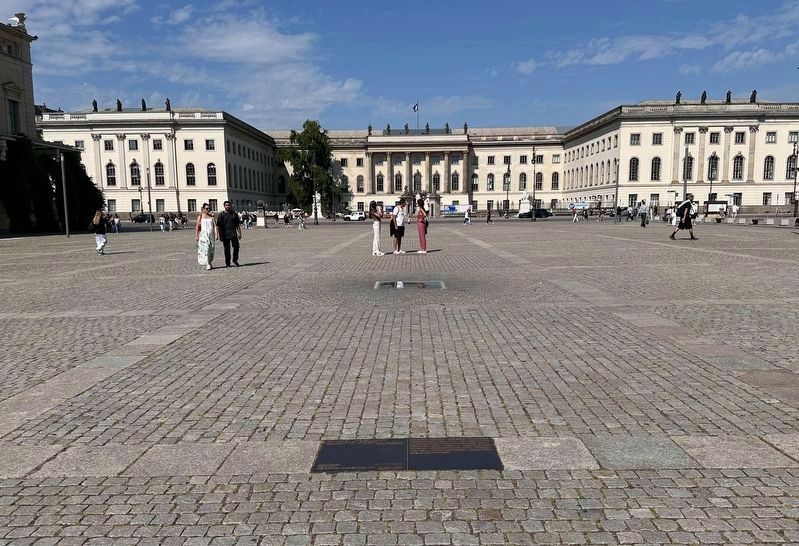
On April 6, 1933, the Nazi German Student Association's(Submitted on December 16, 2025.)Main Office for Press and Propaganda announced a nationwide initiative "against the un-German spirit", climaxing in a literary Säuberung, or cleansing, by fire. Local chapters of the group were charged with the distribution of literary blacklists that included Jewish, Marxist, Socialist, anti-family, and anti-German literature and planned grand ceremonies for the public to gather and dispose of the objectionable material.Photographed by Andrew Ruppenstein, August 27, 20252. Book Burning Memorial and marker - wide view, looking northThe memorial itself is the glass inset in the pavement (and the space below it) - see Photo 3. Visible in the background is Humboldt University. Not visible here, just a few steps out of the frame, both to the left and right, are identically worded plaques also embedded in the pavement.
In Berlin, the German Student Union organized the celebratory book burnings that took place on May 10, 1933, on a dreary, rainy evening. 40,000 people crowded into the Opernplatz (as it was then known) as 5,000 German students proceeded past them, holding burning torches to ceremonially ignite the pile of books seized for the event. Joseph Goebbels, Germany's Reich Minister of Propaganda, spoke at the event, declaring that "the era of exaggerated Jewish intellectualism is now at an end… and the future German man will not just be a man of books… this late hour [I] entrust to the flames the intellectual garbage of the past." Thirty-four additional book burnings took place across Germany that month.
2. Nazi book burnings (Wikipedia).
Photographed by Andrew Ruppenstein, August 27, 2025
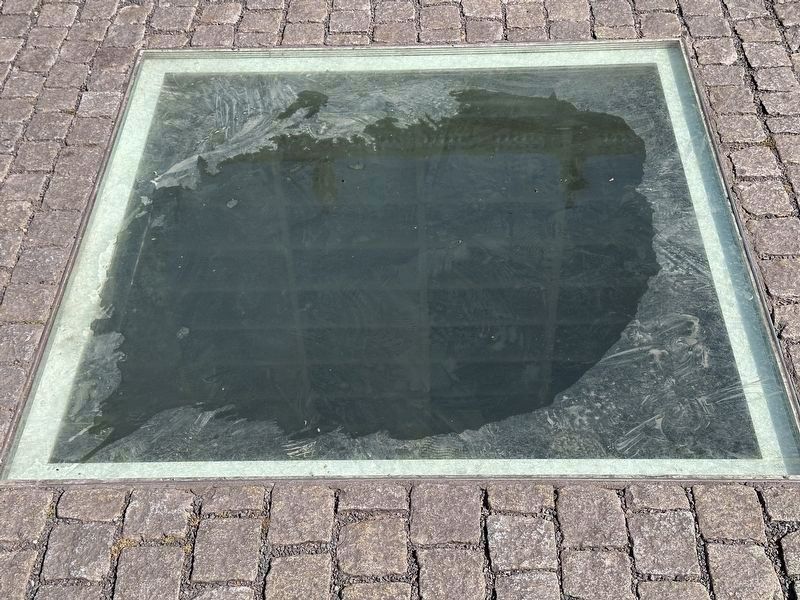
3. Bibliothek / “The Empty Library” by Micha Ullman
…The memorial exemplifies what art historian James E. Young terms as "negative form," sinking into the cobblestones of the Bebelplatz to create a void. The placement of the room underneath the cobblestones of the plaza forces viewers to crane their necks in order to look into the memorial. Approximating the volume of the 20,000 books burned on that site on May 10, 1933… - Wikipedia
The Nazi book burnings were a campaign conducted by the German Student Union (German: Deutsche Studentenschaft, DSt) to ceremonially burn books in Nazi Germany and Austria in the 1930s. The books targeted for burning were those viewed as being subversive or as representing ideologies opposed to Nazism. These included books written by Jewish, half-Jewish, communist, socialist, anarchist, liberal, pacifist, and sexologist authors among others. The initial books burned were those of Karl Marx and Karl Kautsky, but came to include other authors, including Albert Einstein, Helen Keller, Magnus Hirschfeld, and effectively any book incompatible with Nazi ideology. In a campaign of cultural genocide, books were also burned en masse by the Nazis in occupied territories, such as in Poland.(Submitted on December 16, 2025.)
3. A Book Burning Memorial in Berlin (Youtube, 40 seconds). A DW short (Submitted on December 16, 2025.)
4. Burning The Books - May 10 1933 - (Youtube, 2:54, in German). A British Pathé newsclip, likely unfinished as there is no English-language voiceover, only the original German-language
courtesy United States Holocaust Memorial Museum (via Wikimedia Commons), May 10, 1933
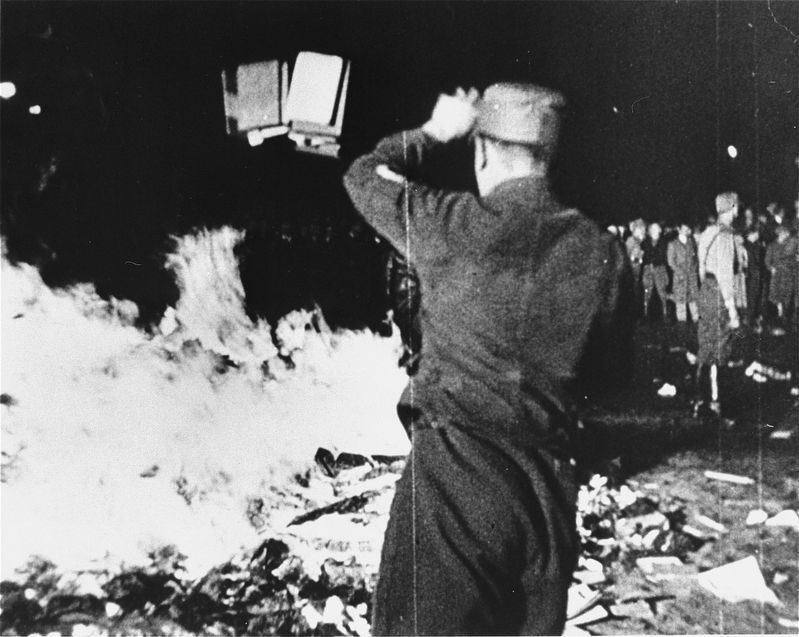
4. Burning books
“A member of the SA throws confiscated books into the bonfire during the public burning of "un-German" books on the Opernplatz in Berlin”.
Additional keywords. Gedenktafel
Credits. This page was last revised on December 16, 2025. It was originally submitted on December 16, 2025, by Andrew Ruppenstein of Lamorinda, California. This page has been viewed 159 times since then and 108 times this year. Photos: 1, 2, 3, 4. submitted on December 16, 2025, by Andrew Ruppenstein of Lamorinda, California.
