Near Grottoes in Augusta County, Virginia — The American South (Mid-Atlantic)
Piedmont Battlefield
| — | 1 Story / 1 Thousand Voices | — |
Photographed by Bernard Fisher, December 18, 2025
1. Piedmont Battlefield Marker
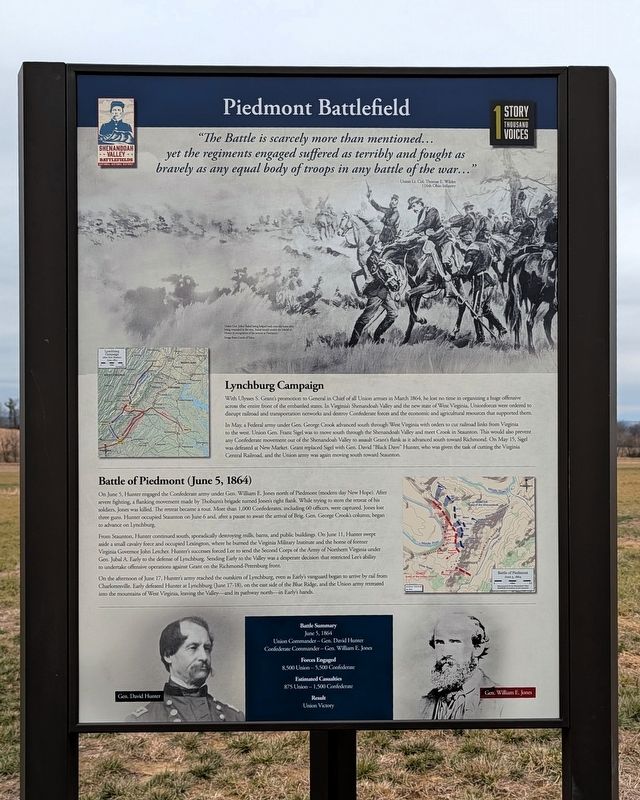
Lynchburg Campaign
With Ulysses S. Grant's promotion to General in Chief of all Union armies in March 1864, he lost no time in organizing a huge offensive across the entire front of the embattled states. In Virginia's Shenandoah Valley and the new state of West Virginia, Union forces were ordered to disrupt railroad and transportation networks and destroy Confederate forces and the economic and agricultural resources that supported them.
In May, a Federal army under Gen. George Crook advanced south through West Virginia with orders to cut railroad links from Virginia to the west. Union Gen. Franz Sigel was to move south through the Shenandoah Valley and meet Crook in Staunton. This would also prevent any Confederate movement out of the Shenandoah Valley to assault Grant's flank as it advanced south toward Richmond. On May 15, Sigel was defeated at New Market. Grant replaced Sigel with Gen.
this page online
Battle of Piedmont (June 5, 1864)
On June 5, Hunter engaged the Confederate army under Gen. William E. Jones north of Piedmont (modern day New Hope). After severe fighting, a flanking movement made by Thoburn's brigade turned Jones's right flank. While trying to stem the retreat of his soldiers, Jones was killed. The retreat became a rout. More than 1,000 Confederates, including 60 officers, were captured. Jones lost three guns. Hunter occupied Staunton on June 6 and, after a pause to await the arrival of Brig. Gen. George Crook's column, began to advance on Lynchburg.
From Staunton, Hunter continued south, sporadically destroying mills, barns, and public buildings. On June 11, Hunter swept aside a small cavalry force and occupied Lexington, where he burned the Virginia Military Institute and the home of former Virginia Governor John Letcher. Hunter's successes forced Lee to send the Second Corps of the Army of Northern Virginia under Gen. Jubal A. Early to the defense of Lynchburg.

Photographed by Bernard Fisher, December 18, 2025
2. Piedmont Battlefield Marker
On the afternoon of June 17, Hunter's army reached the outskirts of Lynchburg, even as Early's vanguard began to arrive by rail from Charlottesville. Early defeated Hunter at Lynchburg (June 17-18), on the east side of the Blue Ridge, and the Union army retreated into the mountains of West Virginia, leaving the Valley—and its pathway north—in Early's hands.
(captions)
Union Gen. Julius Stahel being helped back ono his horse after being wounded in the arm. Scahel would receive the Medal of Honor in recognition of his actions at Piedmont. Image from Deeds of Valor
Gen. David Hunter Gen. William E. Jones
Battle Summary
June 5, 1864
Union Commander-Gen. David Hunter
Confederate Commander-Gen. William E. Jones
Forces Engaged
8,500 Union - 5,500 Confederate
Estimated Casualties
875 Union - 1,500 Confederate
Result
Union Victory
(panel 2)
Explore.
Learn.
Remember.
Today the Piedmont Battlefield retains much of the agricultural appearance it

Photographed by Bernard Fisher, December 18, 2025
3. Piedmont Battlefield Marker
You, too, can help preserve and interpret the battlefields of the Shenandoah Valley.
Become a Member today!
Erected 2025 by Shenandoah Valley Battlefields Foundation.
Topics. This historical marker is listed in this topic list: War, US Civil. A significant historical date for this entry is June 5, 1864.
Location. 38° 13.051′ N, 78° 53.876′ W. Marker is near Grottoes, Virginia, in Augusta County. It is on Battlefield Road north of Patterson Mill Road, on the right when traveling south. Touch for map. Marker is at or near this postal address: 1131 Battlefield Rd, Grottoes VA 24441, United States of America. Touch for directions.

Regionally, this marker is in the Shenandoah Valley. It is also in the American South and specifically in the Upper South. Globally, it is in North America, the Western Hemisphere, the Western World, and the Anglosphere. Historically, it finds itself in what was once the territory of the Mississippian Culture, one of the original Thirteen Colonies, one of the Confederate States of America, and the Antebellum South.
Other nearby markers. At least 8 other markers are within walking distance of this marker: General Jones's Last Stand (here, next to this marker); Thoburn's Flank Attack (a few steps from this marker); The Battle's Aftermath (within shouting distance of this marker); "Grumble" Jones Memorial (within shouting distance of this marker); a different marker also named Piedmont Battlefield (about 500 feet away, measured in a direct line); Battle of Piedmont (approx. 0.3 miles away); Hunter's Second Attack (approx. 0.3 miles away); Hunter's First Attack (approx. 0.3 miles away).
Credits. This page was last revised on December 19, 2025. It was originally submitted on December 19, 2025, by Bernard Fisher of Richmond, Virginia. This page has been viewed 204 times since then and 130 times this year. Photos: 1, 2, 3. submitted on December 19, 2025, by Bernard Fisher of Richmond, Virginia.
