Near Milam in Sabine County, Texas — The American South (West South Central)
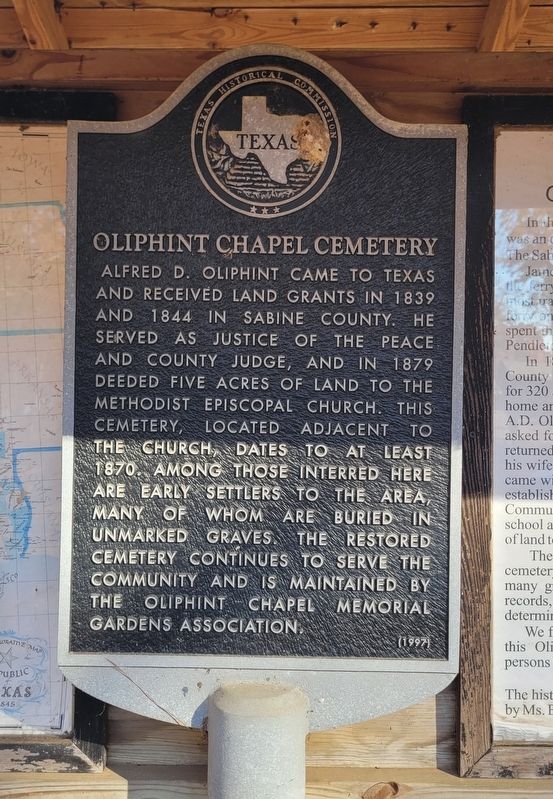
Oliphint Chapel Cemetery
Photographed by James Hulse, December 19, 2025
1. Oliphint Chapel Cemetery Marker
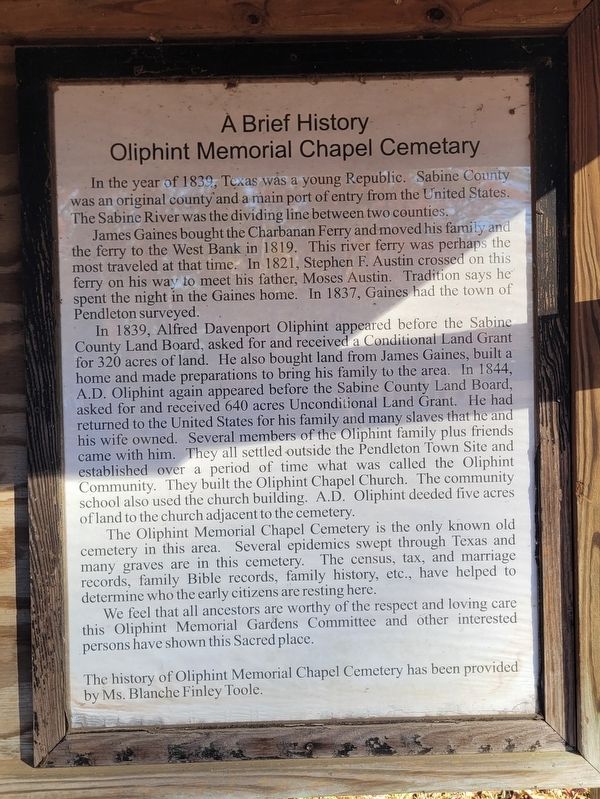
Supplemental Information - Right Side of Marker
A Brief History Oliphint Memorial Chapel Cemetary
In the year of 1839, Texas was a young Republic. Sabine County was an original county and a main port of entry from the United States. The Sabine River was the dividing line between two counties.
James Gaines bought the Charbanan Ferry and moved his family and the ferry to the West Bank in 1819. This river ferry was perhaps the most traveled at that time. In 1821, Stephen F. Austin crossed on this ferry on his way to meet his father, Moses Austin. Tradition says he spent the night in the Gaines home. In 1837,
this page online
In 1839, Alfred Davenport Oliphint appeared before the Sabine County Land Board, asked for and received a Conditional Land Grant for 320 acres of land. He also bought land from James Gaines, built a home and made preparations to bring his family to the area. In 1844, A.D. Oliphint again appeared before the Sabine County Land Board, asked for and received 640 acres Unconditional Land Grant. He had returned to the United States for his family and many slaves that he and his wife owned. Several members of the Oliphint family plus friends came with him. They all settled outside the Pendleton Town Site and established over a period of time what was called the Oliphint Community. They built the Oliphint Chapel Church. The community school also used the church building. A.D. Oliphint deeded five acres of land to the church adjacent to the cemetery.
The Oliphint Memorial Chapel Cemetery is the only known old cemetery in this area. Several epidemics swept through Texas and many graves are in this cemetery. The census, tax, and marriage records, family Bible records, family history, etc., have
Photographed by James Hulse, December 19, 2025
2. Supplemental Information - Right Side of Marker
We feel that all ancestors are worthy of the respect and loving care this Oliphint Memorial Gardens Committee and other interested persons have shown this Sacred place.
The history of Oliphint Memorial Chapel Cemetery has been provided by Ms. Blanche Finley Toole.
Erected 1997 by Texas Historical Commission. (Marker Number 7573.)
Topics. This historical marker is listed in these topic lists: Cemeteries & Burial Sites • Religion & Religious Structures • Settlements & Settlers. A significant historical year for this entry is 1839.
Location. 31° 27.326′ N, 93° 46.065′ W. Marker is near Milam, Texas, in Sabine County. It is at the intersection of Palamino Drive and Pinto Dr N, on the right when traveling west on Palamino Drive. The marker is located at the southeast section of the cemetery. Touch for map. Marker is at or near this postal address: 124 Palamino Dr, Milam TX 75959, United States of America. Touch for directions.

Regionally, this marker is in the American South, specifically in the Deep South, and in the Piney Woods. Globally, it is in North
Photographed by James Hulse, December 19, 2025
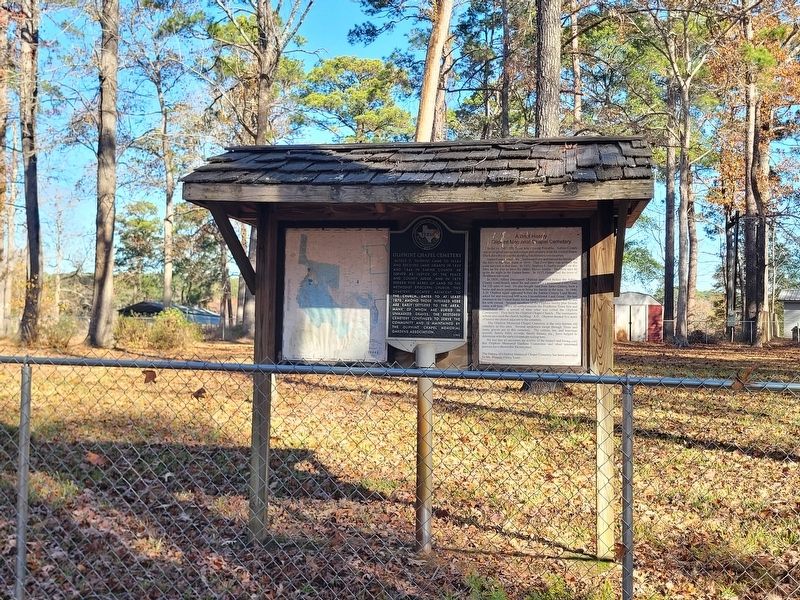
3. Oliphint Chapel Cemetery Marker
The marker is located under a small covered roof.
Other nearby markers. At least 8 other markers are within one mile of this marker, measured as the crow flies: Gaines Memorial Bridge (approx. 0.9 miles away); Site of Historic Crossing on the Sabine River (approx. 0.9 miles away); Site of Sabine River Crossing (approx. 0.9 miles away); Texas Louisiana Boundary (approx. 0.9 miles away); Kings Highway (approx. one mile away); Alfred D. and Martha (Causey) Oliphint (approx. one mile away); The Gaines-Oliphint House (approx. one mile away); James Taylor Gaines (approx. one mile away). Touch for a list and map of all markers in Milam.
Photographed by James Hulse, December 19, 2025
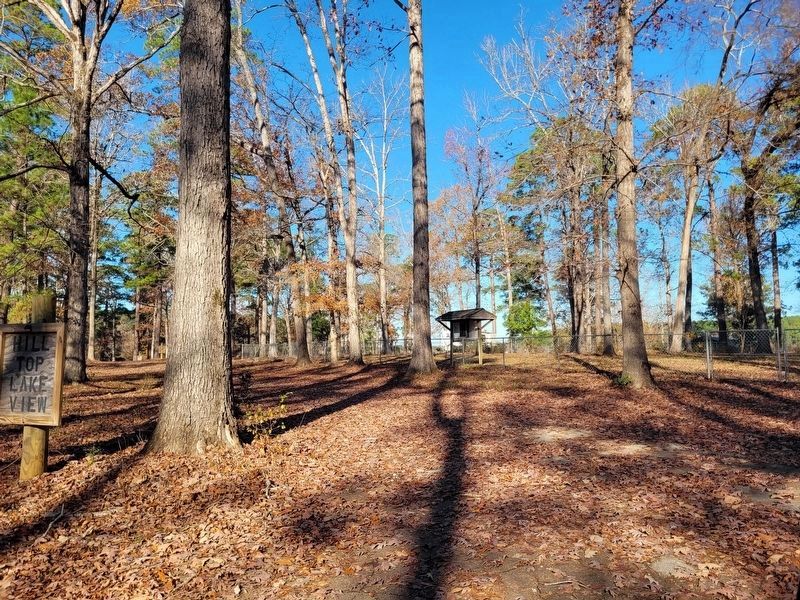
4. Oliphint Chapel Cemetery Marker
The view of the marker and cemetery from the road.
Credits. This page was last revised on December 20, 2025. It was originally submitted on December 19, 2025, by James Hulse of Medina, Texas. This page has been viewed 65 times since then and 33 times this year. Photos: 1, 2, 3, 4. submitted on December 20, 2025, by James Hulse of Medina, Texas.
