Culpeper in Culpeper County, Virginia — The American South (Mid-Atlantic)
What Did The Minute-Men Accomplish?
Photographed by Evan Dwyer, October 25, 2025
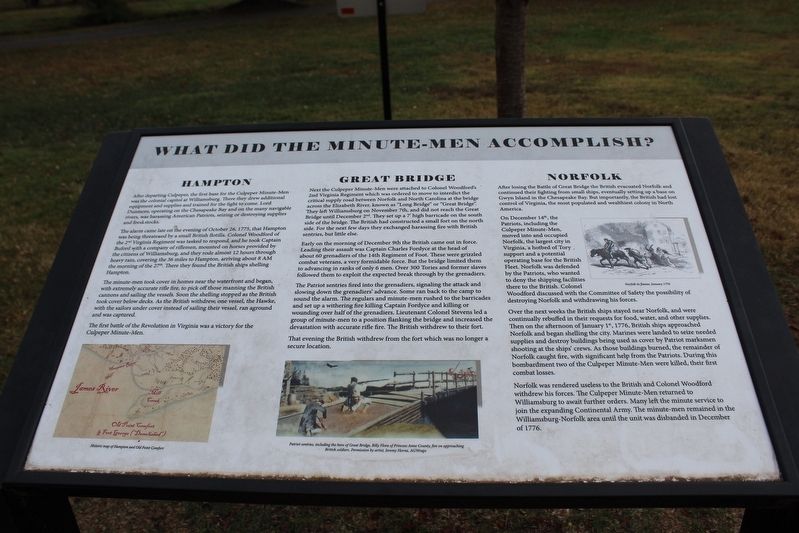
1. What Did The Minute-Men Accomplish? Marker
After departing Culpeper, the first base for the Culpeper Minute-Men was the colonial capitol at Williamsburg. There they drew additional equipment and supplies and trained for the fight to come. Lord Dunmore, operating on the Chesapeake Bay and on the many navigable rivers, was harassing American Patriots, seizing or destroying supplies and food stocks.
The Alarm came late on the evening of October 26, 1775, that Hampton was being threated by a small British flotilla. Colonel Woodford of the 2nd Virginia Regiment was tasked to respond, and he took Captain Buford with a company of riflemen, mounted on horses provided by the citizens of Williamsburg, and they rode almost 12 hours through heavy rain, covering the 36 miles to Hampton, arriving about 8 AM the morning of the 27th. There they found the British ships shelling Hampton.
The Minute-men took cover in homes near the waterfront and began, with extremely accurate rifle fire, to pick off those manning the British cannons and sailing the vessels. Soon the shelling stopped as the British took cover below decks. As the British withdrew, one vessel, the Hawke,
this page online
The first battle of the Revolution in Virginia was a victory for the Culpeper Minute-Men.
Great Bridge
Next the Culpeper Minute-Men were attached to Colonel Woodford's 2nd Virginia Regiment which was ordered to move to interdict the critical supply road between Norfolk and North Carolina at the bridge across the Elizabeth River, known as "Long Bridge" or "Great Bridge". They left Williamsburg on November 7th, and did not reach the Great Bridge until December 2nd. They set up a 7' high barricade on the south side of the bridge. The British had constructed a small fort on the north side. For the next few days they exchanged harassing fire with British sentries, but little else.
Early on the morning of December 9th the British came out in force. Leading their assault was Captain Charles Fordyce at the head of about 60 grenadiers of the 14th Regiment of Foot. These were grizzled combat veterans, a very formidable force. But the bridge limited them to advancing in ranks of only 6 men. Over 300 Tories and former slaves followed them to exploit
Photographed by Evan Dwyer, October 25, 2025
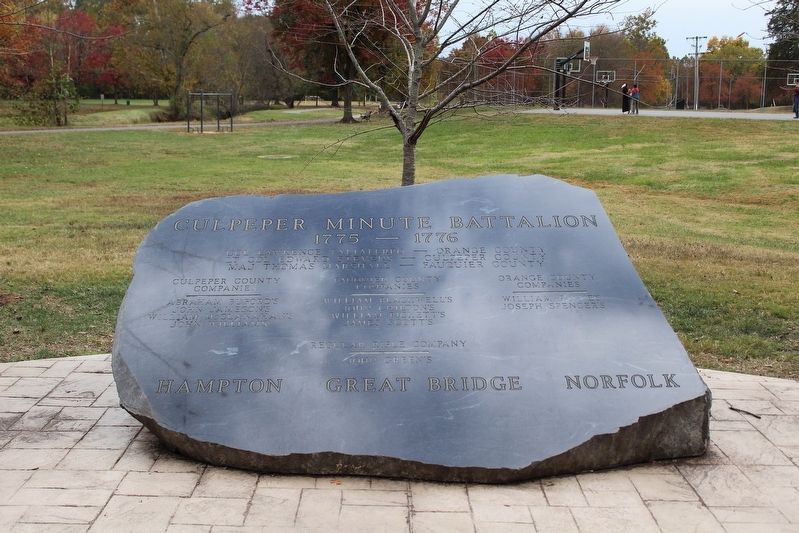
2. Culpeper Minute Battalion Monument
Marker is just to the left (out of frame) of this monument. The plaza was filled with people at the time this marker & monument were photographed, which precluded a proper context shot.
The Patriot sentries fired into the grenadiers, signaling the attack and slowing down the grenadiers' advance. Some ran back to the camp to sound the alarm. The regulars and minute-men rushed to the barricades and set up a withering fire killing Captain Fordyce and killing or wounding over half of the grenadiers. Lieutenant Colonel Stevens led a group of minute-men to a position flanking the bridge and increased the devastation with accurate rifle fire. The British withdrew to their fort.
That evening the British withdrew from the fort which was no longer a secure location.
Norfolk
After losing the Battle of Great Bridge the British evacuated Norfolk and continued their fighting from small ships, eventually setting up a base on Gwyn Island in the Chesapeake Bay. But importantly, the British had lost control of Virginia, the most populated and wealthiest colony in North America.
On December 14th, the Patriots, including the Culpeper Minute-Men, moved into and occupied Norfolk, the largest city in Virginia, a hotbed of Tory support and a potential operating base for the British Fleet. Norfolk was defended by the Patriots, who wanted to deny the shipping facilities there to the British. Colonel Woodford discussed with the Committee of Safety the possibility of destroying Norfolk and withdrawing his forces.
Over the next weeks the British ships stayed near Norfolk, and were continually rebuffed in their requests for food, water, and other supplies. Then on the afternoon of January 1st, 1776, British ships approached Norfolk and began shelling the city. Marines were landed to seize needed supplies and destroy buildings being used as cover by Patriot marksmen shooting at the ships' crews. As those buildings burned, the remainder of Norfolk caught fire, with significant help from the Patriots. During this bombardment two of the Culpeper Minute-Men were killed, their first combat losses.
Norfolk was rendered useless to the British and Colonel Woodford withdrew his forces. The Culpeper Minute-Men returned to Williamsburg to await further orders. Many left the minute service to join the expanding Continental Army. The minute-men remained in the Williamsburg-Norfolk area until the unit was disbanded in December of 1776.
Erected 2020.
Topics. This historical marker is listed in these topic lists: Colonial Era • Patriots & Patriotism • War, US Revolutionary. A significant historical year for this entry is 1775.
Location. 38° 28.547′ N, 78° 0.018′ W. Marker is in Culpeper, Virginia, in Culpeper County. It can be reached from North Blue Ridge Avenue. Marker is in Yowell Meadow Park next to the Culpeper Minute Battalion Monument and the Charters of Freedom display. Touch for map. Marker is at or near this postal address: 226 North Blue Ridge Avenue, Culpeper VA 22701, United States of America. Touch for directions.

Regionally, this marker is in the Washington Metropolitan Area and in Northern Virginia. It is also in the American South, specifically in the Upper South, and in the Mid-Atlantic. Globally, it is in North America, the Western Hemisphere, the Western World, and the Anglosphere. Historically, it finds itself in what was once the territory of the Mississippian Culture, one of the original Thirteen Colonies, one of the Confederate States of America, and the Antebellum South.
Other nearby markers. At least 8 other markers are within walking distance of this marker: Culpeper Minute Battalion (here, next to this marker); Who Were The Culpeper Minute-Men? (here, next to this marker); Major Gabriel Long (about 300 feet away, measured in a direct line); Yowell Meadow Park (about 400 feet away); Mountain Run Watershed (about 600 feet away); The Civil War (approx. 0.2 miles away); a different marker also named The Revolutionary War (approx. 0.2 miles away); Vietnam War Memorial (approx. 0.2 miles away). Touch for a list and map of all markers in Culpeper.
Other markers no longer nearby. The Revolutionary War (was approx. 0.2 miles away but has been replaced with another marker now near it); a different marker also named The Civil War (was approx. 0.2 miles away but has been replaced with another marker now near it).
Regarding What Did The Minute-Men Accomplish?. There is a monument to the Culpeper Minute Men at the Great Bridge Battlefield in Chesapeake, Virginia, as a result of the events described on this marker.
Related marker. Click here for another marker that is related to this marker. The Culpeper Minute-Men feature prominently on this monument at Great Bridge Battlefield.
Credits. This page was last revised on December 22, 2025. It was originally submitted on December 21, 2025, by Evan Dwyer of Richmond, Virginia. This page has been viewed 76 times since then and 32 times this year. Photos: 1, 2. submitted on December 21, 2025, by Evan Dwyer of Richmond, Virginia. • Bill Pfingsten was the editor who published this page.
