East Avenue in Rochester in Monroe County, New York — The American Northeast (Mid-Atlantic)
Douglass Home
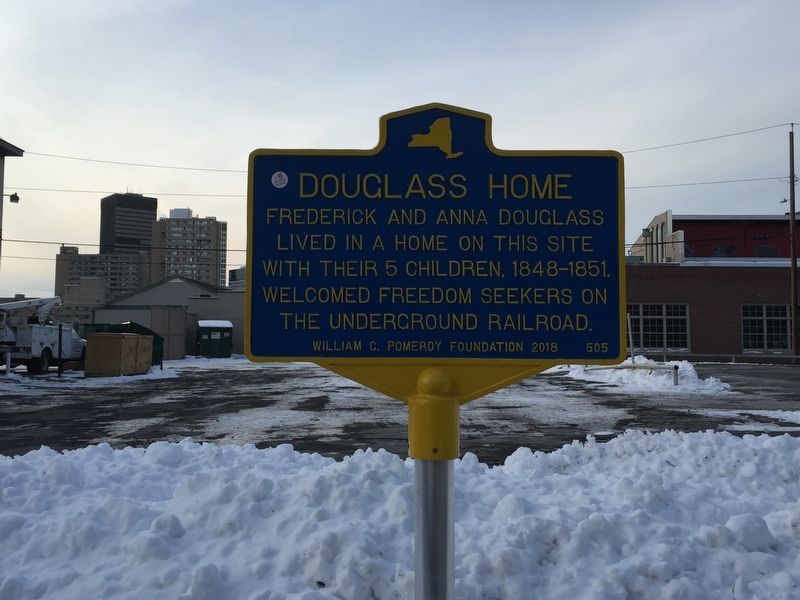
Photographed by Steve Stoessel, January 12, 2019
1. Douglass Home Marker
Frederick and Anna Douglass lived in a home on this site with their 5 children, 1848-1851. Welcomed freedom seekers on the Underground Railroad
Erected 2018 by William G. Pomeroy Foundation. (Marker Number 505.)
Topics and series. This historical marker is listed in these topic lists: Abolition & Underground RR • African Americans. In addition, it is included in the William G. Pomeroy Foundation series list.
Location. 43° 9.259′ N, 77° 35.696′ W. Marker is in Rochester, New York, in Monroe County. It is in East Avenue. It is on Alexander Street south of East Avenue, on the right when traveling south. Marker is front of an empty lot next to the Lanai Restaurant. Touch for map. Marker is at or near this postal address: 295 Alexander Street, Rochester NY 14607, United States of America. Touch for directions.

Regionally, this marker is in Upstate New York, specifically in Western New York, and in the Finger Lakes. It is also in the American Northeast and in the Mid-Atlantic. Globally, it is in North America, on the Great Lakes, in the Western Hemisphere,
this page online
Other nearby markers. At least 8 other markers are within walking distance of this marker: Anna Murray Douglass (here, next to this marker); Seward Seminary (approx. ¼ mile away); Margaret Woodbury Strong (approx. 0.3 miles away); George Eastman (approx. 0.4 miles away); Grove Place (approx. half a mile away); Rochester's Early Banks (approx. 0.6 miles away); Schiller Park (approx. 0.7 miles away); Granite Building (approx. 0.7 miles away). Touch for a list and map of all markers in Rochester.
Regarding Douglass Home. Douglass came to Rochester in 1843 after spending two years in Europe. He was attracted to the Rochester by the present of prominent Abolitionists and Suffragettes such as William Seward and Susan Anthony. His wife Anna, a free woman in Baltimore, had inspired Frederick to escape slavery and had supplied money and support for his escape.
Also see . . .
1. Fredrick Douglass (Wikipedia). (Submitted on January 12, 2019, by Steve Stoessel of Niskayuna, New York.)
2. (YouTube video) William G. Pomeroy Foundation presentation about the marker.
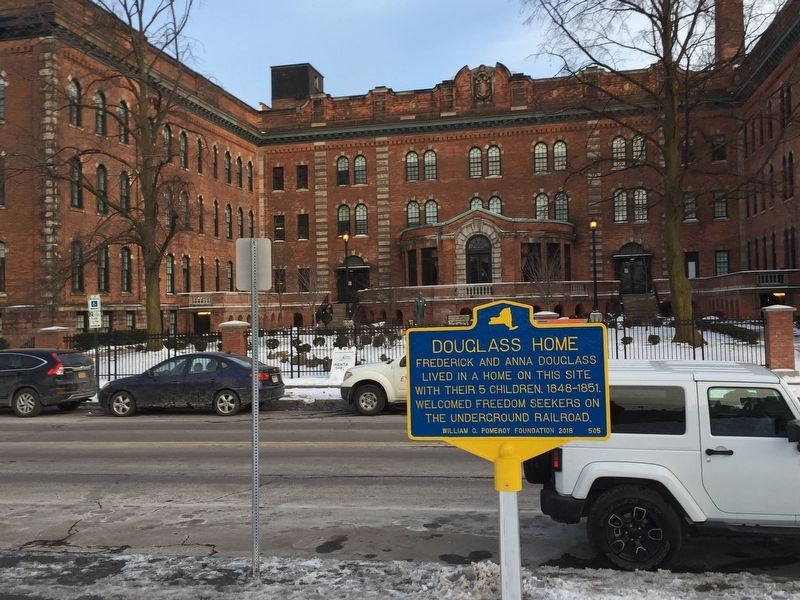
Photographed by Steve Stoessel, January 12, 2019
2. Backside of Douglass Marker
Credits. This page was last revised on December 23, 2025. It was originally submitted on January 12, 2019, by Steve Stoessel of Niskayuna, New York. This page has been viewed 591 times since then and 34 times this year. Last updated on December 22, 2025, by Carl Gordon Moore Jr. of North East, Maryland. Photos: 1, 2. submitted on January 12, 2019, by Steve Stoessel of Niskayuna, New York. • Devry Becker Jones was the editor who published this page.
