Bemidji in Beltrami County, Minnesota — The American Midwest (Upper Plains)
Promises Made, Promises Broken
Photographed by Cosmos Mariner, September 7, 2023
1. Promises Made, Promises Broken Marker
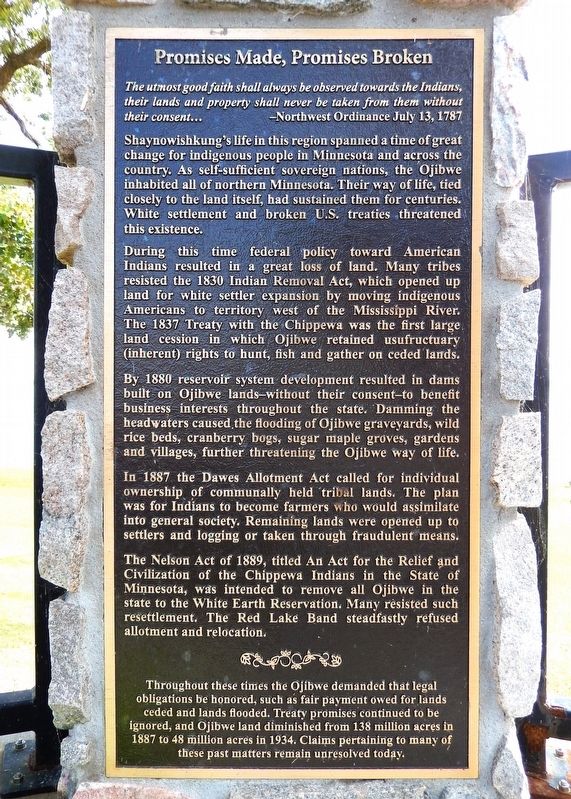
The utmost good faith shall always be observed towards the Indians, their lands and property shall never be taken from them without their consent…
—Northwest Ordinance July 13, 1787
Shaynowishkung's life in this region spanned a time of great change for indigenous people in Minnesota and across the country. As self-sufficient sovereign nations, the Ojibwe inhabited all of northern Minnesota. Their way of life, tied closely to the land itself, had sustained them for centuries. White settlement and broken U.S. treaties threatened this existence.
During this time federal policy toward American Indians resulted in a great loss of land. Many tribes resisted the 1830 Indian Removal Act, which opened up land for white settler expansion by moving indigenous Americans to territory west of the Mississippi River. The 1837 Treaty with the Chippewa was the first large land cession in which Ojibwe retained usufructuary (inherent) rights to hunt, fish and gather on ceded lands.
By 1880 reservoir system development resulted in dams built on Ojibwe lands — without their consent — to benefit business interests throughout the state. Damming
this page online
In 1887 the Dawes Allotment Act called for individual ownership of communally held tribal lands. The plan was for Indians to become farmers who would assimilate into general society. Remaining lands were opened up to settlers and logging or taken through fraudulent means.
The Nelson Act of 1889, titled An Act for the Relief and Civilization of the Chippewa Indians in the State of Minnesota, was intended to remove all Ojibwe in the state to the White Earth Reservation. Many resisted such resettlement. The Red Lake Band steadfastly refused allotment and relocation.
Erected 2015 by City of Bemidji.
Topics. This historical
Photographed by Cosmos Mariner, September 7, 2023
2. Promises Made, Promises Broken Marker
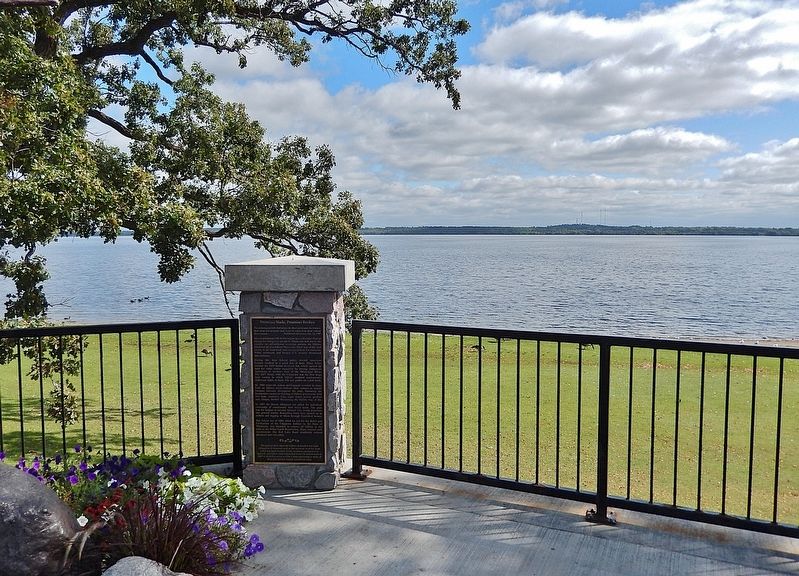
Looking northeast from the Paul Bunyan State Trail. Lake Bemidji is in the background.
Location. 47° 28.318′ N, 94° 52.759′ W. Marker is in Bemidji, Minnesota, in Beltrami County. It is on Bemidji Avenue North (State Highway 197) just north of 4th Street Northwest, on the right when traveling north. The marker is beside the Paul Bunyan State Trail, overlooking Lake Bemidji. Touch for map. Marker is in this post office area: Bemidji MN 56601, United States of America. Touch for directions.

Regionally, this marker is in the Northland. It is also in the American Midwest and in the Corn Belt. Globally, it is in North America, the Great North Woods, the Western Hemisphere, the Western World, and the Anglosphere. Historically, it finds itself in what was once Rupert’s Land, the territory of the Mississippian Culture, the Louisiana Purchase, and the Northwest Territory.
Other nearby markers. At least 8 other markers are within walking distance of this marker: Tragedy and Survival (here, next to this marker); Shaynowishkung (here, next to
Photographed by Cosmos Mariner, September 7, 2023
3. Shaynowishkung Memorial Landing
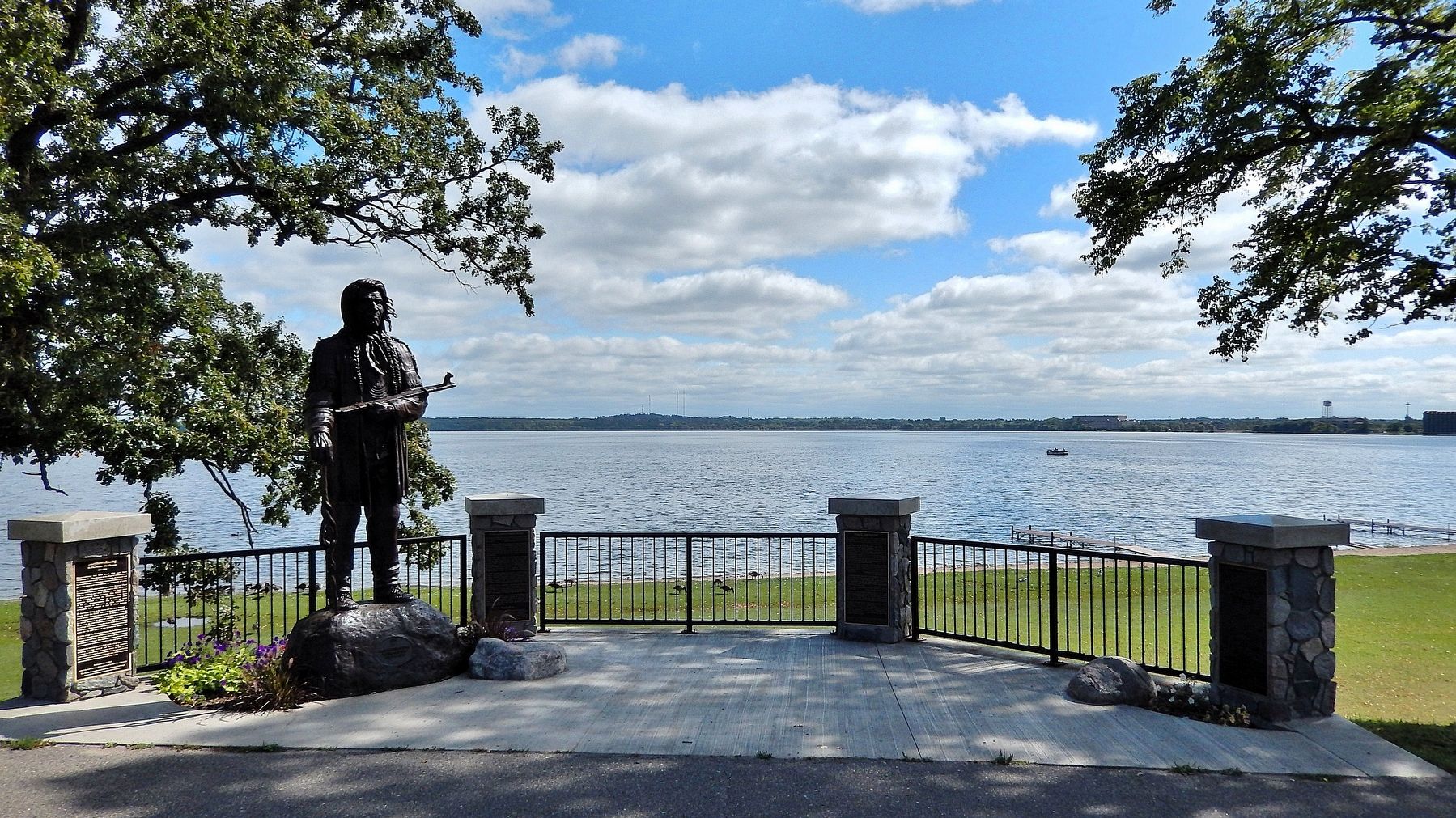
Looking east from the Paul Bunyan State Trail. Lake Bemidji is in the background. This is the 2nd from the left of 4 related historical markers at this location.
Related markers. Click here for a list of markers that are related to this marker.
Also see . . .
1. Northwest Ordinance (Wikipedia).
Excerpt: Formally An Ordinance for the Government of the Territory of the United States, North-West of the River Ohio and also known as the Ordinance of 1787, it was an organic act of the Congress of the Confederation of the United States. It created the Northwest Territory, the new nation's first organized incorporated territories between British North America and the Great Lakes to the north and the Ohio River to the south. The upper Mississippi River formed the territory's western boundary. Pennsylvania was the eastern boundary.(Submitted on December 28, 2025, by Cosmos Mariner of Cape Canaveral, Florida.)
Considered one of the most important legislative acts of the Confederation Congress, it established the precedent by which the federal government would be sovereign and expand westward with the admission of new states, rather than with the expansion of existing states and their established sovereignty under the Articles of Confederation. It also set legislative precedent with regard to American public domain lands.
2. Dawes Act (Wikipedia).
Excerpt: It regulated land rights on tribal territories within the United States, and authorized the President of the United States to subdivide Native American tribal communal landholdings into allotments for Native American heads of families and individuals. This would convert traditional systems of land tenure into a government-imposed system of private property by forcing Native Americans to "assume a capitalist and proprietary relationship with property" that did not previously exist in their cultures.(Submitted on December 28, 2025, by Cosmos Mariner of Cape Canaveral, Florida.)
3. Nelson Act of 1889 (Wikipedia).
Excerpt: A United States federal law intended to relocate all the Anishinaabe people in Minnesota to the White Earth Indian Reservation in the western part of the state and expropriate the vacated reservations for sale to European settlers. Approved by Congress on January 14, 1889, the Nelson Act was the equivalent for reservations in Minnesota to the Dawes Act of 1887, which had mandated allotting communal Indian lands to individual households in Indian Country, and selling the surplus. The goal of the Nelson Act was to consolidate Native Americans within the state of Minnesota on a western reservation, and, secondly, to encourage allotment of communal lands to individual households in order to encourage subsistence farming and assimilation.(Submitted on December 28, 2025, by Cosmos Mariner of Cape Canaveral, Florida.)
Credits. This page was last revised on December 28, 2025. It was originally submitted on December 28, 2025, by Cosmos Mariner of Cape Canaveral, Florida. This page has been viewed 58 times since then and 27 times this year. Photos: 1, 2, 3. submitted on December 28, 2025, by Cosmos Mariner of Cape Canaveral, Florida.
