Fayette in Jefferson County, Mississippi — The American South (East South Central)
Charles Evers
| — | Mississippi Freedom Trail | — |

Photographed by Cajun Scrambler, December 28, 2025
1. Charles Evers Marker
Following the 1963 assassination of his brother, Medgar Evers, the state's first NAACP field secretary, James Charles Evers returned to Mississippi and took over as field secretary. In 1969, he received the organization's "Man of the Year" award for his civil rights advocacy and political leadership, including his historic election in Fayette as the first Black mayor of a multiracial town since Reconstruction. Despite his later unsuccessful bids for governor and U.S. senator, Evers remained politically active, supporting candidates across party lines.
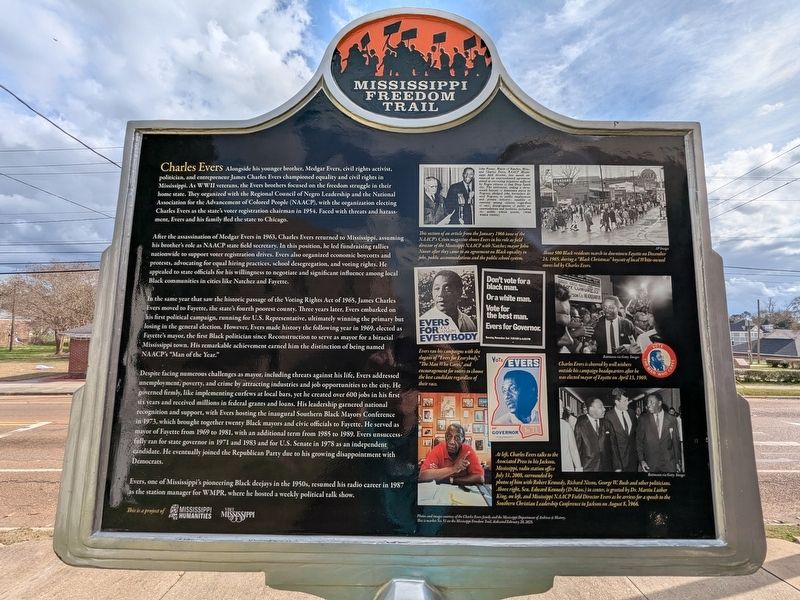
Charles Evers Alongside his younger brother, Medgar Evers, civil rights activist, politician, and entrepreneur James Charles Evers championed equality and civil rights in Mississippi. As WWII veterans, the Evers brothers focused on the freedom struggle in their home state. They organized with the Regional Council of Negro Leadership and the National Association for the Advancement of Colored People (NAACP), with the organization electing Charles Evers as the state's voter registration chairman in 1954. Faced with threats and harassment, Evers and his
this page online
After the assassination of Medgar Evers in 1963, Charles Evers returned to Mississippi, assuming his brother's role as NAACP state field secretary. In this position, he led fundraising rallies nationwide to support voter registration drives. Evers also organized economic boycotts and protests, advocating for equal hiring practices, school desegregation, and voting rights. He appealed to state officials for his willingness to negotiate and significant influence among local Black communities in cities like Natchez and Fayette.
In the same year that saw the historic passage of the Voting Rights Act of 1965, James Charles Evers moved to Fayette, the state's fourth poorest county. Three years later, Evers embarked on his first political campaign, running for U.S. Representative, ultimately winning the primary but losing in the general election. However, Evers made history the following year in 1969, elected as Fayette's mayor, the first Black politician since Reconstruction to serve as mayor for a biracial Mississippi town. His remarkable achievement earned him the distinction of being named NAACP's
Photographed by Cajun Scrambler, December 28, 2025
2. Charles Evers Marker
Despite facing numerous challenges as mayor, including threats against his life, Evers addressed unemployment, poverty, and crime by attracting industries and job opportunities to the city. He governed firmly, like implementing curfews at local bars, yet he created over 600 jobs in his first six years and received millions in federal grants and loans. His leadership garnered national recognition and support, with Evers hosting the inaugural Southern Black Mayors Conference in 1973, which brought together twenty Black mayors and civic officials to Fayette. He served as mayor of Fayette from 1969 to 1981, with an additional term from 1985 to 1989. Evers unsuccess- fully ran for state governor in 1971 and 1983 and for U.S. Senate in 1978 as an independent candidate. He eventually joined the Republican Party due to his growing disappointment with Democrats.
Erected 2025 by Visit Mississippi, Mississippi Humanities. (Marker Number 51.)
Topics and series. This historical marker is listed in this topic list: Civil Rights. In addition, it is included in the Mississippi Freedom Trail series list.
Location. 31° 42.696′ N,

Photographed by Cajun Scrambler, December 28, 2025
3. Charles Evers Marker

Regionally, this marker is in Southwest Mississippi and in Natchez Trace Corridor. It is also in the American South, specifically in the Deep South, and in the Great River Road Region. Globally, it is in North America, a Gulf of Mexico state, the Western Hemisphere, the Western World, and the Anglosphere. Historically, it finds itself in what was once New Spain, the territory of the Mississippian Culture, one of the Confederate States of America, and the Antebellum South.
Other nearby markers. At least 8 other markers are within 6 miles of this marker, measured as the crow flies: Adam Rum (here, next to this marker); Charles Evers & The Blues (within shouting distance of this marker); Thomas Hinds (within shouting distance of this marker); Old Greenville (approx. 5.2 miles away); William Carey University (approx. 5.8 miles away); Blue Mountain College (approx. 5.8 miles away); Mississippi College (approx. 5.8 miles away); The Baptist Children's Village (approx. 5.8 miles away). Touch for a list and map of all markers in Fayette.
Another marker is no longer nearby. Confederate Soldiers Monument (was within shouting distance of this marker but has been confirmed missing).
Credits. This page was last revised on August 25, 2026. It was originally submitted on December 31, 2025, by Cajun Scrambler of Assumption, Louisiana. This page has been viewed 63 times since then and 42 times this year. Photos: 1, 2, 3. submitted on December 31, 2025, by Cajun Scrambler of Assumption, Louisiana.
