Delta in Delta County, Colorado — The American Mountains (Southwest)
This is Ute Country
People of the Shining Mountains
Photographed by Cosmos Mariner, July 19, 2025
1. This is Ute Country Marker
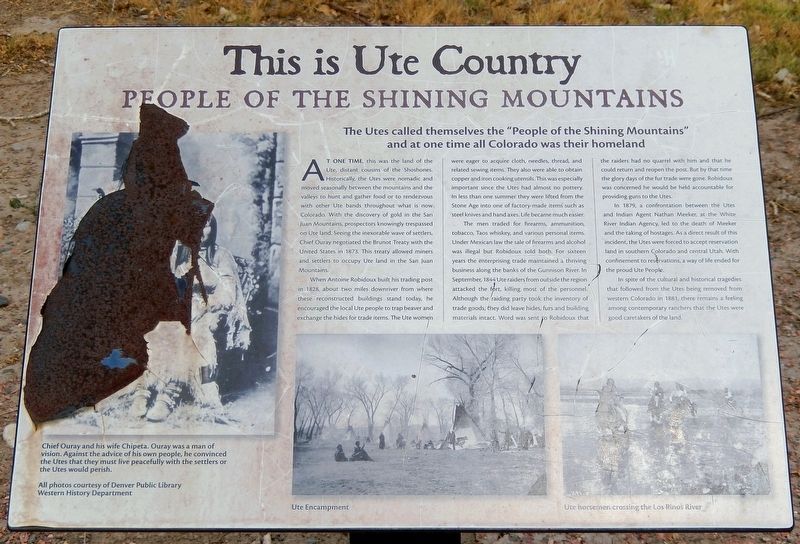
The Utes called themselves the “People of the Shining Mountains” and at one time all Colorado was their homeland
At one time, this was the land of the Ute, distant cousins of the Shoshones. Historically, the Utes were nomadic and moved seasonally between the mountains and the valleys to hunt and gather food or to rendezvous with other Ute bands throughout what is now Colorado. With the discovery of gold in the San Juan Mountains, prospectors knowingly trespassed on Ute land. Seeing the inexorable wave of settlers, Chief Ouray negotiated the Brunot Treaty with the United States in 1873. This treaty allowed miners and settlers to occupy Ute land in the San Juan Mountains.
When Antoine Robidoux built his trading post in 1828, about two miles downriver from where these reconstructed buildings stand today, he encouraged the local Ute people to trap beaver and exchange the hides for trade items. The Ute women were eager to acquire cloth, needles, thread, and related sewing items. They also were able to obtain copper and iron cooking utensils. This was especially important since the Utes had almost no pottery. In less than one
this page online
The men traded for firearms, ammunition, tobacco, Taos whiskey, and various personal items. Under Mexican law the sale of firearms and alcohol was illegal but Robidoux sold both. For sixteen years the enterprising trade maintained a thriving business along the banks of the Gunnison River. In September, 1844 Ute raiders from outside the region attacked the fort killing most of the personnel. Although the raiding party took the inventory of trade goods, they did leave hides, furs and building materials intact. Word was sent to Robidoux that the raiders had no quarrel with him and that he could return and reopen the post. But by that time the glory days of the fur trade were gone. Robidoux was concerned he would be held accountable for providing guns to the Utes.
In 1879, a confrontation between the Utes and Indian Agent Nathan Meeker, at the White River Indian Agency, led to the death of Meeker and the taking of hostages. As a direct result of this incident, the Utes were forced to accept reservation land

Denver Public Library Western History Department
2. Marker detail: Ute Encampment
In spite of the cultural and historical tragedies that followed from the Utes being removed from western Colorado in 1881, there remains a feeling among contemporary ranchers that the Utes were good caretakers of the land.
[damaged photo caption] Chief Ouray and his wife Chipeta. Ouray was a man of vision. Against the advice of his own people, he convinced the Utes that they must live peacefully with the settlers or the Utes would perish.
Topics. This historical marker is listed in these topic lists: Indigenous Peoples and Communities • Industry & Commerce • Settlements & Settlers. A significant historical date for this entry is September 29, 1879.
Location. 38° 44.965′ N, 108° 4.436′ W. Marker is in Delta, Colorado, in Delta County. It can be reached from Gunnison River Drive (North Palmer Street) 0.3 miles west of U.S. 50. The marker is on the Fort Uncompahgre Interpretive Center grounds. Touch for map. Marker is at or near this postal address: 330 Gunnison River Drive, Delta CO 81416, United States of America. Touch for directions.

Regionally,

Denver Public Library Western History Department
3. Marker detail: Ute Horsemen Crossing the Los Pinos River
Other nearby markers. At least 8 other markers are within walking distance of this marker: Fort Uncompahgre (a few steps from this marker); Old Spanish National Historic Trail (within shouting distance of this marker); Historic Fort Uncompahgre (within shouting distance of this marker); Western Slope Agriculture / Delta County (within shouting distance of this marker); The Tipi and the Wickiup (within shouting distance of this marker); The Ute Council Tree (within shouting distance of this marker); “Modern” Ferry (about 500 feet away, measured in a direct line); a different marker also named Ute Council Tree (approx. 0.4 miles away). Touch for a list and map of all markers in Delta.
Also see . . .
1. Brunot Agreement (History Colorado).
Excerpt: Miners first made their way into the San Juan Mountains in 1860–61,(Submitted on January 2, 2026, by Cosmos Mariner of Cape Canaveral, Florida.)but it was not until 1869 that valuable minerals were discovered and not until 1871–72 that mine development took place. The Treaty of 1868 put the San Juan Mountains within a Ute reservation that encompassed almost the entire western third of Colorado. Although off limits to non-Indians, prospectors and miners entered the region. The growing mining activity drew the attention of the Utes, who were unhappy about the incursions but not openly hostile.Photographed by Cosmos Mariner, July 19, 20254. This is Ute Country Marker
The Brunot Agreement between the Nuche (Ute) and the US government in 1873 led to the development of mining in the San Juan Mountains by taking 3.7 million acres (about 5,780 square miles) from the Ute Reservation in western Colorado. As white encroachment continued over the next decade, tensions escalated and the Utes were eventually force-marched to Utah in 1881.

2. Meeker Massacre (Wikipedia).
Excerpt: Members of a band of Ute Indians attacked the Indian agency on their reservation, killing the Indian agent Nathan Meeker and his 10 male employees and taking five women and children as hostages. Meeker had been attempting to convert the Utes to Christianity, to make them farmers, and to prevent them from following their migratory culture. On the same day as the massacre, United States Army forces were en route to the Agency from Fort Steele in Wyoming due to threats against Meeker. The Utes attacked U.S. troops led by Major Thomas T. Thornburgh at Milk Creek, 18 miles north of present day Meeker, Colorado. They killed the major and 13 troops. Relief troops were called in and the Utes dispersed.(Submitted on January 2, 2026, by Cosmos Mariner of Cape Canaveral, Florida.)
The conflict resulted in the Utes losing most of the lands granted to them by treaty in Colorado, the forced removal of the White River Utes and the Uncompahgre Utes from Colorado, and the reduction in the Southern Utes' land holdings within Colorado. The expulsion of the Utes from Colorado opened up millions of acres of land to white settlement.
Credits. This page was last revised on January 2, 2026. It was originally submitted on December 31, 2025, by Cosmos Mariner of Cape Canaveral, Florida. This page has been viewed 120 times since then and 119 times this year. Photos: 1, 2, 3, 4. submitted on January 2, 2026, by Cosmos Mariner of Cape Canaveral, Florida.
