Missouri Valley in Harrison County, Iowa — The American Midwest (Upper Plains)
Missouri Valley Freedom Rock Veterans Memorial
Honoring Harrison County Veterans
| — | Ray “Bubba” Sorensen II | — |

Photographed by Cosmos Mariner, September 16, 2025
1. Missouri Valley Freedom Rock Marker (panel 1)
What is a Freedom Rock and the Freedom Rock Tour?
The Freedom Rock (established in 1999) is a large boulder located in rural Iowa that is repainted every year with a different Thank You for our nations Veterans to honor their service to our country. The artist, Ray "Bubba" Sorensen II, was inspired by the movie Saving Private Ryan, as well as wanting to give Veterans a unique recognition on Memorial Day.
While painting murals across the country Sorensen had the idea of spreading the message of The Freedom Rock to other small communities across Iowa. The goal is to be unique and tell area specific stories on each rock, and so the Freedom Rock Tour was born.
Zola Leonard
Zola Beth (Barnett) Leonard was born on October 2nd 1924 in rural Underwood where she lived up until graduating from Underwood High School in 1941. Despite having a full scholarship to attend Drake University to study journalism, the bombing of Pearl Harbor changed her career path. After the start of WWII, Zola decided to attend the Jennie Edmundson Nursing School in Council Bluffs, Iowa. After two years of hard work and dedication, Zola became a registered
this page online
After the war ended, Zola continued nursing while raising three children with her husband, Ivan. Two of her children would go on to serve in the military as well. After retiring from nursing at the age of 87, she continued to be active in the community within such organizations as American Legion Auxiliary and the American Red Cross. Zola Beth Leonard passed away on July 18th 2019, at the age of 94.
Hans Hansen
Dr. Hans Hansen was born in Denmark on March 24, 1878 and he came to America in 1896 at the age of 18 years old. He became a Doctor and ran his practice

Photographed by Cosmos Mariner, September 16, 2025
2. Missouri Valley Freedom Rock Marker (panel 2)
He served in World War I as a Division Surgeon in the 88th Infantry Division. He was shipped out on August 5, 1918 on the Aquitania from New York, N.Y. with the Advanced Detachment and Billeting Party. They first landed in Liverpool England on Aug 12th and after 4 days were sent to Cherbourg, France and then on to Semur, Cote d'Or to set up Headquarters.
He was overseas until July 19, 1919, coming home on the USS Zeppelin, which was a German-built ship surrendered to the U.K. then given to the U.S. for troop transport. Hans finished his career with the rank of Lieutenant Colonel; he came home to Iowa for a few years. He then became a Physician at the Veterans Administration. He was the Manager of the V.A. Hospital in St. Cloud Minnesota and later Manager of the V.A. Hospital in N.Y.
After retiring from the V.A. he came home to Logan Iowa and ran his General Practice from 1948 until his death in 1955 at the age of 77 years. His daughter, Eileen Buckley donated Dr. Hansen's items from his time in the war.
Clifford Totten
Sergeant

Photographed by Cosmos Mariner, September 16, 2025
3. Missouri Valley Freedom Rock Veterans Memorial
(west side)
(west side)
and the Army Medical Department Regimental Coat of Arms

Photographed by Cosmos Mariner, September 16, 2025
4. Missouri Valley Freedom Rock Veterans Memorial
(east side)
(east side)
Mr. Totten served in the US Army from 1960 to 1981, with the exception of a seven-month break in 1969 during which he served as a Missouri Valley police officer.
After retiring from the military, Mr. Totten returned to Missouri Valley and became a police officer and private investigator. He later engaged in security consultant work and security management. He also served as a Reserve Offers Training Course Military Science Instructor in Omaha, Neb.
American Legion Auxiliary
After the end of World War I, 20 officers who served in the American Expeditionary Forces were asked to suggest ideas for improving troop morale. One officer, U.S. Army Lieutenant Colonel Theodore Roosevelt Jr., proposed an organization of veterans, the American Legion. After its formation in 1919, a number of existing women's organizations
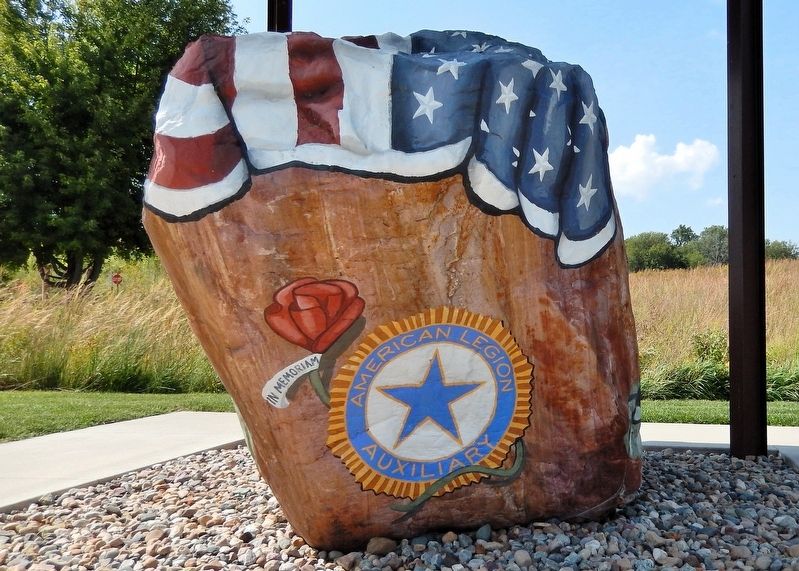
Photographed by Cosmos Mariner, September 16, 2025
5. Missouri Valley Freedom Rock Veterans Memorial
(south side)
(south side)
In the spirit of service, not self, the mission of the American Legion Auxiliary is to support The American Legion and to honor the sacrifice of those who serve by enhancing the lives of our veterans, military and their families, both at home and abroad.
Army Medical Department Regimental Coat of Arms
The Medical Department regimental coat of arms was devised at the direction of Army Surgeon General William Alexander Hammond around 1863 and is one of the Army's oldest regimental emblems. Its design dates back to 1818, which is the year Congress created a permanent Army “Medical Department”. The 20 white stars on a blue background and the red and white stripes represent the U.S. flag of 1818. The green staff entwined with a green serpent combined

Photographed by Cosmos Mariner, September 16, 2025
6. Missouri Valley Freedom Rock Veterans Memorial
(north side)
(north side)
The colors Argent (silver/white) and Gules (red) are those associated with the flag of the United States. The rooster is also connected with Asclepius/Aesculapius, the ancient Greek and Roman god of healing and medicine. The torse (twisted rope) below the rooster shows alternating blue and silver colors which were the colors of the Army in 1818. The Latin motto Experientia et Progressus ("Experience and Progress") is meant to convey the steady and unfailing progress of the Army Medical Department since its original incarnation as the “Army Hospital” in July 1775. The regimental coat of arms is worn by U. S. Army soldiers affiliated with the Army Medical Department.
The Poppy Story
From the battlefields of World War I, weary soldiers brought home the memory of a barren landscape transformed by wild poppies, red as the blood that had soaked the soil. By that miracle of nature, the spirit of their lost comrades lived on. The poppy became
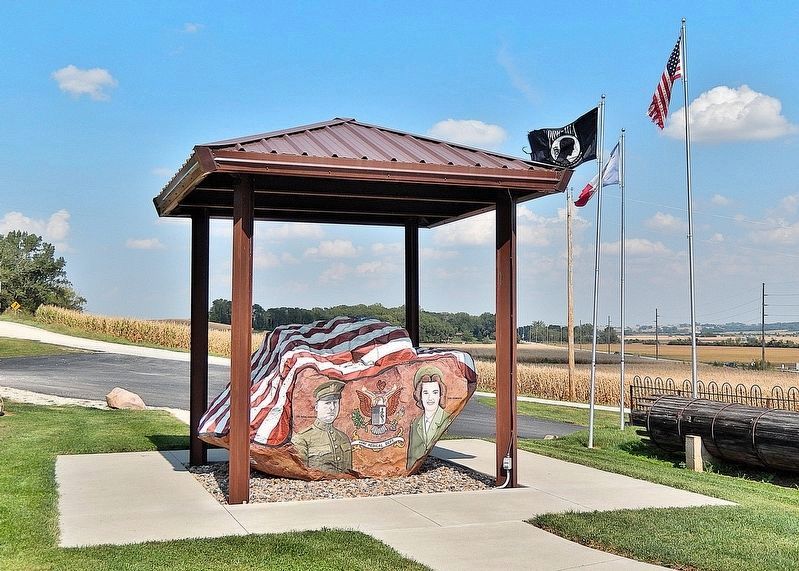
Photographed by Cosmos Mariner, September 16, 2025
7. Missouri Valley Freedom Rock Veterans Memorial
Looking southeast; US Highway 30 continues eastward in the distant background.
…the blood of heroes never dies
But lends a luster to the red
Of the flower that blooms above the dead
In Flanders' Fields.
On impulse, she bought a bouquet of poppies — all that New York City's Wanamaker's Department Store had — and handed them to businessmen meeting at the New York YMCA where she worked. She asked them to wear the poppy as a tribute to the fallen. That was November 1918. World War I was over, but America's sons would rest forever "in Flanders' Fields." Later she would spearhead a campaign that would result in the adoption of the poppy as the national symbol of sacrifice.

Photographed by Cosmos Mariner, September 16, 2025
8. Missouri Valley Freedom Rock Veterans Memorial
Looking west; the two marker panels are mounted on the Iowa Welcome Center north wall – visible in the left background.
In Flanders Fields
In Flanders fields the poppies blow
Between the crosses, row on row
That mark our place; and in the sky
The larks, still bravely singing, fly
Scarce heard amid the guns below
We are the Dead. Short days ago
We lived, felt dawn, saw sunset glow,
Loved, and were loved, and now we lie
In Flanders fields.
Take up our quarrel with the foe:
To you from failing hands we throw
The torch; be yours to hold it high
If ye break faith with us who die
We shall not sleep, though poppies grow
In Flanders fields.
—Lt. Col. John McCrae, Canadian physician
He was inspired to write it on May 3, 1915, after presiding over the funeral of friend and fellow soldier Alexis Helmer, who died during the Second Battle of Ypres.
US Military Awards listed in order of precedence
The Medal of Honor
Highest military decoration, presented by the President in the name of Congress. Awarded for “gallantry and intrepidity at risk of life above and beyond the call of duty”.
The Distinguished Service Cross (Army)
Second highest military decoration, awarded for “extraordinary heroism”. The Army Distinguished Service Cross is equivalent to the Navy Cross and Air Force Cross.
The Silver Star Medal
Third highest military combat decoration, awarded for “distinguished gallantry in action”.
Distinguished Flying Cross
Awarded for heroism or extraordinary achievement in aerial flight.
Bronze Star
For heroic or meritorious achievement of service, not involving aerial flight in connection with operations against an opposing armed force.
Purple Heart
Awarded for wounds or death as a result of an act of any opposing armed force, as a result of an international terrorist attack or as a result of military operations while serving as part of a peace-keeping mission.
The Air Medal
For meritorious achievement while participating in aerial flight or for a single act of heroism against an armed enemy.
Erected 2021.
Topics and series. This historical marker and memorial is listed in these topic lists: War, Vietnam • War, World I • War, World II • Women. In addition, it is included in the Distinguished Service Cross/Navy Cross/Air Force Cross Recipients, the Freedom Rock Memorials, and the Military Order of the Purple Heart series lists.
Location. 41° 35.034′ N, 95° 50.836′ W. Marker is in Missouri Valley, Iowa, in Harrison County. It is on Monroe Avenue just north of Lincoln Highway (U.S. 30), on the left when traveling north. The Freedom Rock is at the Harrison County Historical Village & Iowa Welcome Center. Touch for map. Marker is at or near this postal address: 2931 Monroe Avenue, Missouri Valley IA 51555, United States of America. Touch for directions.

Regionally, this marker and memorial is in Western Iowa, in Loess Hills, and in Greater Omaha. It is also in the American Midwest, in the Lewis & Clark Corridor, and in the Corn Belt. Globally, it is in North America, the Western Hemisphere, the Western World, and the Anglosphere. Historically, it finds itself in what was once the territory of the Mississippian Culture and also the Louisiana Purchase.
Other nearby markers. At least 8 other markers are within 11 miles of this marker, measured as the crow flies: 3389 Miles from New York to San Francisco... Join the Ride! (within shouting distance of this marker); Agriculture in the Loess Hills (within shouting distance of this marker); Terracing in the Loess Hills (within shouting distance of this marker); Loess Hills of Western Iowa (within shouting distance of this marker); Missouri Valley Veterans' Memorial (approx. 3.6 miles away); Lewis and Clark Campsite Area (approx. 9 miles away in Nebraska); Steamboat Bertrand Discovery Site (approx. 10.3 miles away in Nebraska); April 1, 1865: The Bertrand Goes Down (approx. 10.3 miles away in Nebraska). Touch for a list and map of all markers in Missouri Valley.
More about this marker. The two detailed historical marker panels are mounted on the Iowa Welcome Center north wall, adjacent to the Freedom Rock they describe.
Also see . . .
1. The Freedom Rock (facebook).
Thanking our Veterans, one painting at a time.(Submitted on January 1, 2026, by Cosmos Mariner of Cape Canaveral, Florida.)
2. Freedom Rock Tour - Harrison County Freedom Rock (facebook).
(by Ray “Bubba” Sorensen II) Excerpt: I included a Distinguished Service Cross recipient in Vietnam and couple of folks that were members of the Army Medical Department in WWI and WWII.(Submitted on January 1, 2026, by Cosmos Mariner of Cape Canaveral, Florida.)
Clifford Totten saw combat in Southeast Asia in 1965-1966. Sergeant Totten distinguished himself on 3 July 1966 while serving as artillery forward observer for a two-squad patrol near Thang Duc. Clifford was award the Distinguished Service Cross, Silver Star Medal, Two Purple Hearts among many others.
On the flip side I’ve painted Hans Hansen and Zoe Leonard with the Army Medical Dept crest in between them. Hans was a doctor during WWI and Leonard would become part of the largest contingent of women in the military, the U.S. Army Cadet Nurse Corps. That corps served extensively at war and in support roles at home. I also painted the American Legion Auxiliary logo to recognize the largest women’s patriotic service organization in the world! The local Auxiliary helped out with this project and are crucial in support of our military and military families.
3. Clifford Ralph Totten (Hall of Valor).
Excerpt: The President of the United States of America takes pleasure in presenting the Silver Star to Sergeant Clifford Ralph Totten, United States Army, for gallantry in action while engaged in military operations involving conflict with an armed hostile force while serving with Company B, 1st Battalion, 35th Infantry Regiment, 3d Brigade, 25th Infantry Division, in action against the enemy in the Republic of Vietnam. His gallant actions and dedicated devotion to duty, without regard for his own life, were in keeping with the highest traditions of military service and reflect great credit upon himself and the United States Army.(Submitted on January 1, 2026, by Cosmos Mariner of Cape Canaveral, Florida.)
4. American Legion Auxiliary Poppy Program.
Excerpt: Connecting the visual image of the poppy with the sacrifice of service made by our veterans has been an important goal of the American Legion Auxiliary Poppy Program since its inception in 1921. On Memorial Day and Veterans Day, millions of red crepe paper poppies are distributed across the country in exchange for donations that go directly to assist disabled and hospitalized veterans in our communities.(Submitted on January 1, 2026, by Cosmos Mariner of Cape Canaveral, Florida.)
Credits. This page was last revised on January 1, 2026. It was originally submitted on January 1, 2026, by Cosmos Mariner of Cape Canaveral, Florida. This page has been viewed 85 times since then. Photos: 1, 2, 3, 4, 5, 6, 7, 8. submitted on January 1, 2026, by Cosmos Mariner of Cape Canaveral, Florida.
