Perryville in Boyle County, Kentucky — The American South (East South Central)
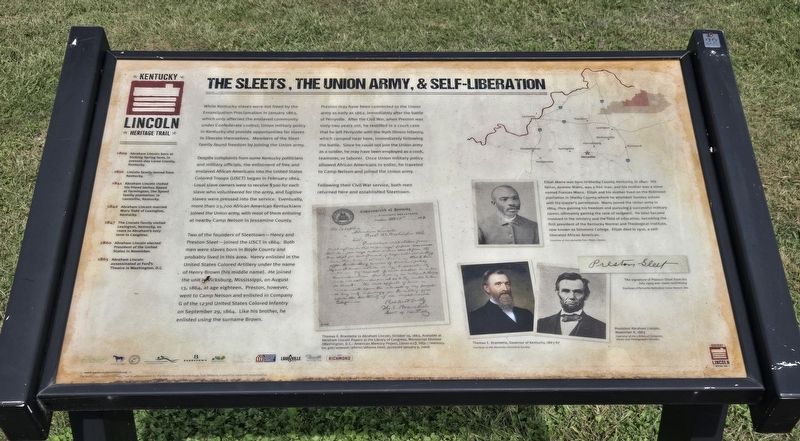
The Sleets, The Union Army, & Self-Liberation
Photographed by Bradley Owen, October 17, 2025
1. The Sleets, The Union Army, & Self-Liberation Marker
While Kentucky slaves were not freed by the Emancipation Proclamation in January 1863, which only affected the enslaved community under Confederate control, Union military policy in Kentucky did provide opportunities for slaves to liberate themselves. Members of the Sleet family found freedom by joining the Union army.
Despite complaints from some Kentucky politicians and military officials, the enlistment of free and enslaved African Americans into the United States Colored Troops (USCT) began in February 1864. Loyal slave owners were to receive $300 for each slave who volunteered for the army, and fugitive slaves were pressed into the service. Eventually, more than 23,700 African American Kentuckians joined the Union army, with most of them enlisting at nearby Camp Nelson in Jessamine County.
Two of the founders of Sleettown - Henry and Preston Sleet - joined the USCT in 1864. Both men were slaves born in Boyle County and probably lived in this area. Henry enlisted in the United States Colored Artillery under the name of Henry Brown (his middle name). He joined the unit in Vicksburg, Mississippi, on August 13,
this page online
Preston may have been connected to the Union army as early as 1862, immediately after the battle of Perryville. After the Civil War, when Preston was sixty-two years old, he testified in a court case that he left Perryville with the 89th Illinois Infantry, which camped near here, immediately following the battle. Since he could not join the Union army as a soldier, he may have been employed as a cook, teamster, or laborer. Once Union military policy allowed African Americans to enlist, he traveled to Camp Nelson and joined the Union army.
Following their Civil War service, both men returned here and established Sleettown.
(Sidebar):
Kentucky Lincoln Heritage Trail
1809 Abraham Lincoln born at Sinking Spring farm, in present-day Larue County, Kentucky.
1816 Lincoln family moved from Kentucky.
1841 Abraham Lincoln visited his friend Joshua Speed at Farmington, the Speed family plantation, in Louisville, Kentucky.
1842

Photographed by Bradley Owen, October 17, 2025
2. The Sleets, The Union Army, & Self-Liberation Marker
Marker is on the right.
1847 The Lincoln family visited Lexington, Kentucky, en route to Abraham's only term in Congress.
1860 Abraham Lincoln elected President of the United States in November.
1865 Abraham Lincoln assassinated at Ford's Theatre in Washington, D.C.
(Captions):
Thomas E. Bramlette to Abraham Lincoln, October 19, 1863. Available at Abraham Lincoln Papers at the Library of Congress, Manuscript Division (Washington, D.C.: American Memory Project, [2000-02]), http://memory. loc.gov/ammem/alhtml/alhome.html, accessed January 9, 2008.
Elijah Marrs was born in Shelby County, Kentucky, in 1840. His father, Andrew Marrs, was a free man, and his mother was a slave named Frances Marrs. Elijah and his mother lived on the Robinson plantation in Shelby County, where he attended Sunday school with his master's permission. Marrs joined the Union army in 1864, thus gaining his freedom and pursuing a successful military career, ultimately gaining the rank of sergeant. He later betame involved in the ministry and the field of education, becoming the first president of the Kentucky Normal and Theological Institute, now known as Simmons College. Elijah died in 1910, a self-liberated African American.
Courtesy of the Louisville Free Public Library
The signature of Preston Sleet from his July 1904 war claim testimony.
Courtesy of Perryville Battlefield State Historic Site
Thomas E. Bramlette, Governor of Kentucky, 1863-67
Courtesy of the Kentucky Historical Society
President Abraham Lincoin, November 8, 1863
Courtesy of the Library of Congress, Prints and Photographs Division
Erected by The Kentucky Lincoln Heritage Trail.
Topics and series. This historical marker is listed in these topic lists: African Americans • Government & Politics • Settlements & Settlers • War, US Civil. In addition, it is included in the Former U.S. Presidents: #16 Abraham Lincoln series list. A significant historical month for this entry is January 1863.
Location. 37° 39.96′ N, 84° 57.919′ W. Marker is in Perryville, Kentucky, in Boyle County. It can be reached from Park Road 0.3 miles west of Battlefield Road (Kentucky Route 1920). Marker is located on the Buckner's Advance Trail at the Perryville Battlefield State Historic Site. Touch for map. Marker is at or near this postal address: 1825 Battlefield Road, Perryville KY 40468, United States of America. Touch for directions.

Regionally, this marker is in the Bluegrass Region. It is also in the American South and specifically in the Upper South. Globally, it is in North America, the Western Hemisphere, the Western World, and the Anglosphere. Historically, it finds itself in what was once the territory of the Mississippian Culture and also the Antebellum South.
Other nearby markers. At least 8 other markers are within walking distance of this marker: The Sleet Family (here, next to this marker); Sleettown: Gateway To Freedom (about 400 feet away, measured in a direct line); Hawkins' Mississippi Sharpshooters (approx. 0.2 miles away); Jones' Crossing (approx. 0.2 miles away); Palmer's GA Battery (approx. ¼ mile away); Bottom House (approx. ¼ mile away); Baptism of Fire: The 42nd Indiana Story (approx. ¼ mile away); The H.P. Bottom House (approx. ¼ mile away). Touch for a list and map of all markers in Perryville.
Other markers no longer nearby. Baptism of Fire (was approx. ¼ mile away but has been replaced with another marker now near it); The H. P. Bottom House (was approx. ¼ mile away but has been replaced with another marker now near it).
Credits. This page was last revised on January 1, 2026. It was originally submitted on January 1, 2026, by Bradley Owen of Morgantown, West Virginia. This page has been viewed 174 times since then. Photos: 1, 2. submitted on January 1, 2026, by Bradley Owen of Morgantown, West Virginia.
