Miracle Mile in Los Angeles in Los Angeles County, California — The American West (Pacific Coastal)
When Mammoths Walked on Wilshire
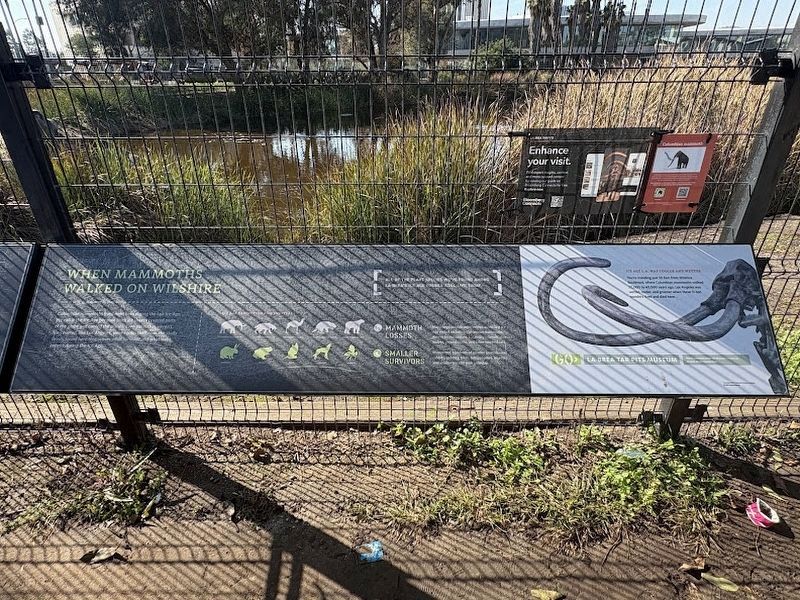
Photographed by Darren Jefferson Clay, November 24, 2025
1. When Mammoths Walked on Wilshire Marker
All of the plant species we've found among La Brea's Ice Age fossils still live today.
Mammoth losses: Many large animals went extinct as the last Ice Age ended, including Columbian mammoths, American mastodons, Yesterday's camels, dire wolves, ground sloth, and saber-tooth cats.
Smaller survivors: In contrast, hundreds of smaller animals - like rabbits, rodents, birds, bats, coyotes, insects, and snails-are still with us today.
Ice Age L.A. was cooler and wetter
You're standing just 30 feet from Wilshire Boulevard, where Columbian mammoths walked 20,000 to 40,000 years ago. Los Angeles was wetter, cooler, and greener when these 11-ton wonders lived and died here.
Topics. This historical marker is listed in these topic lists: Animals • Environment • Paleontology.
Location. 34° 3.777′ N,
this page online

Regionally, this marker is in the Transverse Ranges. It is also on the American Pacific Coast. Globally, it is in North America, on the Ring of Fire, on the Pacific Rim, in the Western Hemisphere, in the Western World, and in the Anglosphere. Historically, it finds itself in what was once New Spain and also Mexico’s Alta California.
Other nearby markers. At least 8 other markers are within walking distance of this marker: Imagining Ice Age L.A. (here, next to this marker); Hancock Park (a few steps from this marker); La Brea Tar Pits (within shouting distance of this marker); Rancho La Brea (within shouting distance of this marker); Different Types of Fossils (about 300 feet away, measured in a direct line); Chester Stock Ph.D. (about 500 feet away); Pits 3, 4, 61/67 (about 600 feet away); Tar seeps form Ice Age time capsules (about 600 feet away). Touch for a list and map of all markers in Los Angeles.
Credits. This page was last revised on August 26, 2026. It was originally submitted on January 4, 2026, by Darren Jefferson Clay of Duluth, Georgia. This page has been viewed 48 times since then. Photo 1. submitted on January 4, 2026, by Darren Jefferson Clay of Duluth, Georgia. • Andrew Ruppenstein was the editor who published this page.
Editor’s want-list for this marker. High resolution close-up photo of the marker with text easily readable. • Can you help?
