
Harington Point in Dunedin, Otago Region, New Zealand — Southwestern Pacific Ocean
Taiaroa Head Jail
Photographed by Shirley A Stirling, December 24, 2025
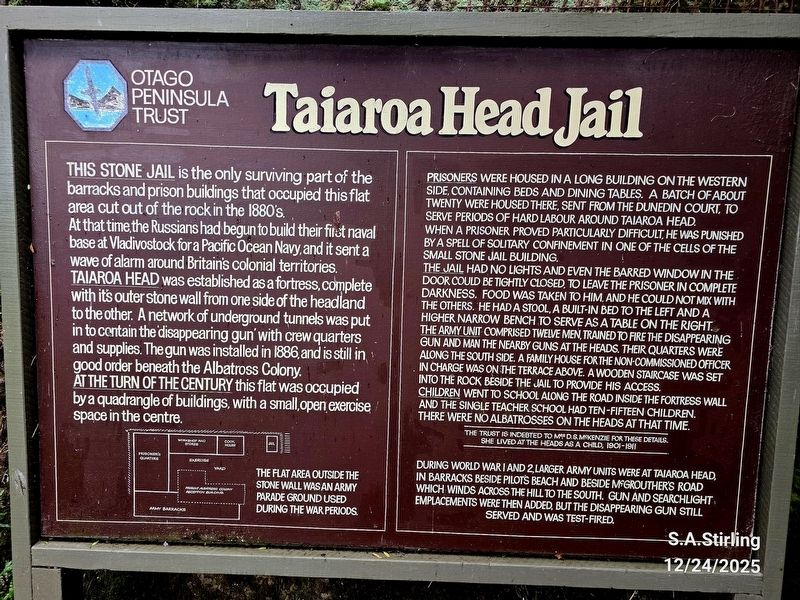
1. Taiaroa Head Jail Marker
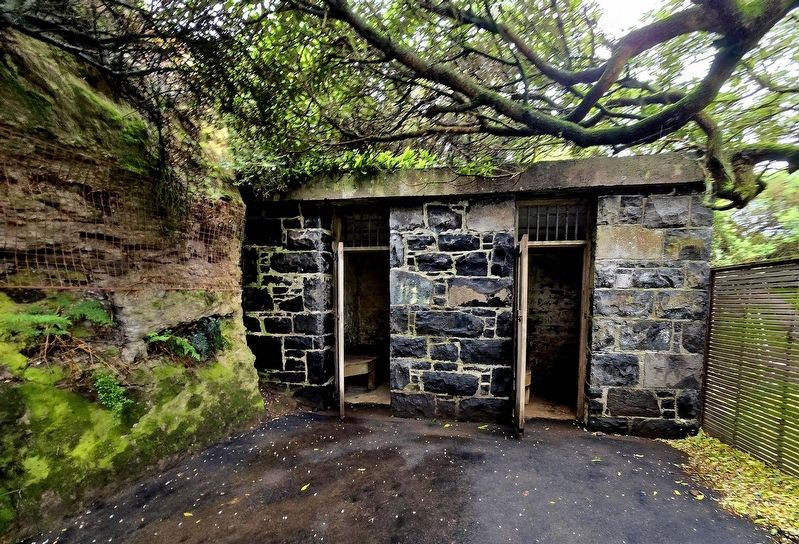
THIS STONE JAIL is the only surviving part of the barracks and prison buildings that occupied this flat area cut out of the rock in the 1880's.
At that time the Russians had begun to build their first naval base at Vladivostock for a Pacific Ocean Navy, and it sent a wave of alarm around Britain's colonial territories.
TAIAROA HEAD was established as a fortress, complete with it's outer stone wall from one side of the headland to the other. A network of underground tunnels was put in to contain the disappearing gun' with crew quarters and supplies. The gun was installed in 1886, and is still in good order beneath the Albatross Colony.
AT THE TURN OF THE CENTURY this flat was occupied by a quadrangle of buildings, with a small, open exercise space in the centre.
Prisoners were housed in a long building on the western side, containing beds and dining tables. A batch of about twenty were housed there, sent from the Dunedin Court, to serve periods of hard labour around Taiaroa Head.
When a prisoner proved particularly difficult, he was punished by a spell of solitary confinement in one of the
this page online
The jail had no lights and even the barred window in the door could be tightly closed to leave the prisoner in complete darkness. Food was taken to him, and he could not mix with the others. He had a stool, a built-in bed to the left and a higher narrow bench to serve as a table on the right.
The army unit comprised twelve men, trained to fire the disappearing gun and man the nearby guns at the heads. Their quarters were along the south side. A family house for the non-commissioned officer in charge was on the terrace above. A wooden staircase was set into the rock beside the jail to provide his access.
Children went to school along the road inside the fortress wall and the single teacher school had ten-fifteen children. There were no albatrosses on the heads at that time.
The Trust is indebted to Mrs. D.S. McKenzie for these details. She lived at the heads as a child, 1901-1911.
During World War I and 2, larger army units were at Taiaroa hHead, in barracks beside Pilots Beach and beside McGrouther's Road which winds across the hill to the south. Gun and Searchlight emplacements
Photographed by Shirley A Stirling, December 24, 2025
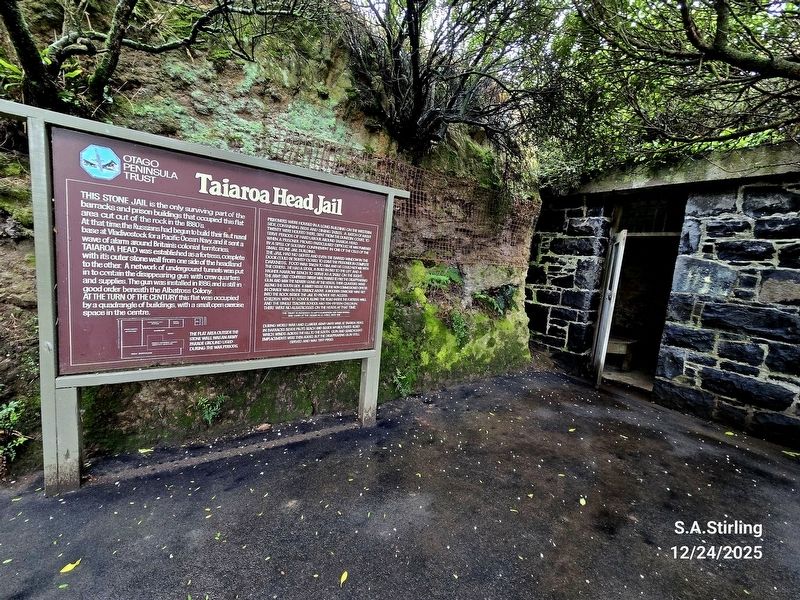
2. Taiaroa Head Jail Marker
Erected by Otago Peninsula Trust.
Topics. This historical marker is listed in these topic lists: Forts and Castles • Law Enforcement. A significant historical month for this entry is November 1886.
Location. 45° 46.561′ S, 170° 43.698′ E. Marker is in Harington Point, Otago Region, in Dunedin. It is on Harington Point Road, on the left when traveling north. Touch for map. Marker is at or near this postal address: 1260 Harington Point Road, Harington Point, Otago Region 9077, New Zealand. Touch for directions.

Regionally, it is in Oceania, in Australasia, in Polynesia, in the Pacific Ocean, on the Ring of Fire, on the Pacific Rim, in the Western World, and in the Anglosphere. Historically, it finds itself in what was once a British colony.
Other nearby markers. At least 2 other markers are within 13 kilometers of this marker, measured as the crow flies: Quo Fas et Gloria Ducunt (within shouting distance of this marker); W.J.M. Larnach Mansion (approx. 12.4 kilometers away).
Photographed by Shirley A Stirling, December 24, 2025
3. Taiaroa Head Jail Marker
Credits. This page was last revised on January 10, 2026. It was originally submitted on January 6, 2026, by Shirley A Stirling of Lacey, Washington. This page has been viewed 60 times since then. Photos: 1, 2, 3. submitted on January 6, 2026, by Shirley A Stirling of Lacey, Washington. • Andrew Ruppenstein was the editor who published this page.
