
Petit-Montrouge in Paris in Département de Paris, Île-de-France, France — Western Europe
Alfred Döblin, Wolfgang Döblin
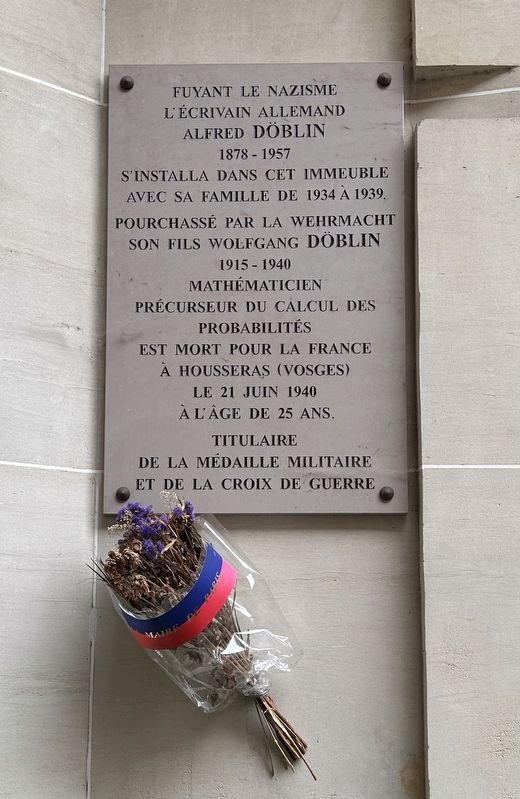
Photographed by Andrew Ruppenstein, April 27, 2024
1. Alfred Döblin, Wolfgang Döblin Marker

l'écrivain allemand
Alfred Döblin
1878-1957
s'installa dans cet immeuble
avec sa famille de 1934 à 1939.
Pourchassé par la Wehrmacht
son fils Wolfgang Döblin
1915-1940
Mathématicien
Précurseur du calcul des probabilités
est mort pour la France
a Housseras (Vosges)
le 21 juin 1940
à l'âge de 25 ans.
Titulaire de la Medaille Militaire
et de la Croix de Guerre
Fleeing Nazism, the German writer Alfred Döblin (1878-1957) settled in this building with his family from 1934 to 1939.
Hunted by the Wehrmacht, his son Wolfgang Döblin (1915-1940), Mathematician, Precursor of probability theory, died for France in Housseras (Vosges) on June 21, 1940 at the age of 25. Recipient of the Military Medal and the Croix de Guerre.
Topics. This historical marker is listed in these topic lists: Arts, Letters, Music • Science & Medicine • War, World II. A significant historical year for this entry is 1934.
Location. 48° 49.923′ N, 2° 19.759′ E. Marker is in Paris, Île-de-France, in Département de Paris. It is in Petit-Montrouge. It is on Square Henri Delormel, on the right when traveling south. Touch for map. Marker is at or near this postal address: 5 Square Henri Delormel, Paris, Île-de-France 75014, France. Touch for directions.

Regionally, it is in the North Atlantic Region, Europe, the European Union, Atlantic Europe, the Schengen Area, Western Europe, a coastal Mediterranean country, and the Western World. Historically, it finds itself in what was once a French colony and also the Roman Empire.
Other nearby markers. At least 8 other markers are within walking distance of this marker: Charles Couyba (about 120 meters away, measured in a direct line); Amadeo de Souza-Cardoso (about 120 meters away); Gilbert Privat (about 120 meters
this page online
Also see . . .
1. Alfred Döblin (Wikipedia). Excerpt:
Bruno Alfred Döblin (10 August 1878 – 26 June 1957) was a German novelist, essayist, and doctor, best known for his novel Berlin Alexanderplatz (1929). A prolific writer whose œuvre spans more than half a century and a wide variety of literary movements and styles, Döblin is one of the most important figures of German literary modernism. His complete works comprise over a dozen novels ranging in genre from historical novels to science fiction to novels about the modern metropolis; several dramas, radio plays, and screenplays; a true crime story; a travel account; two book-length philosophical treatises; scores of essays on politics, religion, art, and society; and numerous letters—his complete works, republished by Deutscher(Submitted on January 6, 2026.)Taschenbuch Verlag and Fischer Verlag, span more than thirty volumes…Photographed by Andrew Ruppenstein, April 27, 20242. Alfred Döblin, Wolfgang Döblin Marker - wide view
…Only a few years after his rise to literary celebrity with the 1929 publication of Berlin Alexanderplatz, Döblin was forced into exile by the rise of the Nazi dictatorship. Works by Döblin were also considered "Asphalt literature". He spent 1933–1940 in France and then was forced to flee again at the start of the Second World War. Like many other German émigrés he spent the war years in Los Angeles, where he converted to Catholicism. He moved to West Germany after the war but did not feel at home in postwar Germany's conservative cultural climate and returned to France. His final years were marked by poor health and financial difficulties, and his literary work was met with relative neglect.

2. Wolfgang Doeblin (Wikipedia). Excerpt:
…Drafted in November 1938, after refusing to be exempted from military service, he was a soldier in the French army when World War II broke out in 1939, and was stationed at Givet, in the Ardennes, as a telephone operator. There, he wrote down his latest work on the Chapman–Kolmogorov equation,(Submitted on January 6, 2026.)and sent this as a "pli cacheté" (sealed envelope) to the French Academy of Sciences. His company, sent to the sector of the Saare on the ligne Maginot in April 1940, was caught in the German attack in the Ardennes in May, withdrew to the Vosges, and capitulated on 22 June 1940. Finding himself cut off from his unit and with Wehrmacht troops approaching to take him prisoner, Doeblin burned his mathematical notes and then shot himself on 21 June in a barn near the village of Housseras (a small village near Epinal) in the Vosges.Photographed by Andrew Ruppenstein, April 27, 20243. Alfred Döblin, Wolfgang Döblin Marker - wider viewThose wishing to visit the marker location should note that it it on a “square privé”, i.e. a private street, although publicly accessible.
The sealed envelope was opened in 2000, revealing that Doeblin had obtained major results on the Chapman-Kolmogorov equation and the theory of diffusion processes.His life was the subject of a 2007 movie by Agnes Handwerk and Harrie Willems, A Mathematician Rediscovered.

Additional keywords. plaque commémorative
Credits. This page was last revised on January 7, 2026. It was originally submitted on January 6, 2026, by Andrew Ruppenstein of Lamorinda, California. This page has been viewed 53 times since then. Photos: 1, 2, 3. submitted on January 6, 2026, by Andrew Ruppenstein of Lamorinda, California.
