Wheaton in DuPage County, Illinois — The American Midwest (Great Lakes)
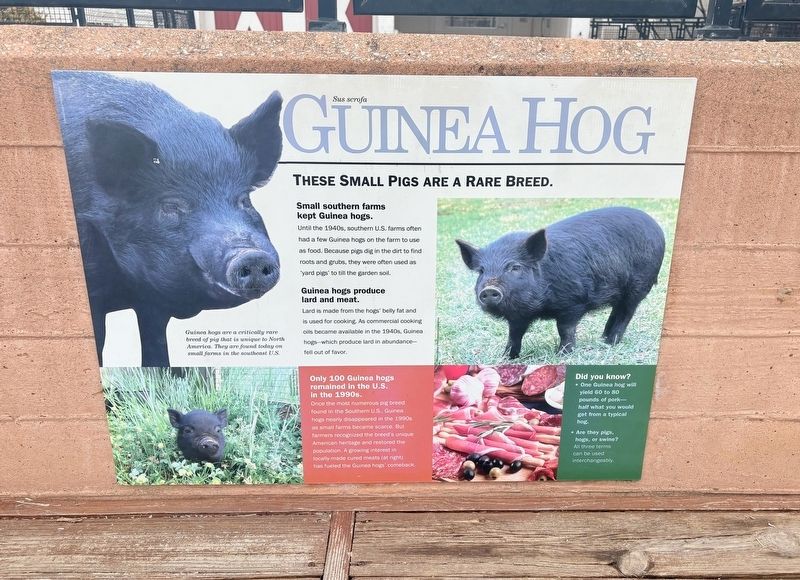
Guinea Hog
Sus scrofa
| — | These small pigs are a rare breed. | — |
Photographed by Sean P. Flynn, January 6, 2026
1. Guinea Hog Marker
Small southern farms kept Guinea hogs.
Until the 1940s, southern U.S. farms often had a few Guinea hogs on the farm to use as food. Because pigs dig in the dirt to find roots and grubs, they were often used as "yard pigs to till the garden soil.
Guinea hogs produce lard and meat.
Lard is made from the hogs' belly fat and is used for cooking. As commercial cooking oils became available in the 1940s, Guinea hogs—which produce land in abundance—fell out of favor.
Only 100 Guinea hogs remained in the U.S. in the 1990s.
Once the most numerous pig breed found in the Southern U.S., Guinea hogs nearly disappeared in the 1990s as small farms became scarce. But farmers recognized the breed's unique American heritage and restored the population. A growing interest locally-made cured meats (at right) has fueled the Guinea hogs comeback.
Did you know?
• One Guinea hog will yield 60 to 80 pounds of pork-half what you would get from a typical hog.
• Are they pigs, hogs, or swine? All three terms can be used interchangeably.
[Photo caption:]
Guinea hogs are a critically rare breed of pig that is unique to North America. They are found today on small farms in the southeast U.S.
Erected by Cosley
this page online
Topics. This historical marker is listed in these topic lists: Agriculture • Animals • Industry & Commerce.
Location. 41° 52.694′ N, 88° 7.265′ W. Marker is in Wheaton, Illinois, in DuPage County. It can be reached from Gary Avenue south of Jewell Road, on the right when traveling south. The marker is in Cosley Zoo. Touch for map. Marker is at or near this postal address: 1356 North Gary Avenue, Wheaton IL 60187, United States of America. Touch for directions.

Regionally, this marker is in Greater Chicago. It is also in the American Midwest. Globally, it is in North America, on the Great Lakes, in the Western Hemisphere, in the Western World, and in the Anglosphere. Historically, it finds itself in what was once the territory of the Mississippian Culture and also the Northwest Territory.
Other nearby markers. At least 8 other markers are within walking distance of this marker: Chicken (a few steps from this marker); Domestic Rabbits (within shouting distance of this marker); North American Porcupine (within shouting distance of this marker); North American Bison • Blanding's Turtle • Cheetah
Photographed by Sean P. Flynn, January 6, 2026
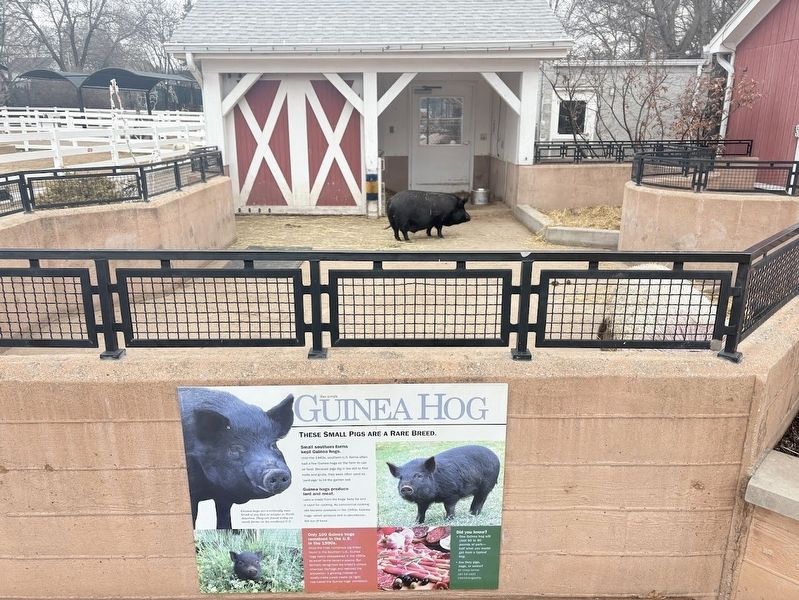
2. Guinea Hog at Cosley Zoo
Also see . . . Livestock Conservancy: American Guinea Hog.
Excerpt: "Written records indicate the presence of the Guinea Hog breed in the American South as early as 1811. After 1840, the Guinea Hog was likely crossed with the now extinct “Improved Essex”, a solid black pig from Essex County, England, that was developed in 1840. Documents from the period indicate that Essex pigs were imported to Georgia and cross-bred with local, coarser southern stock. The breed in America was referred to as American Essex."(Submitted on January 8, 2026, by Sean P. Flynn of Oak Park, Illinois.)
Photographed by Sean P. Flynn, January 6, 2026
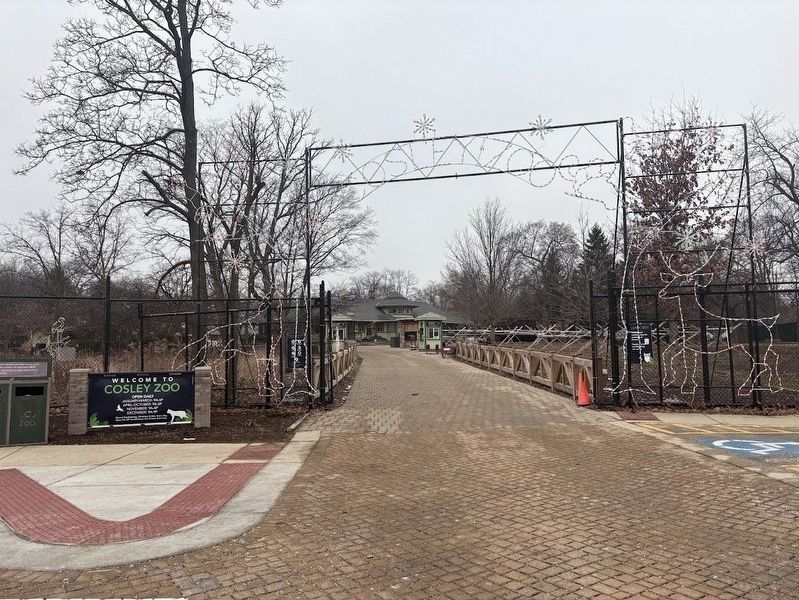
3. Cosley Zoo entrance
Credits. This page was last revised on January 8, 2026. It was originally submitted on January 8, 2026, by Sean P. Flynn of Oak Park, Illinois. This page has been viewed 66 times since then. Photos: 1, 2. submitted on January 8, 2026, by Sean P. Flynn of Oak Park, Illinois. 3. submitted on January 7, 2026, by Sean P. Flynn of Oak Park, Illinois.
