Eufaula in Barbour County, Alabama — The American South (East South Central)
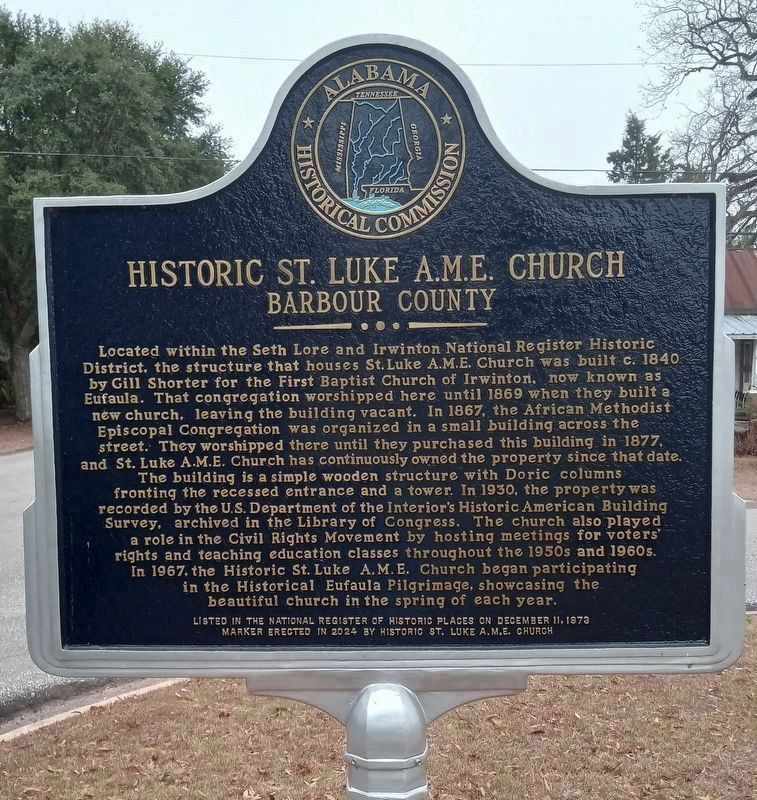
Historic St. Luke A.M.E. Church
Barbour County
Photographed by James L.Whitman, January 8, 2026
1. Historic St. Luke A.M.E. Church Marker
this page online
Erected 2024 by Alabama Historical Commission and Historic St. Luke A.M.E Church.
Topics. This historical marker is listed in these topic lists: African Americans • Civil Rights • Religion & Religious Structures. A significant historical year for this entry is 1840.
Location. 31° 53.404′ N, 85° 8.232′ W. Marker is in Eufaula, Alabama, in Barbour County. It is at the intersection of T V McCoo Boulevard South and E Union Street, on the right when traveling south on T V McCoo Boulevard South. Touch for map. Marker is at or near this postal address: 240 Dr T V McCoo Blvd S, Eufaula AL 36027, United States of America. Touch for directions.

Regionally, this marker is in the American South, specifically in the Deep South, in the Black Belt, and in the Wiregrass. Globally, it is in North America, a Gulf of Mexico state, the Western Hemisphere, the Western World, and the Anglosphere. Historically, it finds itself in what was once the territory of the Mississippian Culture, one of the Confederate States of

Photographed by James L.Whitman, January 8, 2026
2. Historic St. Luke A.M.E. Church Marker
Other nearby markers. At least 8 other markers are within walking distance of this marker: Governors Park (about 700 feet away, measured in a direct line); Van Buren School (approx. 0.2 miles away); Confederate Hospital (approx. ¼ mile away); The Lynching of William "Willie Lee" Jenkins (approx. ¼ mile away); William Thomas "Tom" Mann / Eufaula, Alabama (approx. ¼ mile away); Central Railroad of Georgia Freight Depot (approx. ¼ mile away); The City of Eufaula (approx. ¼ mile away); The Second Creek War in the Eufaula Area (approx. 0.3 miles away). Touch for a list and map of all markers in Eufaula.
Photographed by James L.Whitman, January 8, 2026
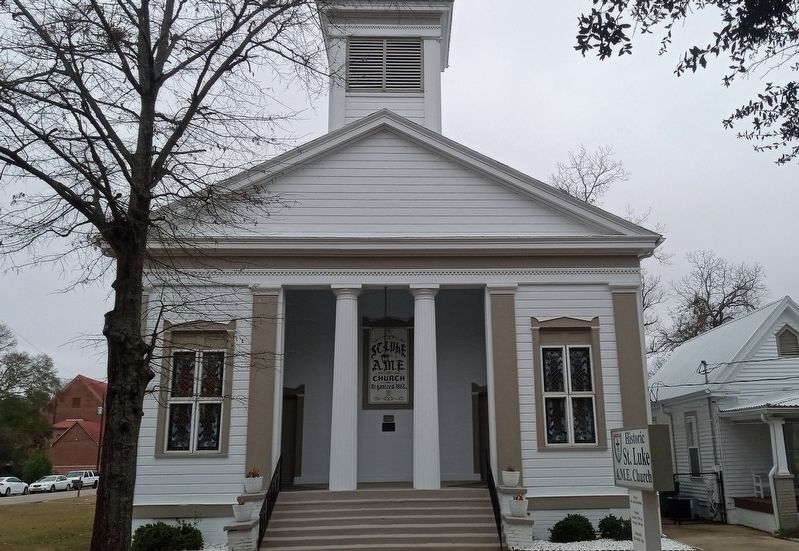
3. St. Luke A.M.E. Church
Credits. This page was last revised on February 2, 2026. It was originally submitted on January 8, 2026, by James L.Whitman of Eufaula, Alabama. This page has been viewed 125 times since then. Photos: 1, 2, 3. submitted on January 8, 2026, by James L.Whitman of Eufaula, Alabama. • James Hulse was the editor who published this page.
